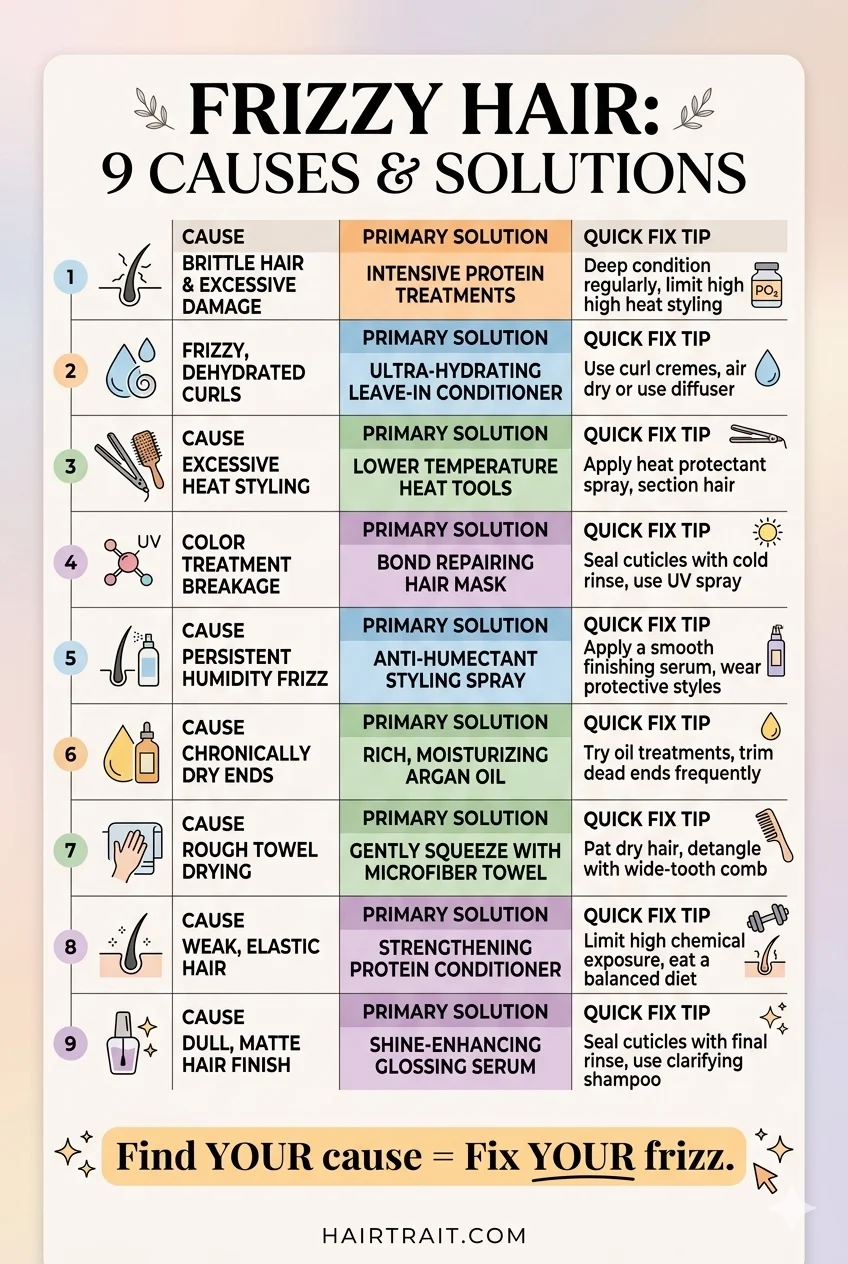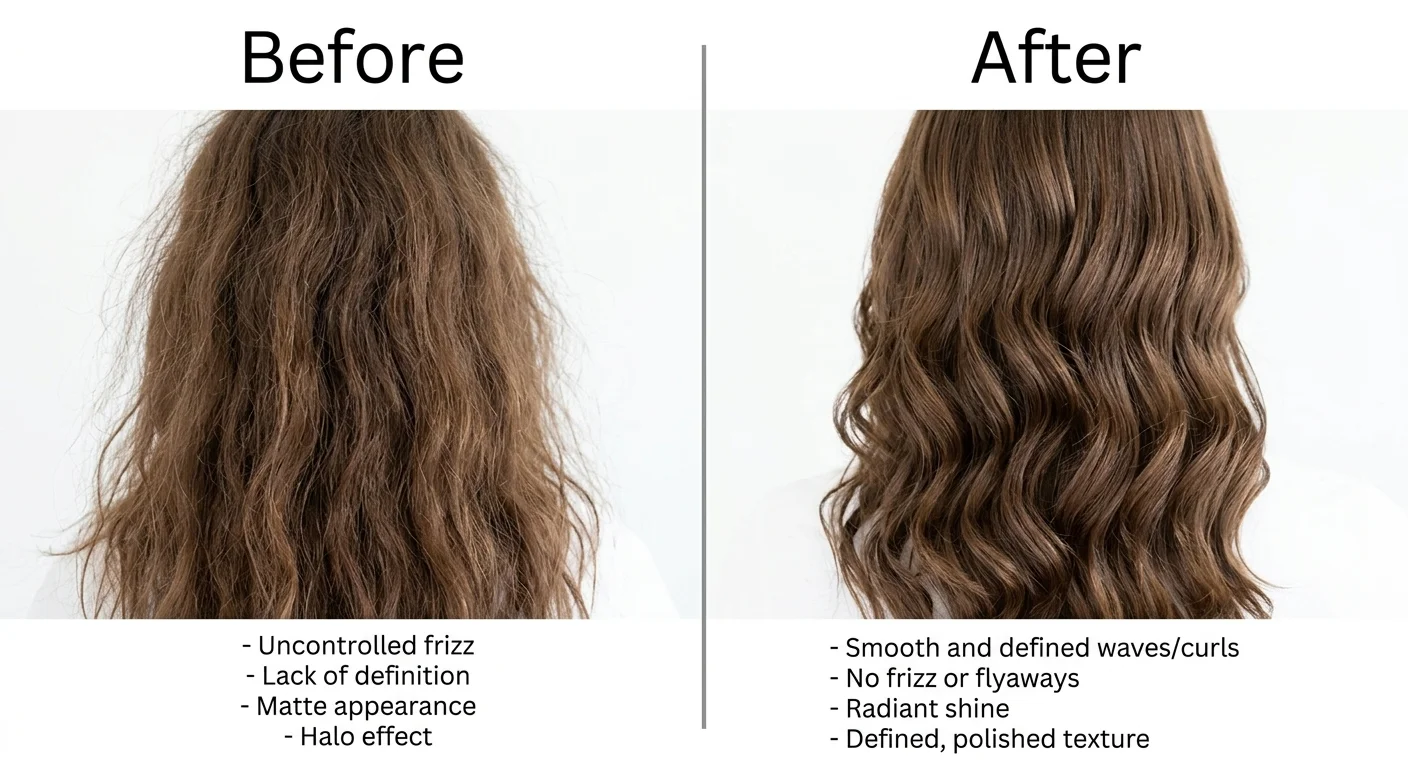
Frizz happens when the outer protective layer of your hair (cuticle) lifts up instead of lying flat. This allows moisture from the air to enter the hair shaft, causing it to swell and create that fuzzy halo effect. But why your cuticle is lifting — that’s where frizzy hair solutions get specific.
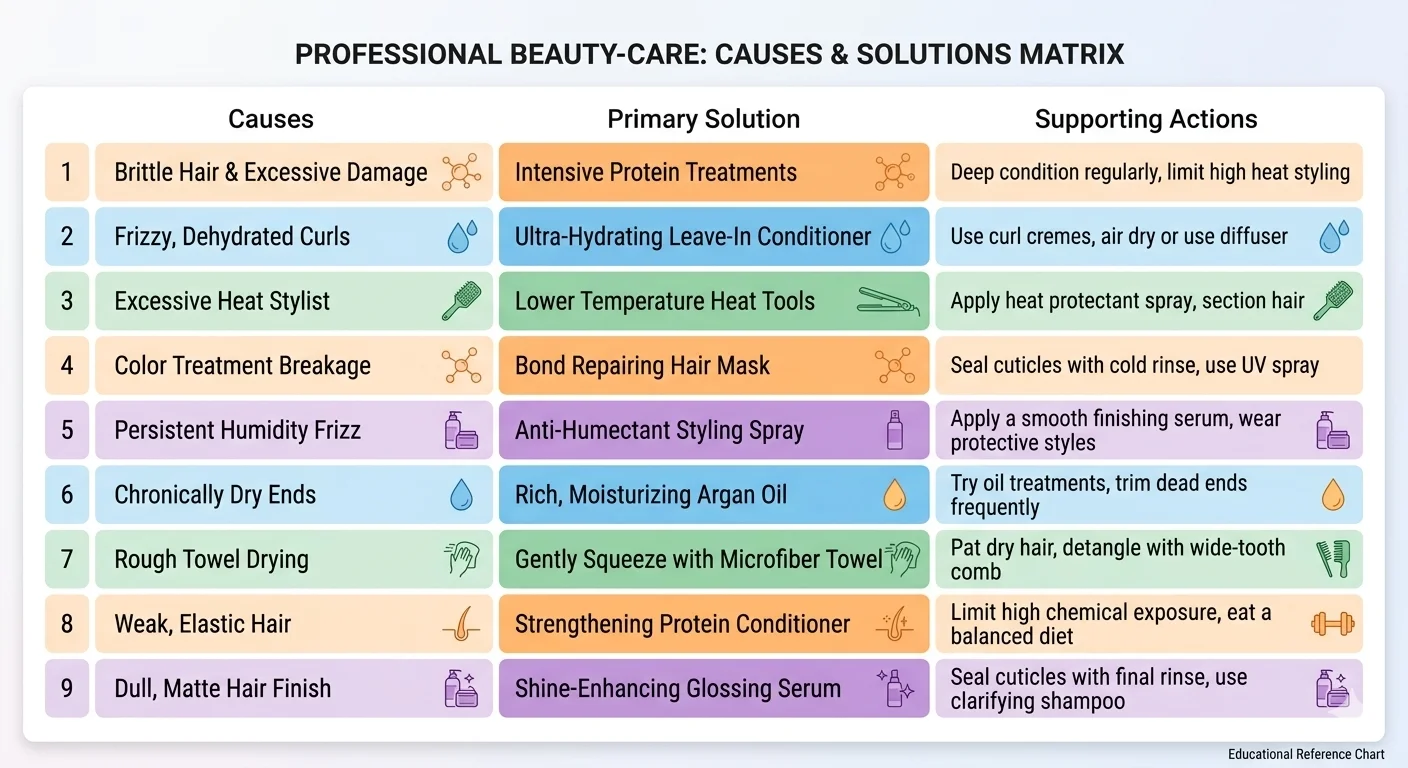
Generic anti-frizz advice doesn’t work because frizz has nine different root causes. Each cause requires a different fix. Using the wrong solution wastes time and money while your frizz continues.
This guide identifies all 9 causes, helps you diagnose which one (or combination) you have, and gives the exact solution for each.
Quick Answer: Frizzy hair solutions depend on the cause: Damage → protein + moisture treatments. High humidity → anti-humectant products. Dryness → deep conditioning. Wrong drying method → technique change. Hard water → chelating. Protein overload → moisture only. High porosity → sealing. Wrong products → ingredient check. Heat damage → bond repair + no heat.
Table of Contents
Cause #1: Damaged Cuticles from Heat/Chemical Processing
How to identify: Frizz is worst at ends. Hair history includes bleaching, relaxing, perming, or frequent heat styling. Hair feels dry and straw-like.
Why it causes frizz: Heat and chemicals break the protein bonds that hold cuticle scales flat. Once damaged, cuticles permanently lift up. Research shows heat above 180°C causes irreversible structural changes [IJCS].
The fix:
- Cut severely damaged ends
- Protein treatments bi-weekly for 6 weeks
- Deep moisture conditioning weekly
- Bond repair treatments (Olaplex, K18)
- Eliminate all heat styling for 3+ months
- Use leave-in with silicones to smooth cuticles temporarily
See our heat damage repair guide for complete recovery protocol.
Cause #2: High Humidity Environment
How to identify: Frizz appears within 30 minutes of leaving house. Worse on humid/rainy days. Hair looks fine indoors (AC) but frizzes outside.
Why it causes frizz: Humid air contains water vapor. If your hair has gaps in the cuticle (even healthy hair has some), water molecules enter and cause swelling. High humidity (70%+) overwhelms hair’s ability to maintain smooth state.
The fix:
- Use anti-humectant products (avoid glycerin in humid weather)
- Apply sealing oils (argan, jojoba) to damp hair
- Use humidity-resistant styling products
- Try silicone serums (create water-resistant barrier)
- Set styles with gel that dries to cast
Products to avoid in humidity: Glycerin, honey, aloe vera (all humectants that attract moisture).
Cause #3: Chronically Dry Hair
How to identify: Hair is frizzy even in low humidity. Feels rough and dry to touch. Tangles easily. Lacks shine.
Why it causes frizz: Dehydrated hair has gaps in the cuticle. The hair shaft desperately seeks moisture from anywhere — including humid air. Studies show moisture content below 10% creates irreg ular cuticle structure [NCBI].
The fix:
- Deep condition with heat weekly
- Use leave-in conditioner daily
- Apply moisturizing cream or butter to seal
- Avoid sulfate shampoos (strip moisture)
- Sleep on satin/silk pillowcase
- Limit wash frequency to 2-3x per week maximum
See our best hair products guide for moisture-focused recommendations.
Cause #4: Wrong Drying Method
How to identify: Frizz develops during/immediately after drying. Hair looks smooth when wet, frizzy when dry.
Why it causes frizz: Rubbing with towels, air drying in random positions, or blow drying with too much heat all roughen the cuticle.
The fix:
- Switch to microfiber towel or T-shirt (never terry cloth)
- Squeeze gently, don’t rub
- Apply products to soaking wet hair before drying begins
- Use plopping method for curls/waves
- If blow drying: use heat protectant, keep 15cm away, medium heat only
See our air drying vs blow drying guide for proper techniques.
Cause #5: Hard Water Mineral Buildup
How to identify: Frizz developed gradually over months. Hair feels coated/waxy. Products don’t work like they used to. You live in hard water area.
Why it causes frizz: Calcium and magnesium minerals coat hair, creating rough surface. This coating prevents moisture absorption and lifts cuticles.
The fix:
- Chelating shampoo every 2-3 weeks
- Apple cider vinegar rinse weekly
- Install shower filter (removes chlorine, not minerals, but helps)
- Final rinse with filtered/distilled water
- Deep condition after every clarifying treatment
See our complete hard water hair care routine and clarifying shampoo guide.
Cause #6: Protein Overload
How to identify: Hair feels stiff, straw-like, brittle. Breaks easily. Frizz accompanied by lack of softness. You’ve been using protein treatments regularly.
Why it causes frizz: Excess protein creates rigid hair that can’t flex. The cuticle becomes inflexible and lifts irregularly.
The fix:
- Stop all protein treatments for 4-6 weeks
- Deep moisture condition weekly with protein-free formula
- Use products with humectants (glycerin, aloe, honey)
- Avoid products with hydrolyzed proteins in first 5 ingredients
- Balance with our protein vs moisture balance guide
Cause #7: High Porosity Hair
How to identify: Hair absorbs water instantly. Dries quickly. Color fades fast. Always frizzy regardless of products. History of damage or naturally high porosity.
Why it causes frizz: High porosity hair has gaps and holes in cuticle. These never lie flat smoothly. Hair constantly seeks moisture and loses it just as fast.
The fix:
- Acidic rinses to temporarily seal cuticles (ACV, pH 4.5 products)
- Protein treatments to fill gaps (weekly to bi-weekly)
- Heavy sealing products (butters, thick oils)
- Avoid humectants in humid weather
- Focus on cuticle-sealing ingredients
Understand your porosity with our complete hair type guide.
Cause #8: Using Wrong Products for Your Hair Type
How to identify: Products that work for friends/influencers don’t work for you. Hair feels weighed down OR not moisturized enough.
Why it causes frizz: Low porosity hair gets buildup from heavy products (cuticles can’t absorb, everything sits on surface creating frizz). Fine hair gets weighed down (creates limpness that looks like frizz). Wrong ingredient profiles for your type.
The fix:
- Identify your porosity and hair type accurately
- Choose products matched to YOUR type, not general recommendations
- Low porosity: lightweight, water-based, no heavy oils/butters
- High porosity: heavier, sealing, protein-enriched
- Fine hair: volumizing, lightweight only
- Thick/coarse: rich, heavy formulas okay
Cause #9: Mechanical Damage from Styling/Handling
How to identify: Frizz appears after brushing, combing, or touching hair. Worsens throughout day as you touch/adjust hair.
Why it causes frizz: Every time you touch hair, you disturb the cuticle. Brushing dry curly hair, using fine-tooth combs, constantly running fingers through hair — all rough up the surface.
The fix:
- Detangle only on wet, conditioned hair
- Use wide-tooth comb or fingers only
- Style once, then don’t touch
- Sleep on satin/silk pillowcase
- Protect hair during sleep (loose braid, satin bonnet)
- Minimize daily manipulation
See our detangling guide and pillowcase comparison.
How to Diagnose Your Specific Cause
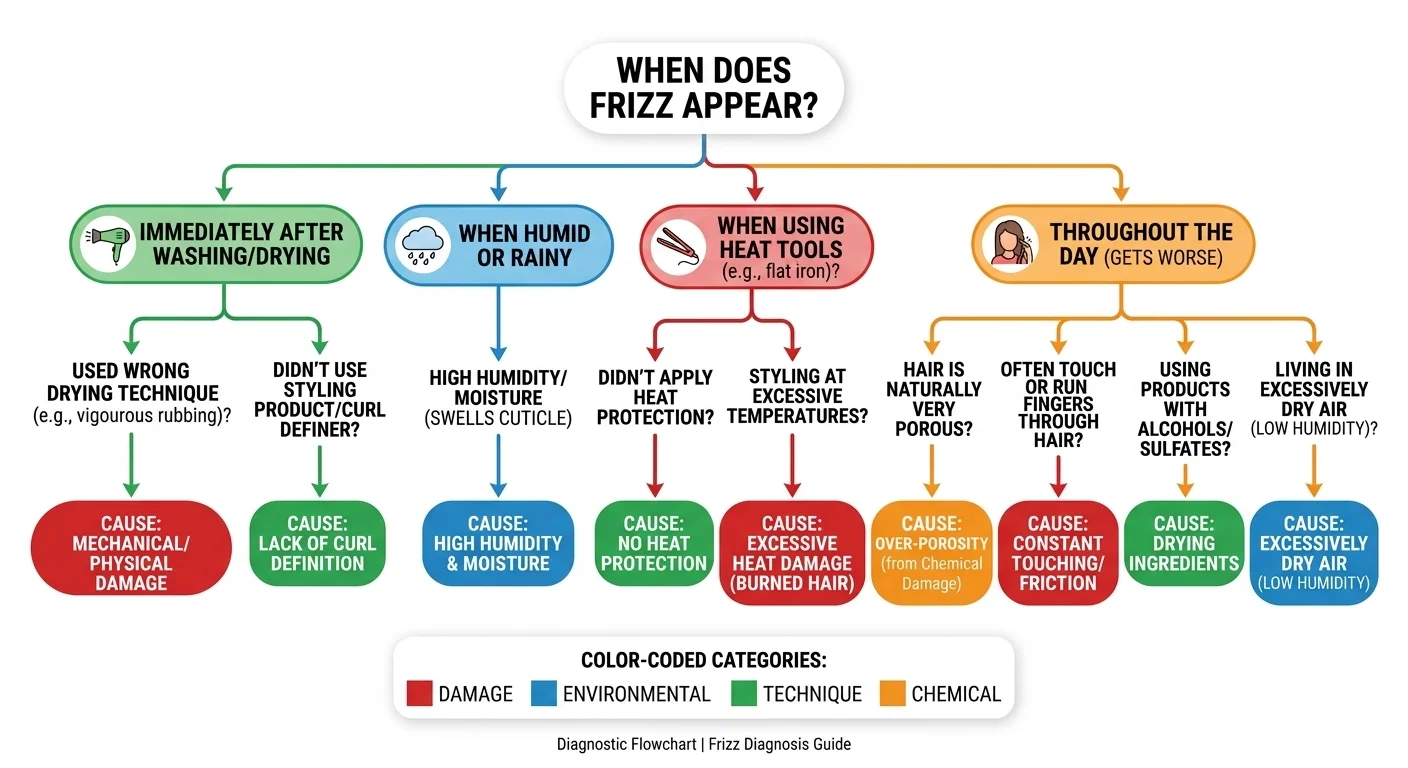
Most people have 2-3 contributing factors. Use this process:
- When does frizz appear?
- During/after drying → Cause #4 (method)
- Within 30 min outdoors → Cause #2 (humidity)
- Always, all conditions → Cause #1, #3, #6, or #7
- What’s your hair history?
- Bleach/color/relaxer → Cause #1 (damage)
- Lots of protein treatments → Cause #6 (overload)
- Hard water area → Cause #5 (minerals)
- How does hair feel?
- Dry, rough → Cause #3 (dehydration)
- Stiff, brittle → Cause #6 (protein overload)
- Soft but frizzy → Cause #7 (high porosity) or #2 (humidity)
The Anti-Frizz Routine Template
Once you’ve identified your cause(s), build this routine:
Weekly Intensive Treatment
- If damaged/dry: Deep condition with heat 30 min
- If protein needed: Protein treatment bi-weekly
- If hard water: Chelating shampoo
Daily/Wash Day Routine
- Cleanse gently (sulfate-free for dry hair)
- Condition with slip
- Apply leave-in to soaking wet hair
- Add curl cream/moisturizer
- Seal with oil (if high porosity)
- Dry using proper method for your type
- Don’t touch until completely dry
Environmental Adjustments
- Satin/silk pillowcase
- Shower filter if hard water
- Humidity-appropriate products
- Protective styles when necessary
Products That Actually Help
For Damage-Related Frizz
- Protein treatments with hydrolyzed keratin
- Bond repair (Olaplex, K18, Redken Acidic)
- Smoothing serums with silicones
For Humidity Frizz
- Anti-humectant styling products
- Silicone-based serums
- Strong-hold gels
For Dryness Frizz
- Deep conditioners with shea butter, oils
- Leave-ins with humectants
- Rich creams and butters
What to Expect
Week 1-2: If using correct solution for your cause, frizz reduces 20-30%. Hair feels better immediately after treatment.
Week 4-6: Noticeable improvement. Frizz still present but manageable. Styles last longer.
Week 8-12: Significant reduction. Hair behaves predictably. Products work as expected.
What won’t change: If frizz is from permanent damage (Cause #1, #7), you can manage it but not eliminate it. Severely damaged hair needs cutting and growing out.
Final Thoughts
Frizzy hair solutions work when they target the actual cause. Generic anti-frizz products fail because they assume all frizz is the same. It’s not.
Identify your specific cause using the diagnostic guide. Apply the targeted solution. Give it 6-8 weeks of consistency. Most frizz improves dramatically when you address the root cause rather than just trying to smooth the symptom.
For complete hair care structure supporting your anti-frizz efforts, see our hair care basics guide.