The debate between air drying vs blow drying hair has raged for years. Conventional wisdom says air drying is always better because you’re avoiding heat. But recent research reveals the answer is more complicated — and surprising.
Both methods cause damage, just different types. Air drying can actually cause more structural damage than proper blow drying. Meanwhile, improper blow drying causes obvious heat damage that air drying avoids. The “better” choice depends on your hair type, technique, and how much time you have.
This guide breaks down what science actually says, proper techniques for each method, and how to minimize damage with either approach.
Before choosing your drying method, understand your hair’s damage level using our heat damage repair guide. If hair is already severely damaged, both methods require extra care.
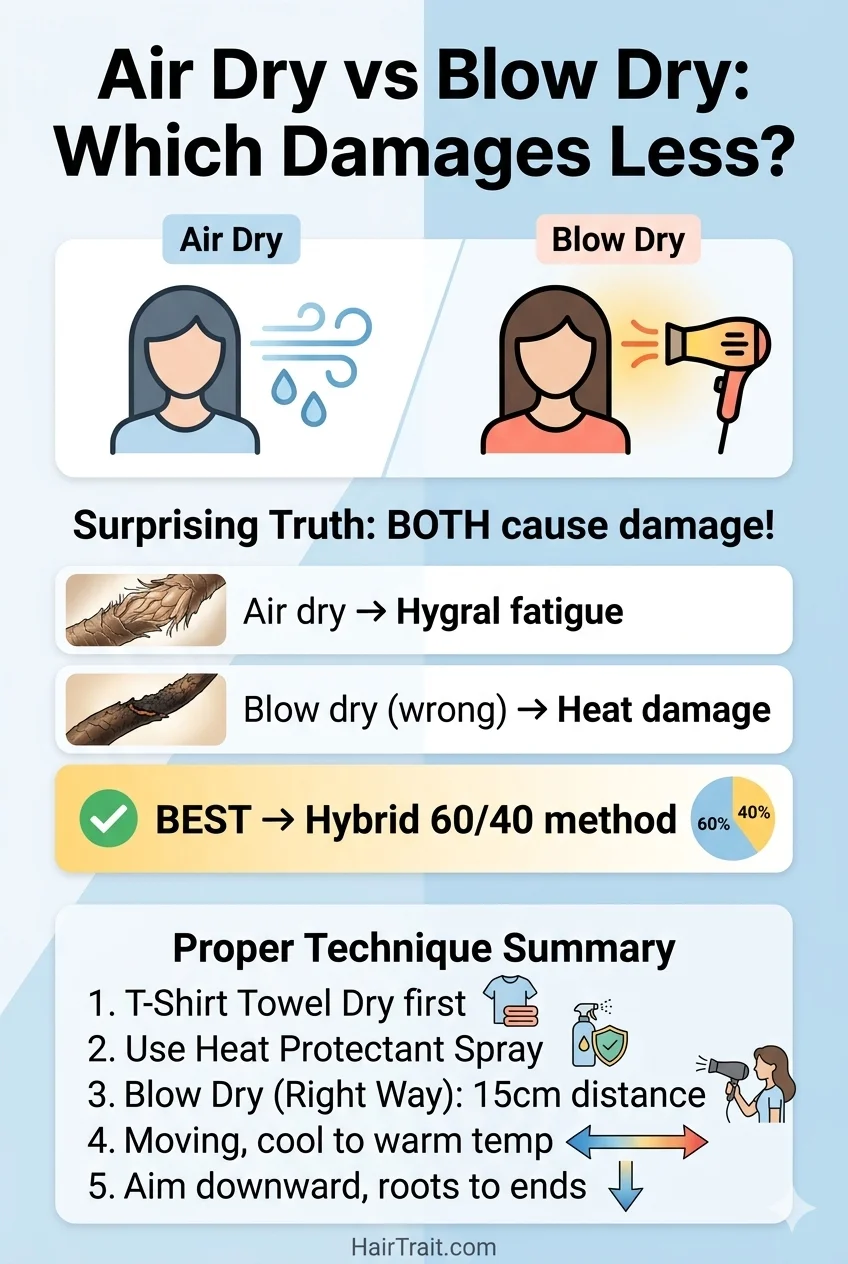
Quick Answer: Air drying vs blow drying hair: Neither is universally “better.” Air drying avoids heat damage but causes hygral fatigue (swelling damage) from prolonged wetness. Blow drying (done correctly at 15cm distance, cool-warm temp, 80% dry only) actually causes less cuticle damage than full air drying. Best approach: Combination — air dry to 60-70%, then blow dry remainder on cool setting.
Table of Contents
What the Science Actually Says
A landmark study published in the International Journal of Trichology compared hair dried three ways: complete air drying, blow drying at 15cm distance, and blow drying at 5cm distance [International Journal of Trichology].
Key Findings
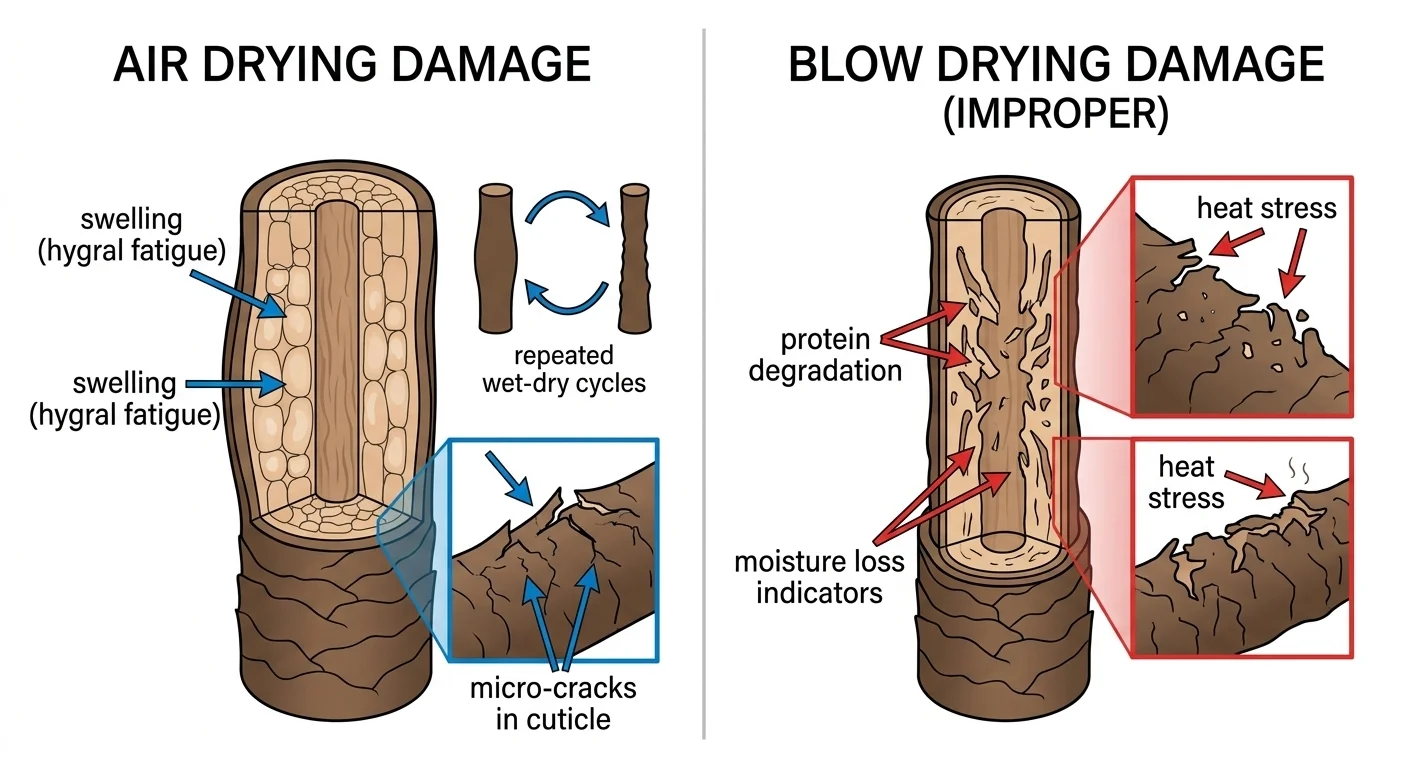
- Complete air drying: Caused significant cuticle damage from extended swelling and water absorption (hygral fatigue)
- Blow drying at 15cm (6 inches): Less cuticle damage than air drying. Internal heat damage present but outer layer more intact
- Blow drying at 5cm (2 inches): Most damage — severe heat degradation plus mechanical stress
The Hygral Fatigue Problem
Hair swells up to 30% when wet. Repeated swelling and contracting (wet-dry cycles) stresses the internal structure. Research shows this creates micro-cracks in the cuticle that compound over time [NCBI].
When hair stays wet for 2-4 hours (typical air dry time), it experiences extended hygral stress. This is why completely air-dried hair often feels rougher and tangles more than properly blow-dried hair.
Air Drying: Pros, Cons, and Proper Technique
Pros of Air Drying
- No heat damage (protein degradation, moisture loss)
- Free — no equipment needed
- Hands-off — do other things while drying
- Better for very damaged hair that can’t tolerate any heat
- Preserves natural curl pattern (if done correctly)
Cons of Air Drying
- Takes 2-4 hours depending on hair thickness
- Causes hygral fatigue from prolonged wetness
- Can create frizz if hair dries in random positions
- Flat roots common (gravity pulls hair down while drying)
- Not practical in cold weather or when rushed
How to Air Dry Correctly
- Remove excess water first: Gently squeeze with microfiber towel. Don’t rub. Get hair to damp (not dripping) before air drying begins.
- Apply products to soaking wet hair: Leave-in conditioner, curl cream, gel. Products provide protection during drying.
- Use plopping for curls: See our hair plopping guide for enhancing curl definition while air drying.
- Don’t touch hair while drying: Every time you touch, you create frizz and disrupt curl formation.
- Clip roots if needed: Add clips at crown for volume while drying.
- Limit wet time: Don’t let hair stay wet longer than necessary. If it’s taking 4+ hours, your hair is too wet when you start air drying.
Blow Drying: Pros, Cons, and Proper Technique
Pros of Blow Drying
- Fast — 10-20 minutes vs 2-4 hours
- Less hygral fatigue (shorter wet time)
- Can add volume at roots
- Smooths cuticles when done correctly
- More styling control
Cons of Blow Drying
- Heat damage risk (protein degradation, dryness)
- Requires equipment and technique
- Can cause severe damage if done wrong (too hot, too close)
- Time-intensive if using proper technique with sections
How to Blow Dry Correctly (Minimizing Damage)
- Start with 60-70% air dry: Remove most water naturally before using heat. This minimizes total heat exposure.
- Apply heat protectant: On damp hair before blow drying. This is non-negotiable.
- Use ionic or ceramic dryer: These technologies reduce frizz and distribute heat more evenly.
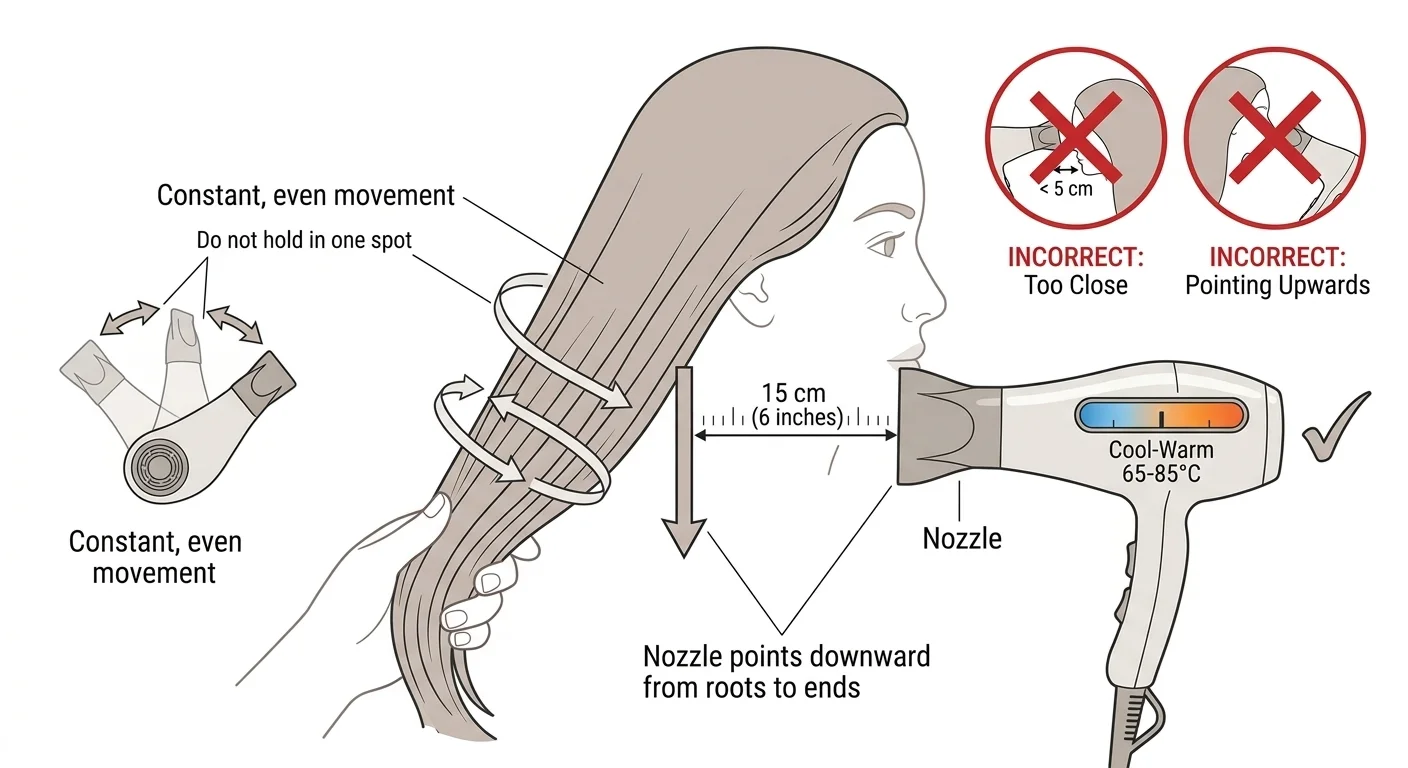
- Keep distance at 15cm (6 inches) minimum: Closer = more damage. Studies confirm this is critical distance.
- Use cool or warm setting (not hot): 65-85°C (150-185°F) maximum. Modern dryers often exceed 100°C on high heat — too damaging.
- Keep dryer moving: Never hold in one spot. Constant motion distributes heat.
- Point down the hair shaft: Nozzle pointing from roots to ends smooths cuticles. Pointing up creates frizz.
- Section hair: Work in 4-6 sections for even drying and less total heat exposure.
- Finish with cool shot: Cool air closes cuticles and sets style.
- Stop at 80-90% dry: Let final 10-20% air dry. Prevents over-drying.
Diffuser for Curly Hair
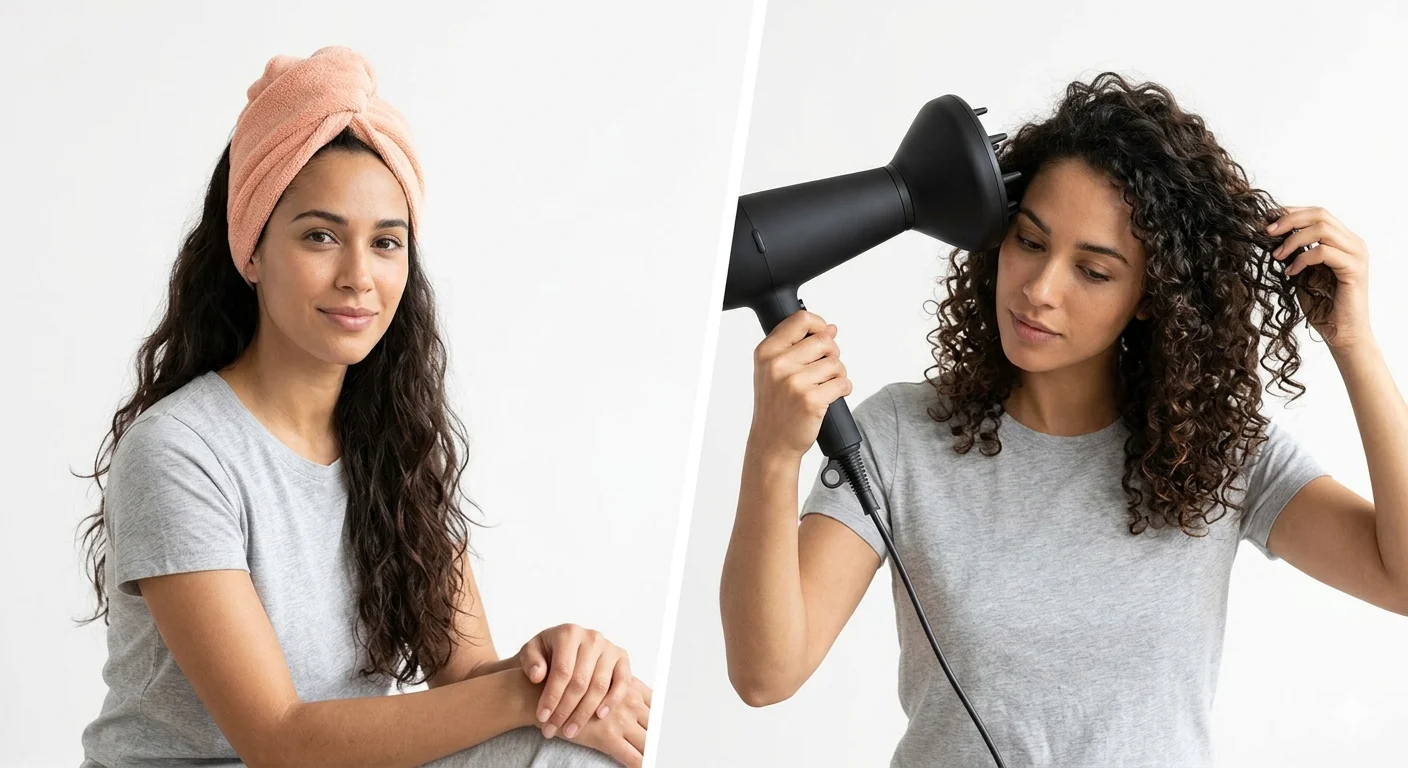
Diffuser attachment spreads airflow and reduces frizz on curls. Use on low-medium heat, hover or “scrunch” method rather than direct contact.
The Hybrid Approach (Best for Most People)
The scientifically optimal method combines both: air dry to 60-70%, then blow dry the remainder.
Why This Works
- Minimizes hygral fatigue (hair isn’t wet for 3+ hours)
- Minimizes heat exposure (only drying 30-40% with heat)
- Faster than complete air drying
- Less damaging than complete blow drying
- Gives styling control without excessive heat
The Process
- Towel dry to remove dripping water
- Apply leave-in products
- Air dry 45-60 minutes (or use plopping)
- When hair is 60-70% dry, blow dry remainder on cool-warm setting
- Use diffuser for curls or nozzle for smooth styles
- Stop at 90% dry, let last bit air dry
| Method | Drying Time | Hygral Stress | Heat Damage | Best For |
|---|---|---|---|---|
| 100% Air Dry | 2-4 hours | High | None | Severely heat-damaged hair, days off |
| 100% Blow Dry | 15-30 min | Low | Moderate-High (if improper) | When rushed, styling events |
| Hybrid (60/40) | 60-90 min | Moderate | Low | Daily routine, most hair types |
Recommendations by Hair Type
Fine/Thin Hair (Type 1-2A)
Best method: Blow dry from 70% damp on cool setting
Why: Fine hair air dries faster but loses volume. Blow drying adds body.
Avoid: Complete air drying (goes flat). High heat (too damaging for fine strands).
Wavy Hair (Type 2B-2C)
Best method: Hybrid — air dry 60% then diffuse remainder
Why: Preserves wave pattern while minimizing drying time.
Avoid: High heat direct blow (kills waves). Complete air dry without product (frizz).
Curly Hair (Type 3)
Best method: Air dry with plopping or diffuse on low heat from 70% damp
Why: Curls need gentle drying to maintain definition.
Avoid: High heat (damages curl pattern). Blow drying without diffuser (frizz).
Coily Hair (Type 4)
Best method: Air dry in protective style or blow dry on cool with tension method
Why: Type 4 hair is most fragile. Heat must be minimal.
Avoid: High heat ever. Blow drying without heat protectant.
For complete hair type guidance, see our complete hair type guide.
Common Mistakes That Increase Damage
Air Drying Mistakes
- Starting air dry with hair too wet (increases hygral stress time)
- Touching/scrunching while drying (creates frizz)
- Sleeping on wet hair (matting, breakage from friction)
- No products applied (lack of protection during drying)
Blow Drying Mistakes
- Too hot (over 95°C damages protein immediately)
- Too close (under 10cm creates hot spots)
- Holding in one spot (concentrates damage)
- Skipping heat protectant
- Blow drying soaking wet hair (too much total heat exposure)
- Drying to 100% (over-drying removes too much moisture)
When to Use Which Method
Use Air Drying When
- Hair is severely heat damaged and can’t tolerate any heat
- You have time (relaxed days, weekends)
- Weather is warm (cold air drying can cause scalp issues)
- Practicing heat-free hair recovery
Use Blow Drying When
- You’re in a rush
- Weather is cold/damp (wet hair in cold is unhealthy)
- You need volume or specific styling
- Hair is already 60-70% dry from air drying
Use Hybrid Method When
- This is your regular routine (most days)
- You want to balance damage minimization with practicality
- Hair is moderately damaged but not severe
For tools that minimize blow drying damage, see our best hair tools guide.
Products That Help
For Air Drying
- Leave-in conditioner with humectants (prevents dryness during long dry time)
- Curl cream or gel (provides hold and definition)
- Anti-frizz serum (lightweight oils)
For Blow Drying
- Heat protectant spray (silicones or proteins that create thermal barrier)
- Smoothing cream (for straight styles)
- Mousse or foam (for volume)
For complete product recommendations, see our best hair products guide.
The Verdict
The answer to air drying vs blow drying hair isn’t simple. Neither is universally better. Both cause damage through different mechanisms.
Air drying causes hygral fatigue from extended wetness. Studies show this creates cuticle micro-damage that compounds over time.
Blow drying (when done correctly) causes less cuticle damage than air drying but introduces heat damage risk. Done incorrectly (too hot, too close), it’s devastatingly damaging.
The ideal approach: Hybrid method — air dry to 60-70%, then blow dry remainder on cool-warm setting at 15cm distance. This minimizes both hygral fatigue and heat exposure.
Choose based on your specific situation: hair condition, time available, styling needs, and weather. And whichever method you use, use proper technique. That’s what determines damage level, not the method itself.