
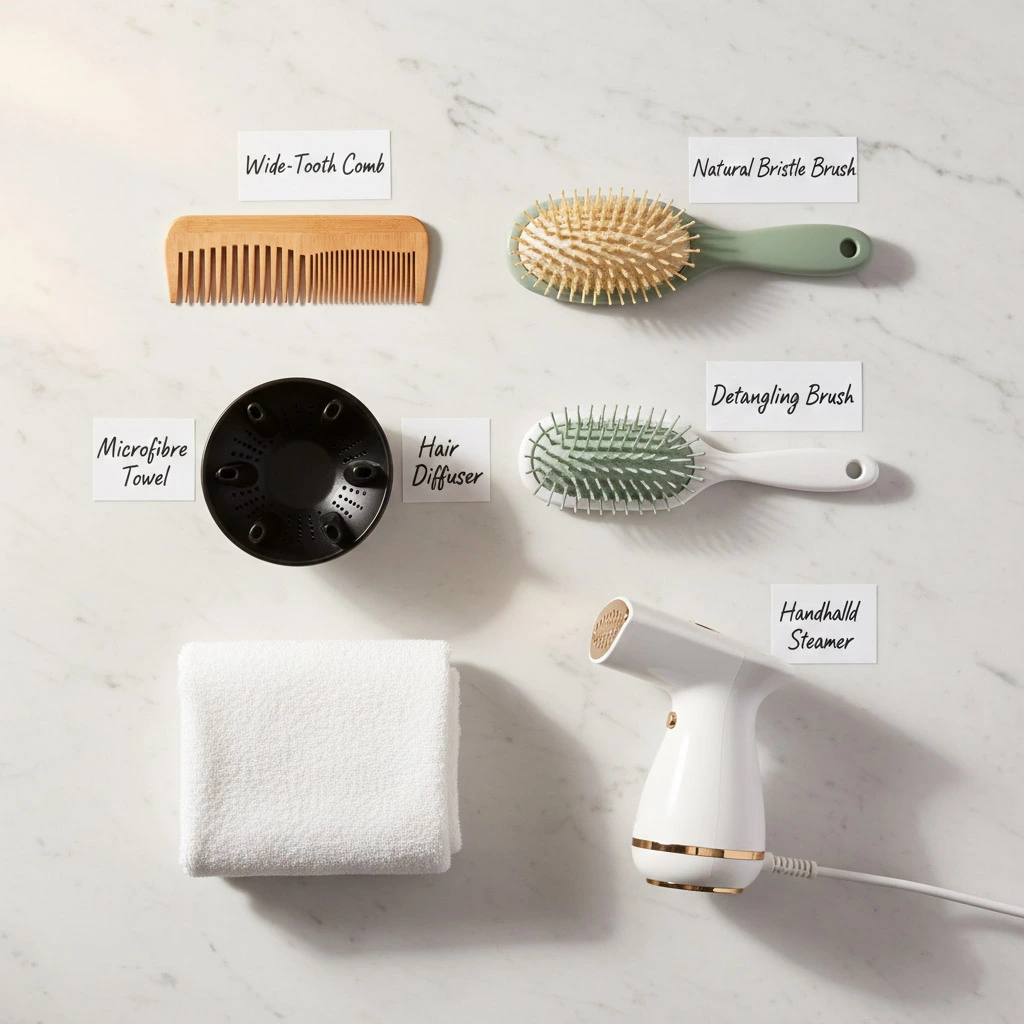
Most people blame their products when their hair is not performing. But the wrong best hair tools can cause more damage than the wrong shampoo. A fine-tooth comb used on dry coily hair. A paddle brush on wet curls. A cotton towel rubbed aggressively over fragile strands.
Tools determine how much physical stress your hair experiences on wash day and during styling. The right best hair tools for your type minimize friction, reduce breakage, and help your products perform better. The wrong ones silently undo hours of careful product application.
This guide covers every tool category — detangling, drying, heat styling, and scalp care — with specific recommendations by hair type and the science behind why each recommendation exists.
If you have not identified your hair type yet, read our complete hair type guide first. All tool recommendations in this page are organized around curl pattern and porosity.
Quick Answer: The best hair tools cause the least mechanical stress for your texture. Wide-tooth combs for detangling, diffusers for curly and coily types, and microfibre towels for drying are the highest-impact upgrades for most people.
Table of Contents
Why Hair Tools Matter as Much as Hair Products
Every interaction between a tool and your hair creates friction. Friction on wet hair — which is significantly weaker and more elastic than dry hair — is the primary mechanical cause of breakage. Studies show this clearly [International Journal of Trichology].
The right tool minimizes that friction. The wrong tool amplifies it. A regular cotton towel, for example, creates a roughing action on the outer layer as you rub. The same outer layer you just spent 20 minutes deep conditioning and smoothing with a cool rinse. A microfibre towel or a cotton T-shirt does the same job with a fraction of the friction.
Choosing the best hair tools for your type is not about buying expensive equipment. It is about understanding which tools are mechanically compatible with your hair’s texture and fragility level. Then making the right substitutions.
Category 1 — Detangling Tools
Detangling is the highest-breakage moment in any hair routine. The tool you choose, and how you use it, determines whether that process is damaging or safe.
Wide-Tooth Comb — Universal Starting Point
A wide-tooth comb is the safest detangling tool for all hair types when used on wet, conditioned hair. The wide spacing between teeth allows the comb to work through tangles without snapping the strand.
- How to use: Always start at the ends and work upward to the roots. Never drag from root to tip through a tangle.
- Best for: All hair types as a primary detangling tool. Essential for Type 3–4 hair.
- What to avoid: Fine-tooth combs on anything other than straight hair. Any comb on dry Type 3–4 hair.
Detangling Brush (Flexi-Bristle)
Detangling brushes with flexible, ball-tipped bristles — like the Tangle Teezer or Wet Brush — work through tangles with less resistance than a comb. The bristles flex rather than catching and pulling.
- Best for: Type 2–3 hair, particularly during the shower with conditioner in.
- Use with caution: Type 4 hair — the brush can grab tightly coiled strands and cause breakage if used without enough product slip.
Natural Bristle Brush
Boar or plant-based bristle brushes distribute scalp oil from root to tip and smooth the outer layer. They are designed for finishing and smoothing — not for detangling. They should only be used on straight or loosely wavy dry hair.
- Best for: Type 1–2 dry hair for smoothing and distributing scalp oils.
- Never use on: Wet hair, curly hair, or coily hair — the friction causes severe outer layer damage and frizz.

Category 2 — Drying Tools
How you dry your hair has an enormous impact on frizz, curl pattern, and outer layer health. The standard approach — vigorous towel rubbing followed by high heat blow-drying — is one of the most damaging things most people do to their hair every single week.
Microfibre Towel or Cotton T-Shirt
Experts say mechanical friction during drying is a primary driver of outer layer damage and frizz formation [AAD.org]. A microfibre towel absorbs water through capillary action rather than friction. It dries hair without roughing up the outer layer.
- Best for: All hair types. The single highest-impact tool upgrade for most people.
- Technique: Gently scrunch and squeeze — never rub. Press the towel against the hair section and hold for 5–10 seconds.
- Budget alternative: A clean cotton T-shirt works almost as well as a microfibre towel for a fraction of the cost.
Diffuser Attachment
A diffuser is a bowl-shaped attachment that fits on the end of a blow-dryer. It disperses airflow across a wide area rather than concentrating it on one spot. This dries hair with significantly less disruption to the curl pattern and dramatically less frizz.
- Best for: Type 2–4 hair — anyone with a wave, curl, or coil pattern. A diffuser is one of the most impactful best hair tools for curly and coily types.
- Settings: Low to medium heat, medium airflow. Never use high heat with a diffuser — the concentrated sitting time increases heat damage risk.
- Technique: Cup sections of hair into the diffuser bowl and hold still for 30–60 seconds per section rather than moving the dryer constantly.
Hooded Dryer
A hooded dryer distributes gentle, consistent heat across the entire head simultaneously. It is ideal for deep conditioning. The sustained heat opens the outer layer and dramatically improves product absorption. This is particularly important for low porosity hair.
- Best for: Low porosity hair needing heat to open the outer layer during deep conditioning. Type 3–4 for setting styles and reducing dry time without direct heat.
- Setting: Medium heat only. 15–30 minutes under the hood during deep conditioning.
Hair Steamer
A hair steamer delivers moist heat — steam — rather than the dry heat of a blow-dryer or hooded dryer. Studies show that moist heat increases outer layer permeability more effectively than dry heat [NCBI]. This makes steamers particularly effective for low porosity hair that struggles to absorb product.
- Best for: Low porosity hair during deep conditioning. Type 4 hair for maximum moisture absorption.
- Investment: Steamers are the highest-cost tool in this guide. A warm shower cap is a low-cost alternative that provides a similar moist-heat effect for home use.

Category 3 — Heat Styling Tools
Heat styling tools are where the most irreversible hair damage happens. Used correctly on the right hair type with the right protectant, they are safe. Used on the wrong heat setting, without protectant, or too frequently, they cause permanent outer layer damage that no product can repair.
Flat Iron (Straightening Iron)
- Safe temperature range: 160–185°C for fine or low porosity hair. 185–210°C maximum for coarser or high porosity hair. Never exceed 230°C on any hair type.
- Always use: A heat protectant applied to completely dry hair before any heat tool contact.
- Best for: Type 1–3 for smoothing and straightening. Use sparingly on Type 4 — the tight coil structure makes it significantly more vulnerable to heat damage.
Curling Wand or Iron
- Best for: Adding defined curl or wave to Type 1–2 hair. Refreshing and defining Type 3 curls on non-wash days.
- Avoid: Using on freshly conditioned or damp hair. The water inside the strand boils on contact with high heat. This causes internal bubble damage visible as white beads on the strand.
Hair Dryer (Standard)
- Best for: Type 1–2 hair without a diffuser attachment for quick drying. Type 3–4 should always use a diffuser.
- Settings: Use the lowest effective heat setting. Finish with a cool shot — the burst of cold air closes the outer layer and locks in smoothness.

Category 4 — Scalp Care Tools
Scalp health is the foundation of healthy hair growth. Scalp tools are an underused category in most routines. These are the best hair tools for supporting scalp circulation and product distribution.
Scalp Massager
Manual or electric scalp massagers stimulate blood circulation in the scalp. This supports the delivery of nutrients to the hair follicle. They are also effective for distributing scalp oil and loosening product buildup before shampooing.
- Best for: All hair types. Particularly beneficial for low porosity hair pre-shampoo to loosen buildup.
- How to use: 3–5 minutes of gentle circular motion on a dry or wet scalp, 3–4 times per week.
Scalp Exfoliation Brush
A soft-bristled scalp brush used during shampooing physically removes dead skin cells, excess oil, and product buildup from the scalp surface. It cleanses more thoroughly than fingers alone.
- Best for: Oily scalp types and anyone who uses heavy styling products regularly.
- Avoid: On an irritated, inflamed, or broken scalp.
The Best Hair Tools Kit by Hair Type
Here is the minimum effective toolkit for each hair type. The essential best hair tools that produce the biggest improvement with the least investment.
- Type 1–2 (Straight/Wavy): Wide-tooth comb, natural bristle brush (dry finishing), microfibre towel, heat protectant, lightweight blow-dryer.
- Type 3 (Curly): Wide-tooth comb, detangling brush, microfibre towel, diffuser attachment, scalp massager.
- Type 4 (Coily/Kinky): Wide-tooth comb, microfibre towel, hooded dryer or steamer, scalp massager. Heat styling tools used sparingly with protectant only.
For the products to pair with these tools, see our best hair products guide and our hair care basics guide for wash day structure and product order.
What to Realistically Expect
Switching to the right tools produces some of the fastest visible results in hair care. Replacing a regular towel with a microfibre version and using a diffuser instead of free-air blow-drying are changes most people notice within a single wash day. Less frizz. Better curl definition. Reduced breakage during detangling.
Tools that improve moisture absorption — steamers and hooded dryers — show results over two to four weeks of consistent use. Hair gradually becomes better hydrated at the outer layer level.
When to See a Professional
If you are experiencing significant breakage despite switching to the correct tools and techniques, the cause may be internal rather than mechanical. Consider a professional consultation if you notice:
- Breakage concentrated at the root rather than mid-shaft or ends
- Sudden increase in shedding across the whole scalp
- Scalp tenderness or visible thinning that does not respond to routine improvements
See our complete hair type guide for more on what normal shedding looks like versus concerning hair loss. And consult our seasonal hair care guide for seasonal tool adjustments.
Final Thoughts
The best hair tools for your type are the ones that work with your hair’s natural texture and fragility rather than against it. A wide-tooth comb on wet conditioned hair. A microfibre towel at drying. A diffuser for curly or coily types. These three changes alone will produce noticeable results within a week.
From there, build upward. Add a steamer or hooded dryer if low porosity moisture absorption is your challenge. Invest in a quality heat protectant before any direct heat tool contact. The goal is always the minimum mechanical stress necessary to achieve the result you want.

