Walk into any pharmacy and you’ll find a shelf full of shampoos claiming to stop hair loss. Bold promises, sleek packaging, and prices that make you wince. But do DHT blocking shampoos work — or are they just expensive soap?
The honest answer is: it depends on which ingredients are in the bottle, how you use them, and what you’re expecting them to do.
In this guide, we’ll cut through the marketing noise and look at the real science behind DHT blocking shampoos. You’ll learn exactly how they work, which ingredients actually have clinical research behind them, what they can and cannot do for your hair, and how to use them properly for the best chance of results.
What you’ll learn:
Table of Contents
What Is DHT and Why Does It Cause Hair Loss?
Before we answer whether do DHT blocking shampoos work, you need to understand what DHT is and why it matters for men’s hair.
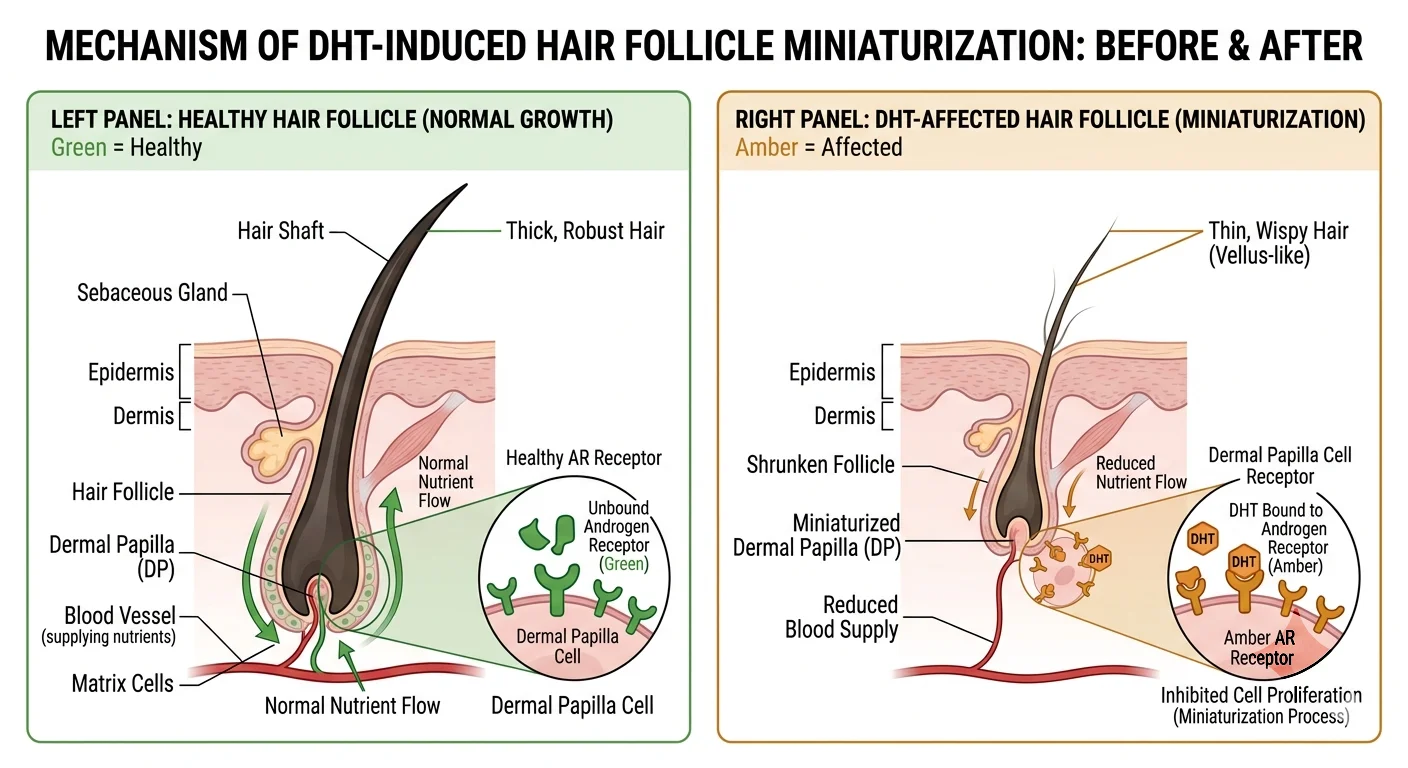
DHT stands for dihydrotestosterone. It is a hormone derived from testosterone through the action of an enzyme called 5-alpha-reductase (5AR). In men who are genetically sensitive to DHT, this hormone binds to receptors in the hair follicles and causes them to shrink. Over time, the follicles produce thinner, shorter hairs — until eventually they stop producing hair altogether. This process is called miniaturization, and it is what drives male pattern baldness (androgenetic alopecia).
Around 50 million men in the United States are affected by androgenetic alopecia. DHT is the root cause in the vast majority of cases. If you notice a receding hairline or thinning at the crown, DHT sensitivity is almost certainly involved. For a full breakdown of the warning signs, read our guide on early signs of male pattern baldness.
DHT blocking shampoos aim to reduce DHT activity at the scalp level — without the systemic effects of oral medications like finasteride.
How Do DHT Blocking Shampoos Work?
DHT blocking shampoos contain ingredients that target the 5-alpha-reductase enzyme. By inhibiting this enzyme, they aim to reduce the conversion of testosterone into DHT on the scalp. Less DHT means less binding to hair follicle receptors — which in theory slows the miniaturization process.
The critical word here is topical. Unlike oral DHT blockers such as finasteride, shampoos only act on the scalp surface and follicle entry points. They do not reduce systemic DHT levels throughout the body. This is both their greatest advantage (fewer side effects) and their main limitation (less powerful effect overall).
There is also the contact time problem. A shampoo typically sits on your scalp for one to five minutes before being rinsed away. Compared to a leave-in treatment or an oral medication, this is a short window for active ingredients to penetrate. This is why how you use a DHT blocking shampoo matters just as much as which one you choose — more on that below.
Key Ingredients: What the Research Actually Shows
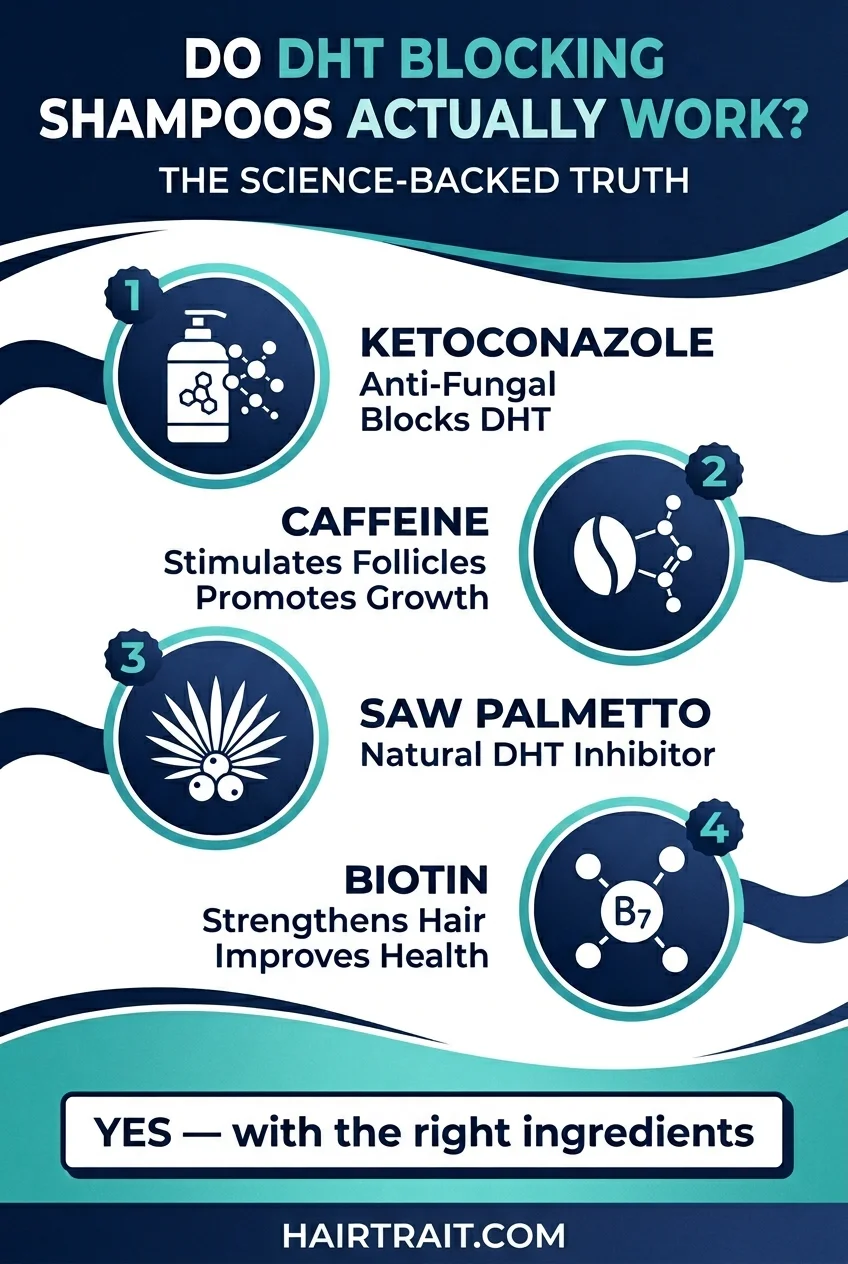
Do DHT blocking shampoos work? The answer largely depends on the ingredients. Not all are created equal. Here is an honest look at the most commonly used actives and what the science actually says about each one.
Ketoconazole
Ketoconazole is the most clinically studied ingredient in DHT blocking shampoos. Originally developed as an antifungal, it was found to have significant anti-androgenic properties — meaning it disrupts DHT activity at the follicular level while also reducing scalp inflammation, which itself worsens follicle damage.
A widely cited study in the journal Dermatology found that ketoconazole 2% shampoo was as effective as 2% minoxidil in improving hair density and the proportion of hairs in the growth phase in men with androgenetic alopecia. More recently, research published in the International Journal of Trichology showed that 1% ketoconazole shampoo produced a 17% reduction in scalp DHT after just eight weeks of consistent use.
Research on PubMed also supports the hypothesis that ketoconazole 2% shampoo locally disrupts the DHT pathway in the hair follicle — a meaningful finding given that topical treatments often struggle to penetrate deeply enough to matter.
Saw Palmetto
Saw palmetto is extracted from the berries of Serenoa repens, a palm native to the southeastern United States. It works by inhibiting 5-alpha-reductase — the same enzyme targeted by finasteride, but in a milder, plant-based form.
A 2020 systematic review of existing research found that saw palmetto offers modest but real improvements in hair regrowth. Research from 2024 has further confirmed meaningful improvements in hair density with consistent use in specialized shampoo formulations.
The caveat: most of the strongest research on saw palmetto involves oral supplementation rather than topical application. When delivered through a rinse-off shampoo, the effective contact time is limited. Saw palmetto works best as a supporting ingredient alongside ketoconazole, rather than as a standalone.
Caffeine
Caffeine in shampoo may sound like a marketing gimmick, but the clinical evidence is surprisingly strong.
Caffeine works through a different mechanism than the other ingredients. Rather than directly blocking DHT, it inhibits phosphodiesterase — an enzyme that, when suppressed, increases levels of cyclic AMP (cAMP) in cells. Higher cAMP levels stimulate cell metabolism and proliferation, effectively counteracting DHT’s miniaturizing effect and extending the anagen (growth) phase of the hair cycle.
A 2024 systematic review published in Healthcare analysed nine clinical trials covering 684 participants. Topical caffeine consistently demonstrated hair growth or reduced hair loss with minimal side effects across all reviewed studies.
One of the most significant recent studies — a 24-week, double-blind, randomized, placebo-controlled trial published in the Journal of Cosmetic Dermatology in 2025 — tested a shampoo containing caffeine and dimethylglycine sodium salt (DMG-Na) on 154 men with androgenetic alopecia. The active shampoo significantly outperformed placebo, with improvements in hair count, hair density, and the anagen-to-telogen ratio — and zero adverse effects reported.
Another study found that after just a two-minute application, caffeine from shampoo penetrated both the outer skin layer and into the hair follicles themselves — directly addressing the contact-time concern that limits many topical treatments.

Biotin
Biotin (Vitamin B7) supports overall hair structure and strength. It is essential for keratin production — the protein that hair is made from. However, biotin does not directly inhibit DHT or 5-alpha-reductase. When applied topically in a shampoo, the research on biotin’s effectiveness is limited compared to oral supplementation.
Biotin is a useful supporting ingredient for overall hair health, but do not choose a shampoo based on biotin alone if hair loss is your primary concern.
Pumpkin Seed Oil
Pumpkin seed oil is rich in phytosterols and zinc, and early research suggests it has 5-alpha-reductase inhibiting properties. One study showed that oral pumpkin seed oil increased hair count by 40% in men with androgenetic alopecia — but this was taken orally, not applied topically. Topical evidence is limited but promising, and it works well as a supporting ingredient.
What DHT Blocking Shampoos CAN and CANNOT Do
What they can realistically do:
- Slow the progression of hair loss by reducing scalp DHT activity
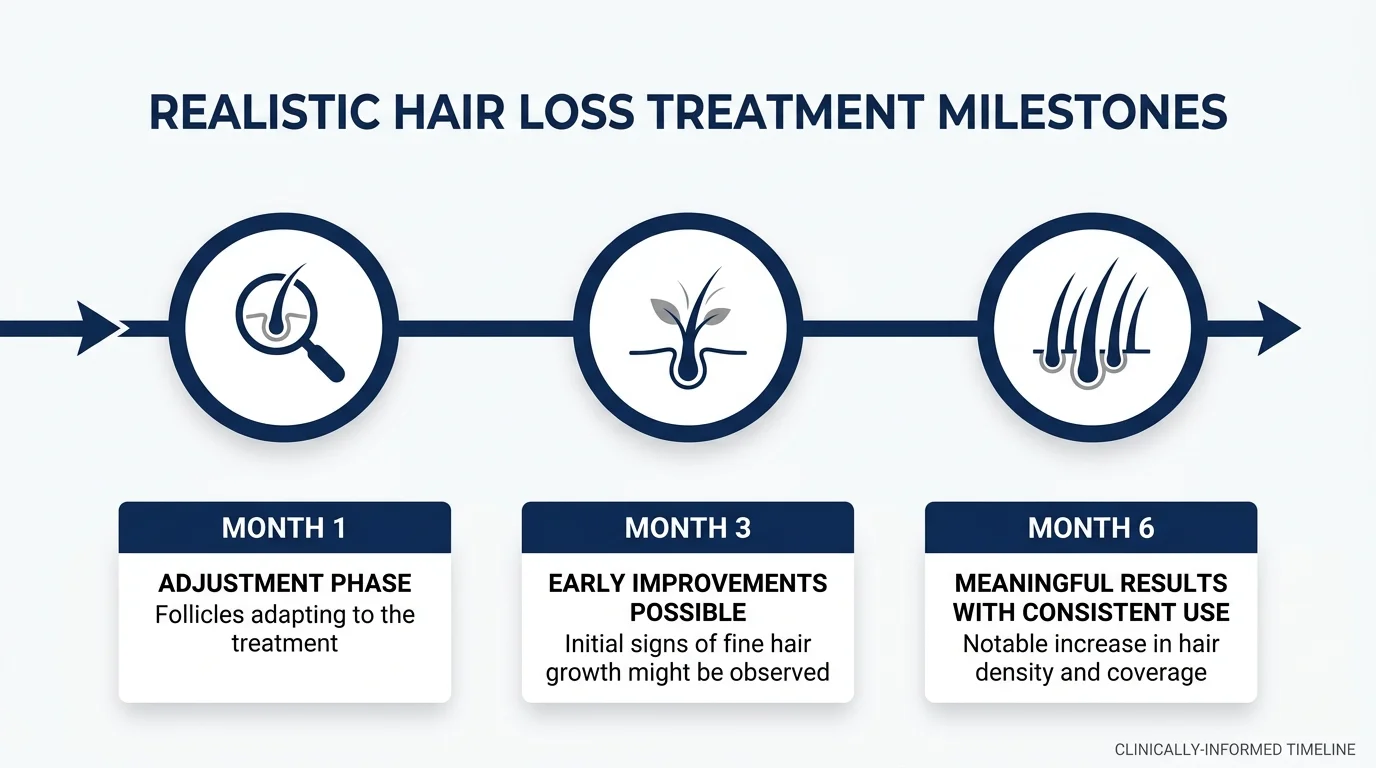
- Improve hair density and scalp health over consistent use (three to six months)
- Reduce scalp inflammation, which worsens follicle damage over time
- Extend the hair growth phase (anagen) for existing follicles
- Support and enhance the effects of stronger treatments like minoxidil
What they cannot do:
- Regrow significant amounts of hair on their own
- Reverse advanced hair loss where follicles have already been permanently damaged
- Replace FDA-approved treatments like minoxidil or finasteride for serious hair loss
- Produce visible results in two to four weeks — hair cycles take months
Think of DHT blocking shampoos as a maintenance and support tool, not a cure. They work best when hair loss is in its early or mid stages, and when used consistently as part of a broader approach. If you are seeing significant thinning, read our complete guide to hair loss treatments for men to understand all your options.
Top DHT Blocking Shampoos: Comparison Table
| Shampoo | Key DHT-Blocking Ingredients | Best For | Price Range |
|---|---|---|---|
| Nizoral (1% or 2% Ketoconazole) | Ketoconazole | Strongest clinical backing | $15–$25 |
| Alpecin Caffeine Shampoo | Caffeine | Caffeine-focused approach | $12–$20 |
| Hims Thickening Shampoo | Saw Palmetto, Biotin | Subscription convenience | $19/bottle or $8/month |
| Keeps Thickening Shampoo | Saw Palmetto, Biotin, Caffeine | Budget-friendly combo | $8/month subscription |
| Happy Head Thickening Shampoo | Ketoconazole + Caffeine | Best ingredient combination | $30–$40 |
How to Use DHT Blocking Shampoos Correctly
Most men use these shampoos wrong — and then wonder why they are not working. Here is the correct approach that maximises your results.
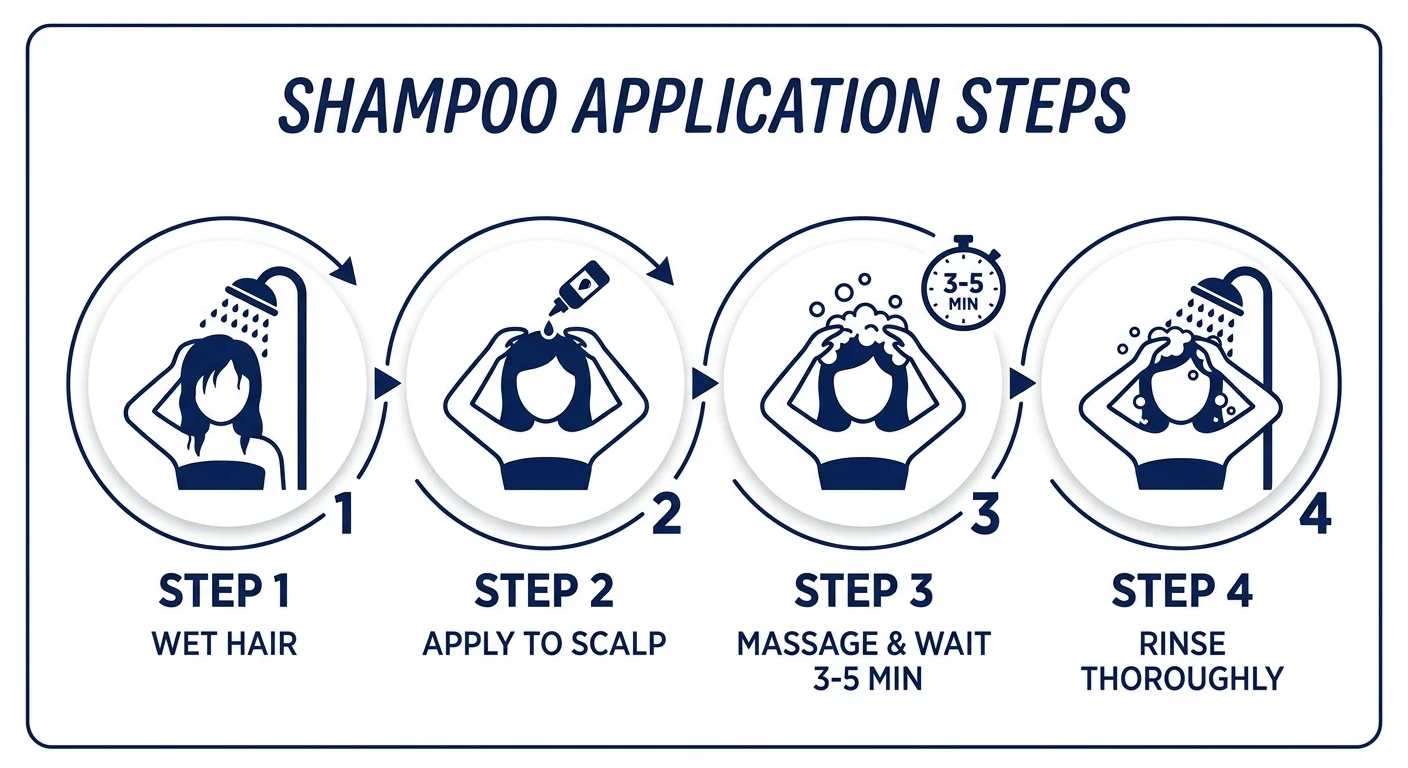
Step 1 — Wet your hair thoroughly. This opens the scalp and prepares it for ingredient absorption.
Step 2 — Apply directly to the scalp, not just the hair. These shampoos target your follicles, which are in the scalp. Rubbing product only through your hair strands misses the point entirely.
Step 3 — Massage and leave it on for 3 to 5 minutes. This is the most important step most men skip. The active ingredients need contact time to penetrate. Set a timer while you do other things in the shower. Do not rinse immediately.
Step 4 — Rinse thoroughly. Make sure no product residue remains, as buildup can clog follicles.
Step 5 — Use 3 to 4 times per week. Daily use is not always necessary — and with ketoconazole specifically, overuse can cause dryness. Alternating with a gentle, non-medicated shampoo on other days helps maintain scalp balance.
Combining DHT Blocking Shampoos with Other Treatments
DHT blocking shampoos work significantly better as part of a multi-pronged approach. Here is how they fit with other treatments.
With Minoxidil: Minoxidil stimulates blood flow to the follicle and extends the growth phase through a different mechanism to DHT blockers. When combined with a ketoconazole shampoo, the two approaches complement each other well. Many dermatologists recommend this combination for men in the early to mid stages of hair loss. See our Minoxidil vs Finasteride comparison for more detail.
With a Healthy Diet: Nutritional deficiencies in zinc, iron, and protein can worsen hair loss independently. A DHT blocking shampoo will not overcome a diet that is starving your follicles of the building blocks they need.
With Scalp Massage: Regular scalp massage improves blood circulation to the follicles, which supports nutrient delivery and can enhance topical ingredient absorption. Even five minutes a day makes a difference over time.
Potential Side Effects
DHT blocking shampoos are generally well tolerated because they are topical and rinsed off quickly. Systemic side effects — a concern with oral finasteride — are rare with shampoo use due to the short contact time. However, some users experience:
- Scalp dryness or irritation, particularly with ketoconazole used at high frequencies
- Occasional allergic reactions to saw palmetto or other botanical ingredients
- Slight hair texture changes with some formulations
If you have a sensitive scalp, a condition like psoriasis, or seborrheic dermatitis, do a patch test before full use and consult a dermatologist first. When in doubt, getting professional guidance is always the right move.
FAQ: Do DHT Blocking Shampoos Work?
How long before I see results from a DHT blocking shampoo?
Give it a minimum of three months, ideally six, before judging results. Hair growth cycles are slow by nature — follicles that were miniaturizing need time to recover and re-enter the growth phase. Take monthly photos under consistent lighting to track progress objectively.
Are there side effects from DHT blocking shampoos?
Topical side effects are mild and uncommon. The most frequent are scalp dryness and occasional irritation, particularly with ketoconazole used too frequently. Systemic side effects like those associated with oral finasteride — such as libido changes — are extremely rare from shampoo use due to the short contact time and rinse-off format.
Can women use DHT blocking shampoos?
Yes, though women metabolize DHT differently and female hair loss often has multiple causes beyond DHT alone. Women who are pregnant or breastfeeding should avoid ketoconazole. Consulting a dermatologist before starting any hair loss treatment is always the right move for women.
Do I need to use DHT blocking shampoos forever?
If your hair loss is genetic, the underlying DHT sensitivity does not go away. Stopping treatment typically means hair loss resumes its previous progression. Most men who benefit from these shampoos find that consistent, ongoing use is needed to maintain results — similar to how you would not stop taking blood pressure medication and expect results to continue.
Which ingredient is the most effective?
Ketoconazole has the strongest clinical evidence for directly blocking DHT activity at the scalp level. Caffeine has a solid and growing body of research supporting hair follicle stimulation through a different mechanism. A shampoo that combines both gives you the broadest coverage of any over-the-counter option available.
Are DHT blocking shampoos worth the cost?
For men in the early stages of hair loss, yes. They are low-risk, easy to incorporate into an existing routine, and have genuine clinical evidence behind them. They will not reverse advanced hair loss, but as a maintenance and prevention tool they offer real value — especially when combined with other treatments like minoxidil.
The Verdict: Do DHT Blocking Shampoos Work?
✅ Bottom Line
Yes — with appropriate expectations. DHT blocking shampoos are not miracle cures, and anyone selling them as such is misleading you. But the best formulations, particularly those containing ketoconazole and caffeine, have legitimate clinical research showing they can slow hair loss progression, improve hair density, and support scalp health over time.
The key conditions: use the right ingredients, apply the shampoo correctly (leave it on for 3 to 5 minutes), be consistent for at least 3 to 6 months, and keep your expectations realistic about what a topical, rinse-off product can achieve.
If your hair loss is progressing rapidly, do not rely on shampoo alone. Talk to a dermatologist and explore combining it with proven treatments like minoxidil. A DHT blocking shampoo is a smart part of your hair health routine — just not the whole strategy.
For your next step, read our guide on the complete hair care routine for men to build a full daily routine that supports your hair from root to tip.