

The transition from a full head of hair to visible thinning is rarely an overnight event. For most, it is a decade-long process of biological attrition known as miniaturization. However, because we see ourselves in the mirror every day, we often miss the subtle shifts until 50% of the hair density is already gone.
Caught early, hair loss is manageable. Left ignored, it becomes a permanent change to your appearance. This guide breaks down the seven primary early signs of balding men, the science of the Norwood Scale, and the exact steps you should take to preserve your hair for years to come.
Quick Answer: Male pattern baldness (androgenetic alopecia) typically begins with a receding hairline at the temples or thinning at the crown. Statistics from the American Academy of Dermatology (AAD) show that 1 in 4 men start noticing these signs before age 21. The most effective intervention occurs when you identify “miniaturization”—where hair strands become thinner and shorter—before the follicle goes dormant permanently.
Table of Contents
1. The Receding Hairline (The M-Shaped Pattern)
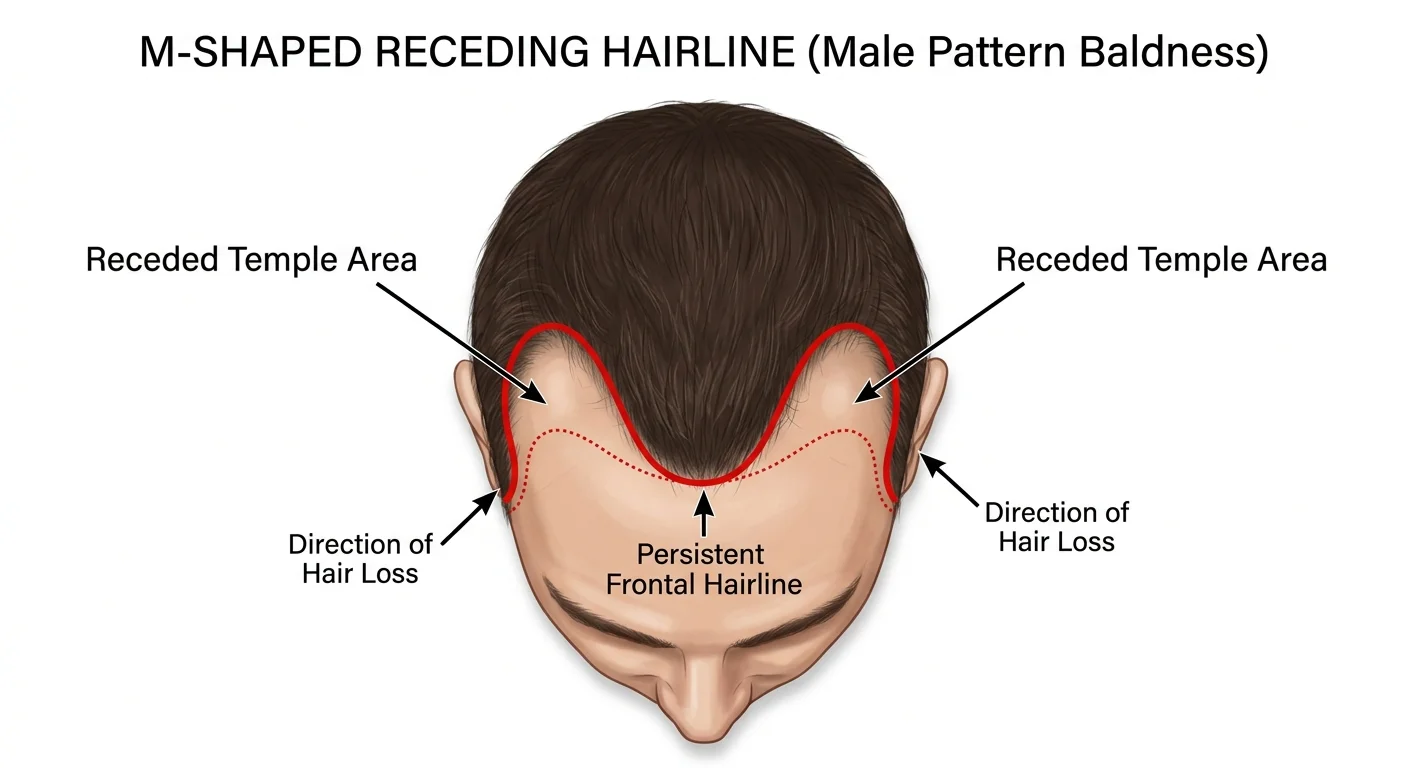
The most iconic of all male hair loss symptoms is the receding hairline. This typically begins at the temples and slowly migrates backward, leaving a “tuft” of hair in the center of the forehead. Over time, this creates a distinct “M” or “V” shape.
To verify this, look for “baby hairs” at your temples that never seem to grow longer. These are follicles under attack by DHT, producing thinner strands that eventually disappear. If you compare your current hairline to a photo from two years ago and notice the corners have pushed back, you are likely entering Stage 2 or 3 of the Norwood Scale.
2. Thinning on the Crown (The Vertex)
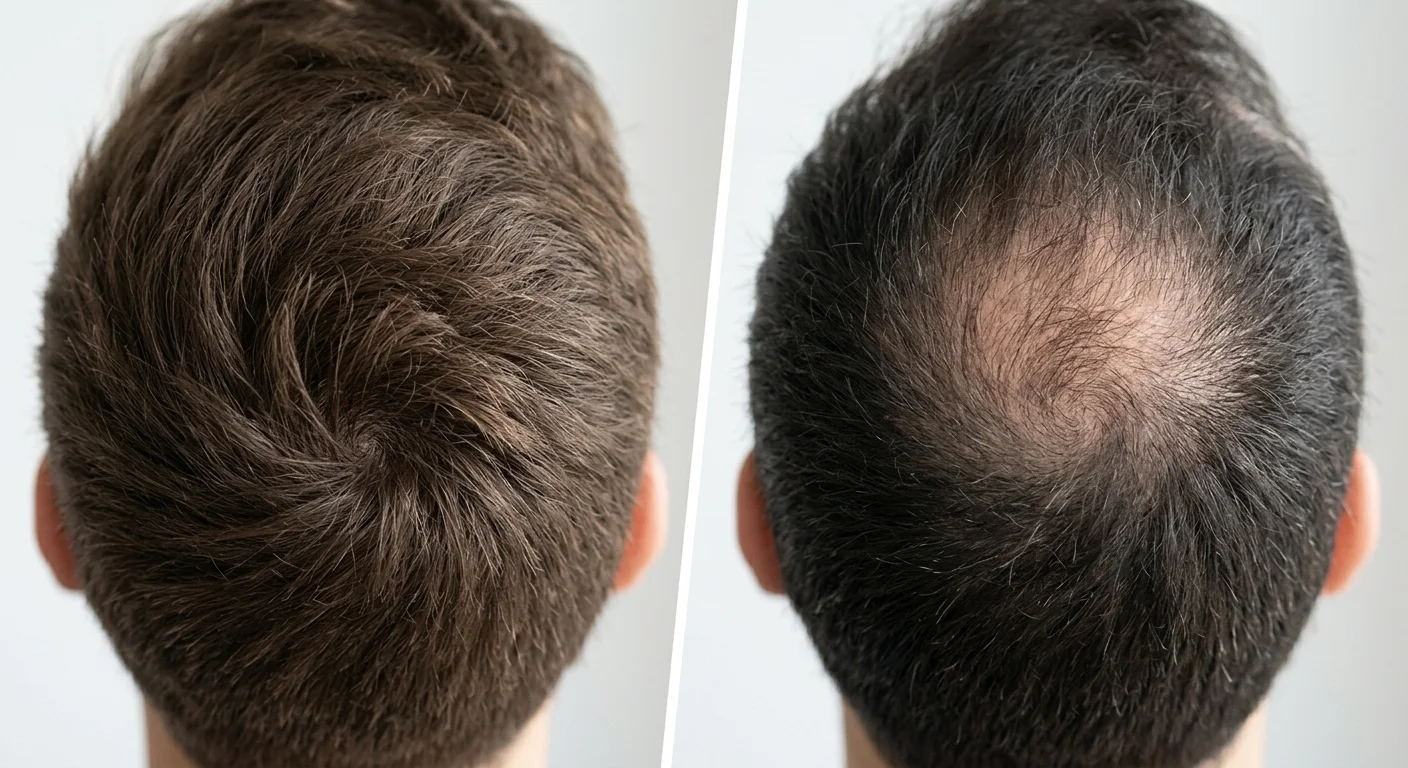
While some men lose hair at the front, others experience thinning at the very top-back of the head, known as the crown or vertex. This is a primary sign of balding that is often discovered by accident in a changing room mirror or a photo taken from behind.
Crown thinning occurs when the follicles in a circular area begin to shrink. Initially, your scalp may just become more visible when your hair is wet or under bright “stadium” lighting. Eventually, the thinning patch expands until it meets the receding hairline from the front.
3. Excessive Hair Shedding
It is normal to lose 50 to 100 strands of hair a day as part of the natural growth cycle. However, if you are noticing a “carpet” of hair in the shower drain or finding dozens of strands on your pillowcase every morning, you are experiencing excessive shedding.
Consistent loss of more than 100 strands daily suggests that a higher percentage of your follicles are entering the “telogen” (resting) phase simultaneously. While shedding can be caused by stress, in the context of male pattern baldness, it often precedes a permanent drop in density.
4. A Widening Part Line
For men who style their hair with a side or center part, the “width” of the part is a reliable barometer for density. As the hair on the top of your head thins, the gap between the follicles increases.
If you notice that your part looks like a wide “road” rather than a tight line, or if you can see significantly more scalp when you comb your hair to the side, it is a clear indicator that the follicles in the mid-scalp are beginning to miniaturize.
5. Visible Scalp Through the Hair
This is perhaps the most distressing male hair loss symptom. When hair density drops by roughly 30–50%, the scalp becomes visible even when the hair is styled. This is often most noticeable under harsh fluorescent lighting or when the hair is damp.
If your hair has a “see-through” quality that wasn’t there a year ago, it means the individual hair shafts have become so thin that they no longer provide adequate coverage. This is the hallmark of advanced miniaturization.
6. Smaller, Thinner Hair Strands (Miniaturization)
Healthy hair is thick, pigmented, and strong. In the early stages of balding, the hair doesn’t just fall out; it changes quality. These new, weak strands are called “villus hairs.” They are shorter, thinner, and often lack the natural color of your original hair.
Check the hair that falls out. If the strands look like fine “peach fuzz” rather than robust hairs, your follicles are shrinking under the influence of androgens. This is a biological warning that the follicle is nearing its end of life.
7. Slower Hair Growth Rate
Because the “anagen” (growth) phase of the hair cycle shortens during male pattern baldness, your hair literally has less time to grow. You may notice that while you used to need a haircut every three weeks, you can now go six or eight weeks without your hair feeling “long.”
This “growth wall” happens because the follicles are no longer capable of sustaining a long growth period. If it feels like your hair has simply stopped growing past a certain length, it is likely due to the shortening of the cycle.
Understanding the Norwood Scale
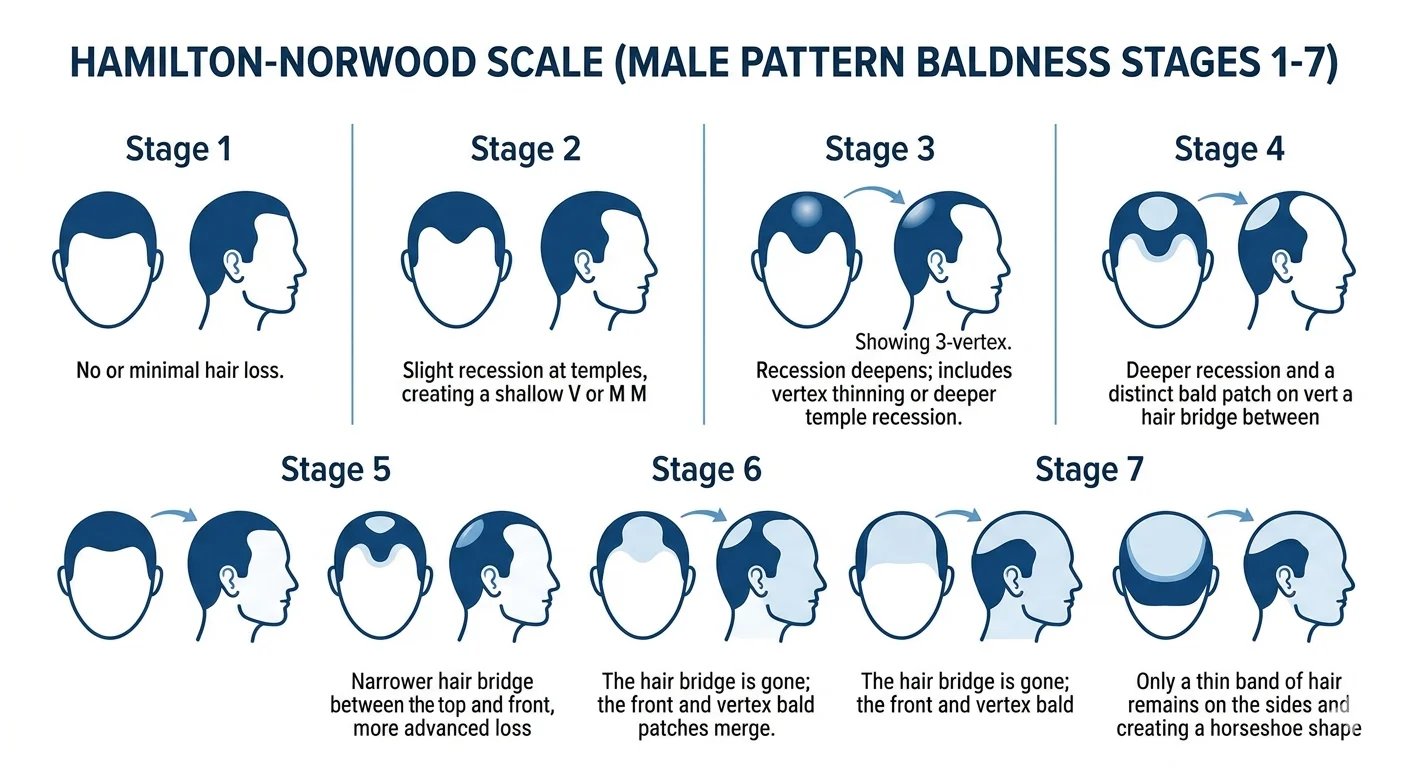
Dermatologists use the Norwood Scale to classify the stages of male pattern baldness. Identifying where you fall on this scale helps determine the best course of treatment.
| Norwood Stage | Description | Recommended Action |
|---|---|---|
| Stage 1 | No visible hair loss or recession. | Preventative care and observation. |
| Stage 2 | Minor “corners” of recession at the temples. | Introduce topical treatments. |
| Stage 3 | The “M” shape becomes deep and clinically evident. | Consult a dermatologist for DHT blockers. |
| Stage 4 | Significant recession and a visible bald spot at the crown. | Aggressive combined therapy (medical). |
What Causes Male Pattern Baldness?
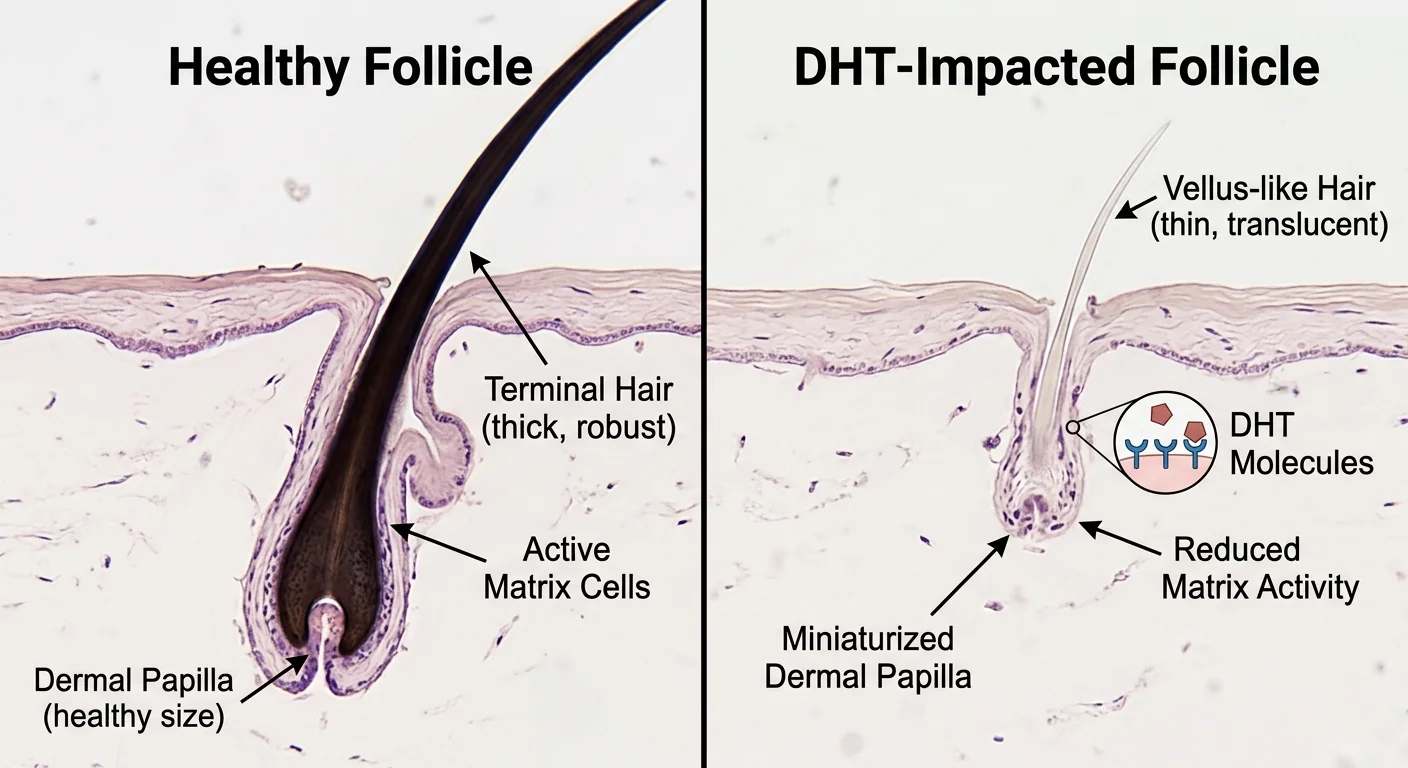
The primary cause of hair loss in 95% of men is **Androgenetic Alopecia**. This is driven by a combination of genetics and hormones. Specifically, your follicles are genetically predisposed to be sensitive to **Dihydrotestosterone (DHT)**, a byproduct of testosterone.
When DHT attaches to the receptors in your hair follicles, it triggers the miniaturization process. Over several cycles, the follicle becomes so small that it can no longer produce a visible hair. Age also plays a role, as the cumulative exposure to DHT and the natural slowing of cell regeneration make the scalp more vulnerable over time.
What to Do If You Notice the Signs
If you have identified one or more of these signs of balding, do not panic. Modern science has made hair loss a choice for many men.
- See a Dermatologist: A professional can perform a “pull test” or use a trichoscope to confirm if your loss is genetic or related to a temporary issue like a vitamin deficiency.
- Explore Treatment Options: FDA-approved treatments like Minoxidil and Finasteride are the gold standards. You can also explore natural alternatives like rosemary oil for early-stage thinning.
- Make Lifestyle Changes: While they won’t stop genetic loss, reducing chronic stress and maintaining a diet rich in Omega-3s and Zinc can improve the health of the hair you still have.
FAQ: Common Questions About Male Hair Loss
Can balding be reversed?
While you cannot “cure” the genetics, you can significantly regrow hair that has recently miniaturized. However, once a follicle has been dormant for years and skin has grown over it, it is usually impossible to revive without a hair transplant. Catching it early is key.
At what age does balding start?
Male pattern baldness can begin as early as the late teens. Most men start noticing the first signs in their mid-20s or early 30s. By age 35, approximately two-thirds of American men will experience some degree of appreciable hair loss.
Is hair loss from stress or genetic?
Stress-related loss (Telogen Effluvium) is usually sudden and results in thinning all over the head. Genetic loss (Androgenetic Alopecia) is slow, progressive, and follows the distinct Norwood patterns at the hairline and crown.
Do hats cause balding?
No. Unless a hat is so tight that it physically pulls the hair out (traction alopecia), wearing hats does not affect the hormonal or genetic drivers of male pattern baldness.
How fast does male pattern baldness progress?
The speed is highly individual. Some men progress from Stage 1 to Stage 7 in less than five years, while others may stay at a Stage 3 “maturing hairline” for decades. Tracking your loss with photos every six months is the best way to determine your rate.

Conclusion: Take Action Today
Identifying the **early signs of balding men** is the first step toward long-term hair preservation. Whether it is a slightly receding hairline or a few extra strands in the shower, these signals are your body’s way of telling you that your follicles need support.
Don’t wait until the loss is obvious to everyone else. By acting now—through medical consultation, routine changes, or styling adjustments—you can maintain your confidence and your hair. Ready to start your recovery? Check out our next guide on the best treatments for thinning hair.
