

The debate between silk vs satin pillowcases for hair is everywhere. Influencers swear by silk. Budget-conscious shoppers defend satin. Which one actually prevents breakage and frizz better?
The answer is more nuanced than “silk is always better.” Both work. But they work differently, cost dramatically different amounts, and require different care. This guide breaks down the real differences so you can make the right choice for your hair type and budget.
If you’re already dealing with breakage, read our hair breakage vs hair loss guide first to identify whether friction damage is your main problem. Pillowcases help prevent friction. They don’t repair existing damage.
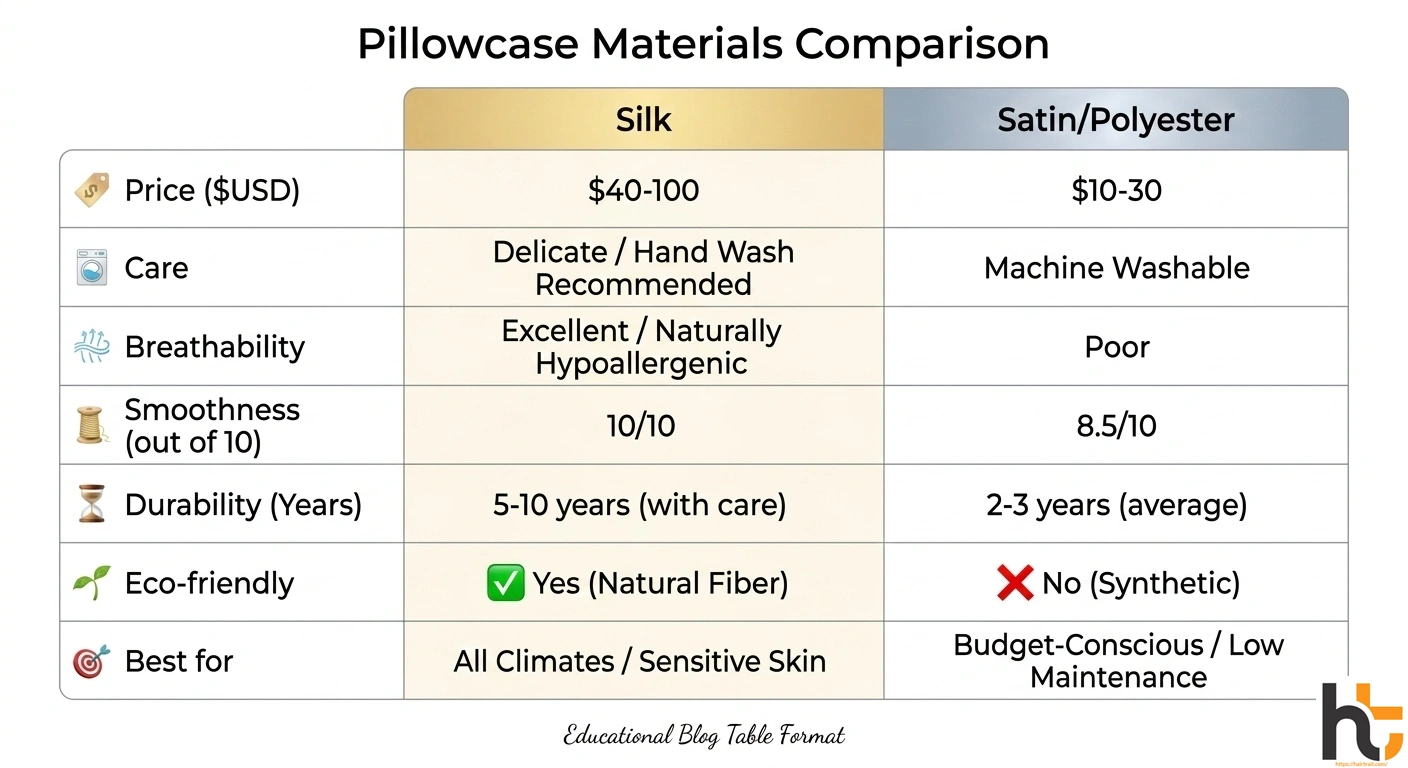
Quick Answer: Silk vs satin pillowcases for hair: Real silk (mulberry) is smoother, naturally temperature-regulating, hypoallergenic, but expensive ($40-100) and requires delicate washing. Satin (usually polyester) is nearly as smooth, affordable ($10-30), machine-washable, but less breathable. Both reduce friction vs cotton by 40-60%. For most people, high-quality satin delivers 85% of silk’s benefits at 20% of the cost.
The Critical Difference: Material vs Weave
Before comparing silk vs satin pillowcases for hair, understand what these terms actually mean.
Silk is a natural protein fiber produced by silkworms. It’s a material. When people say “silk pillowcase,” they mean pillowcases made from silk fibers.
Satin is not a material. It’s a weave pattern. Satin can be made from silk, polyester, nylon, or rayon. When people say “satin pillowcase,” they usually mean polyester satin — synthetic fibers woven in a satin pattern.
This distinction matters because:
- Silk satin exists (silk fibers woven in satin pattern) — expensive, smooth, breathable
- Polyester satin exists (synthetic fibers woven in satin pattern) — affordable, smooth, less breathable
- Cotton cannot be woven in satin pattern the same way — it’s fundamentally different
How Each Affects Your Hair
Both silk and satin pillowcases for hair reduce friction compared to cotton. Research shows that smooth-fiber fabrics reduce hair cuticle friction by 40-60% compared to cotton [International Journal of Cosmetic Science].
Benefits Both Provide
- Reduced friction: Hair slides across the surface rather than catching and pulling
- Less breakage: Particularly at fragile areas like hairline and nape
- Preserved styles: Curls, waves, and blowouts last longer
- Less frizz: Smooth surface doesn’t rough up the outer layer
- Moisture retention: Unlike cotton which absorbs moisture from hair, smooth fabrics don’t wick it away

Silk Pillowcases: The Premium Option
When discussing silk vs satin pillowcases for hair, silk refers specifically to mulberry silk — the highest quality silk produced by domesticated silkworms.
Advantages of Silk
- Smoothest surface: Natural silk has the lowest friction coefficient of any textile
- Temperature-regulating: Naturally breathable. Keeps you cool in summer, warm in winter
- Hypoallergenic: Naturally resistant to dust mites, mold, and allergens
- Moisture-balancing: Absorbs up to 30% of its weight in moisture without feeling damp, then releases it slowly
- Skin benefits: Less absorbent than cotton so nighttime skincare products stay on your face, not your pillowcase
- Durability: High-quality silk (19-22 momme weight) lasts 5-10 years with proper care
Disadvantages of Silk
- Expensive: $40-100+ per pillowcase
- Delicate care required: Hand wash or gentle machine cycle in mesh bag. Air dry only. No bleach, no fabric softener
- Can be damaged by: Sunlight (fades color), sweat, lotions with retinol or benzoyl peroxide, pets with claws
- Requires multiple cases: You need 2-3 to rotate while washing
What to Look For
If buying silk:
- Momme weight: 19-22 momme is ideal. Below 19 is too thin and tears easily. Above 25 is too thick and doesn’t drape well
- Grade: 6A grade mulberry silk is highest quality
- Certification: Oeko-Tex Standard 100 certification ensures no harmful chemicals
Satin Pillowcases: The Budget-Friendly Alternative
Most satin pillowcases are made from polyester fibers woven in a satin weave pattern. This creates a smooth, glossy surface similar to silk at a fraction of the cost.
Advantages of Satin
- Affordable: $10-30 per pillowcase
- Easy care: Machine wash and dry. Wrinkle-resistant
- Durable: Polyester doesn’t tear easily, resists damage from products and pets
- Nearly as smooth: High-quality satin is 85-90% as smooth as silk for hair purposes
- Color options: Wider variety of colors and patterns than silk
Disadvantages of Satin
- Less breathable: Polyester traps heat. Can feel sweaty in hot weather
- Not temperature-regulating: Feels cold in winter, hot in summer
- Not hypoallergenic: Can harbor dust mites and allergens more than silk
- May pill: Lower-quality satin develops pills and loses smoothness over time
- Environmental impact: Polyester is petroleum-based plastic. Sheds microplastics when washed
What to Look For
If buying satin:
- Thread count: 400+ for durability and smoothness
- Reviews mentioning hair: Many cheap satins are too slippery (hair slides off pillow) or develop rough spots quickly
- Return policy: Quality varies dramatically in budget satin. Buy from retailers with easy returns
The Verdict: Which Is Better for Your Hair?
The honest answer to silk vs satin pillowcases for hair: both work. Your choice depends on budget, climate, and maintenance tolerance.
Choose Silk If:
- You can afford $40-100 and don’t mind delicate care
- You sleep hot or live in a warm climate (silk’s breathability is worth the premium)
- You have skin sensitivities or allergies
- You want the absolute smoothest surface and best overall experience
- You’re already investing in premium hair care and want the best tools
Choose Satin If:
- Budget is a primary concern
- You want easy machine-wash care
- You sleep cold (polyester holds warmth better)
- You have pets that might damage delicate fabrics
- You’re trying the concept for the first time and want lower risk
The 85% Solution
Here’s what most experts won’t tell you: for preventing hair breakage specifically, high-quality satin delivers 85% of silk’s benefit at 20% of the cost. The extra smoothness of silk matters, but not dramatically for hair purposes. The main advantages of silk — breathability, hypoallergenic properties, luxury feel — are comfort features, not hair features.
If your primary goal is protecting hair from breakage, start with satin. If it works and you want to upgrade, then invest in silk.
How They Compare to Cotton (The Real Enemy)
Both silk and satin pillowcases for hair are dramatically better than cotton. Studies show cotton pillowcases create 3-5× more friction than smooth-fiber fabrics [NCBI].
Cotton’s rough weave:
- Catches and pulls hair with every movement
- Absorbs moisture from hair (wicks away natural oils and product)
- Creates frizz by roughing up the outer protective layer
- Causes tangles that lead to breakage during morning detangling
If you’re comparing silk to satin, you’ve already made the right decision to abandon cotton. The question is just which smooth fabric suits you better.
For complete breakage prevention, pair your pillowcase choice with guidance from our heat damage repair guide.
Care Instructions
Caring for Silk Pillowcases
- Hand wash in cold water with pH-neutral detergent, or machine wash on delicate cycle in mesh bag
- Never use bleach, fabric softener, or harsh detergents
- Air dry only — never tumble dry (heat damages silk)
- Store away from direct sunlight
- Iron on lowest setting if needed (inside-out with pressing cloth)
- Wash every 3-5 days to remove oils and product buildup
Caring for Satin Pillowcases
- Machine wash on gentle or normal cycle with like colors
- Use regular detergent (avoid fabric softener — makes satin less smooth)
- Tumble dry low or air dry
- Iron on low if wrinkled (though high-quality satin rarely wrinkles)
- Wash weekly

What to Actually Expect
Switching to silk or satin pillowcases for hair produces noticeable but not miraculous results.
Week 1-2: Wake up with smoother hair. Less morning frizz. Styles from previous day better preserved. You’ll notice this immediately.
Week 4-6: Reduced breakage at hairline and nape where friction is highest during sleep. Tangles decrease. Morning detangling is easier.
Month 3+: Overall hair health improves as you eliminate one major source of mechanical damage. Combined with proper care, breakage decreases 20-40%.
What won’t change: Existing damage (that requires cutting and growing out). Hair won’t suddenly become thicker, grow faster, or change texture. Pillowcases prevent future damage. They don’t reverse past damage.
Studies confirm that reducing mechanical stress during sleep measurably improves hair tensile strength over 8-12 weeks [Journal of Textile Science].
For complete hair protection recommendations including tools and techniques, see our best hair tools guide.
Common Misconceptions
Myth: “Satin Doesn’t Work, Only Real Silk Works”
Reality: High-quality polyester satin works nearly as well as silk for preventing hair friction. The difference in smoothness is measurable in lab tests but minimal in real-world use.
Myth: “Silk Repairs Damaged Hair”
Reality: Silk prevents friction damage. It doesn’t repair broken protein bonds or fill structural gaps. Those require treatments like protein and bond repair from our best hair products guide.
Myth: “You Need Silk For Curly Hair But Satin Works For Straight”
Reality: Both hair types benefit equally from reduced friction. Curly hair shows results more visibly (better curl definition, less frizz), but straight hair gets the same breakage prevention.
Myth: “More Expensive Always Means Better”
Reality: $100 silk isn’t necessarily better than $60 silk. Similarly, $30 satin isn’t always better than $15 satin. Look for momme weight (silk) or thread count (satin), not just price.
Final Thoughts
The debate between silk vs satin pillowcases for hair is less important than the decision to switch from cotton to either smooth option. Both silk and satin dramatically reduce friction, prevent breakage, and preserve styles.
Silk is objectively better — smoother, more breathable, hypoallergenic. But it costs 3-5× more and requires delicate care. For most people prioritizing hair health on a budget, high-quality satin delivers excellent results.
Start with satin. If you love the concept and want to upgrade, invest in silk later. Either way, your hair will thank you for eliminating cotton’s damaging friction.

