Hair porosity is arguably the most important hair characteristic you’re probably misunderstanding. It dictates which products work for you, how to apply them, how long your color lasts, and why your friend’s holy grail conditioner does nothing for your hair. Yet the most common way people test their hair porosity — the float test — gives unreliable results.
Understanding your actual hair porosity saves you from years of trial and error with products that were never designed for your hair’s behavior. This article explains what porosity really means at the structural level, debunks the float test, and gives you practical methods that actually work.
Quick Answer: Hair porosity is how easily your hair absorbs and retains moisture, determined by the condition of your cuticle layer. Low porosity hair has a tightly sealed cuticle that resists moisture entry, while high porosity hair has gaps and damage that let moisture in fast — but can’t hold it. The popular “float test” (dropping a hair in water) is unreliable because surface tension, oils, and product residue distort the results. Better tests include the spray test, the absorption time test, and observing how your hair behaves after washing.
Table of Contents
What Hair Porosity Actually Means
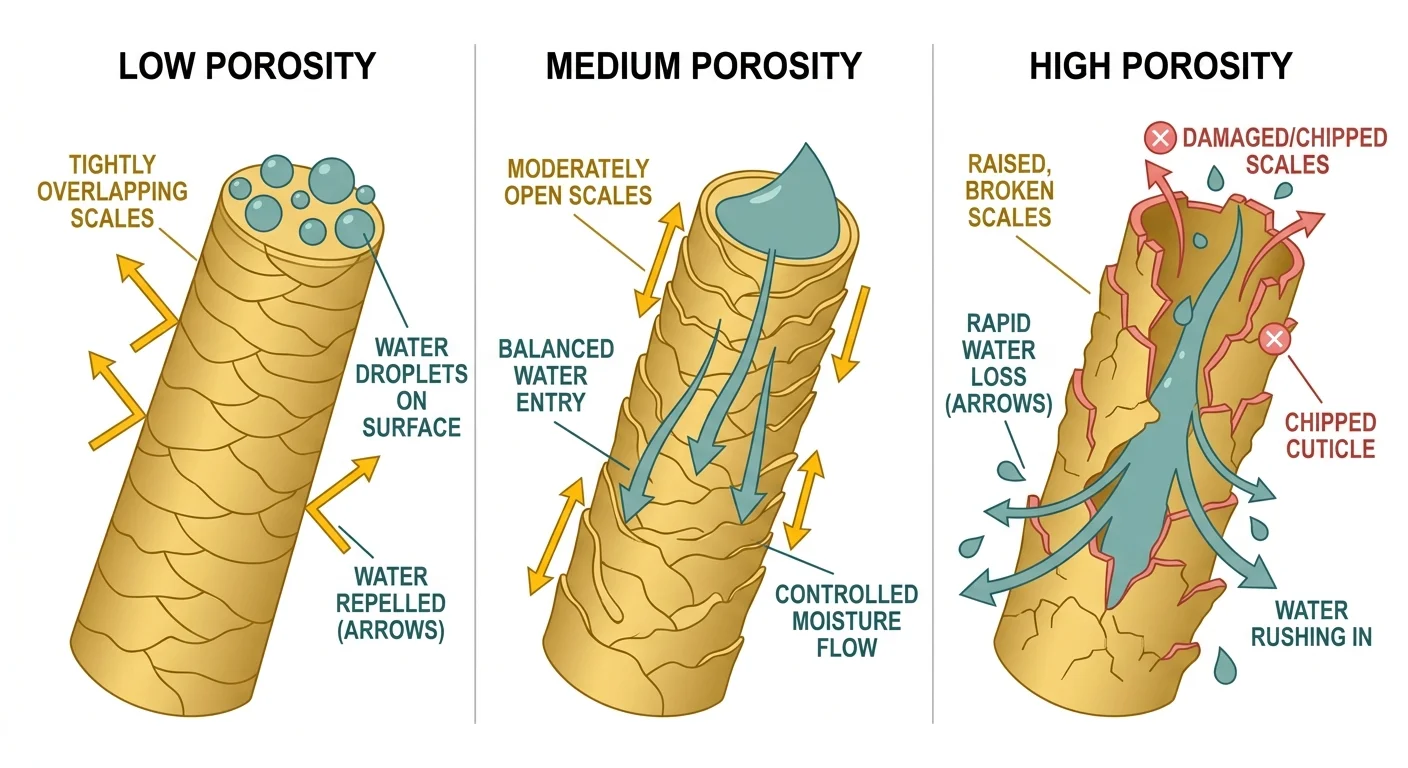
Hair porosity refers to your hair’s ability to absorb and retain moisture. It’s determined by the state of your cuticle — the outermost layer of each hair strand made up of overlapping scale-like cells, similar to roof shingles.
- Low porosity: Cuticle scales lie flat and tightly overlapped. Water, oils, and conditioning ingredients have difficulty getting in. Hair tends to resist moisture rather than absorb it.
- Medium (normal) porosity: Cuticle scales are moderately open — moisture enters reasonably well and is retained effectively. This is the easiest porosity to maintain.
- High porosity: Cuticle scales are lifted, chipped, or have gaps — often from chemical processing, heat damage, or environmental wear. Moisture enters quickly but escapes just as fast.
Your natural porosity is partly genetic. Some people are born with a tighter cuticle structure. But porosity also changes along the length of your hair — roots are typically lower porosity than ends, because ends have experienced more cumulative damage. It can also change over time due to bleaching, heat styling, sun exposure, and chemical treatments. For more on how damage affects your hair structure, check our hair care basics guide.
Why the Float Test Doesn’t Work
The float test — dropping a clean hair strand into a glass of water and seeing whether it floats (low porosity), sinks slowly (medium), or sinks immediately (high porosity) — is the most shared porosity test online. It’s also deeply flawed.
Here’s why it produces unreliable results:
- Surface tension dominates. A single hair strand is so light that surface tension alone can keep it floating regardless of porosity. This is basic physics — objects below a certain weight don’t break the water’s surface film easily.
- Product residue changes buoyancy. Any oil, silicone, or styling product remaining on the strand creates a hydrophobic barrier that prevents sinking. Even “clean” hair retains microscopic residue.
- Hair diameter affects results. Coarse, thick strands sink more easily than fine strands due to weight — this tests density, not porosity.
- Temperature and water mineral content matter. Warm water and soft water behave differently than cold water and hard water, changing how quickly any strand sinks.
- You’re testing one strand. Your hair likely has different porosity at different points — roots vs. mid-shaft vs. ends. A single strand test tells you almost nothing about your overall hair behavior.
Research in the International Journal of Cosmetic Science has studied hair’s interaction with water extensively, and buoyancy in a glass is not a method any trichologist or cosmetic chemist endorses for determining porosity.
How to Actually Test Your Hair Porosity
Instead of the float test, use these observation-based methods that account for your hair’s real-world behavior:
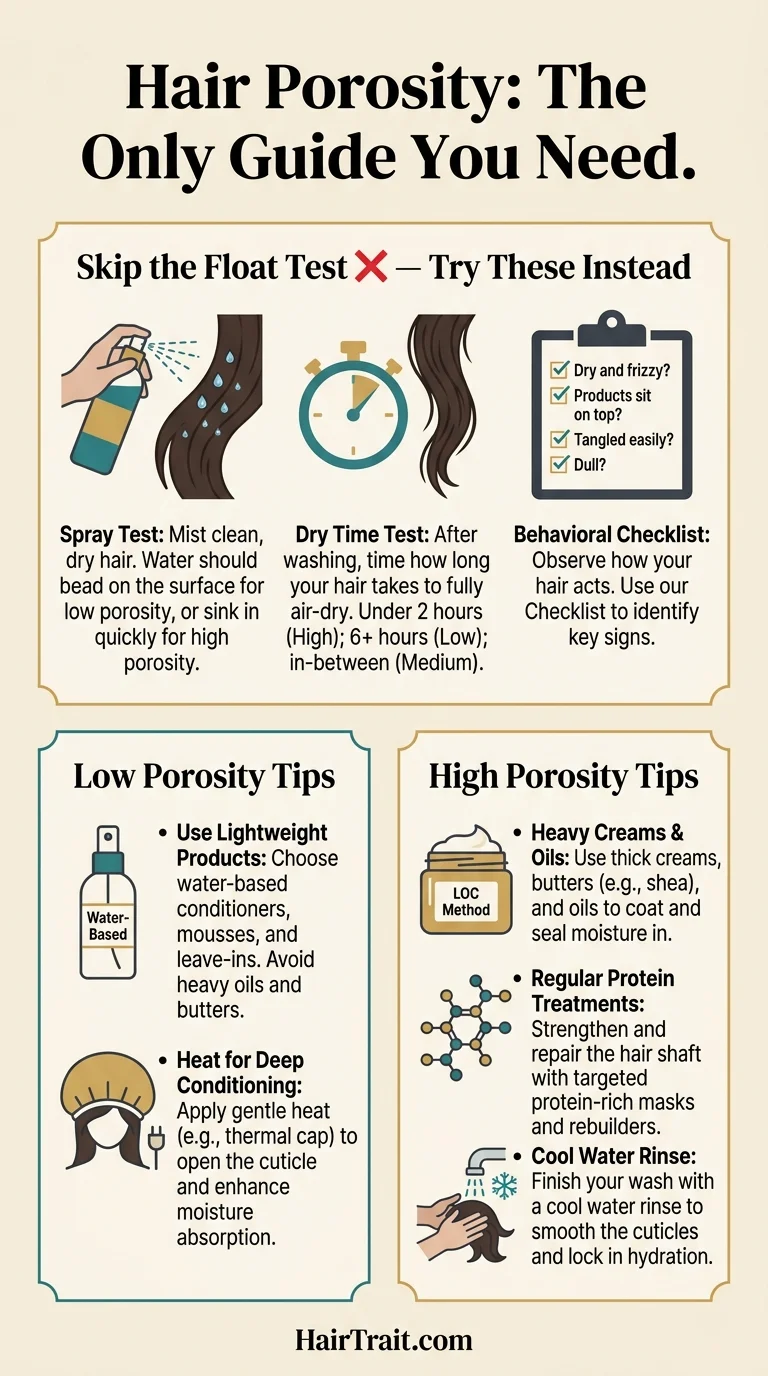
The spray bottle test
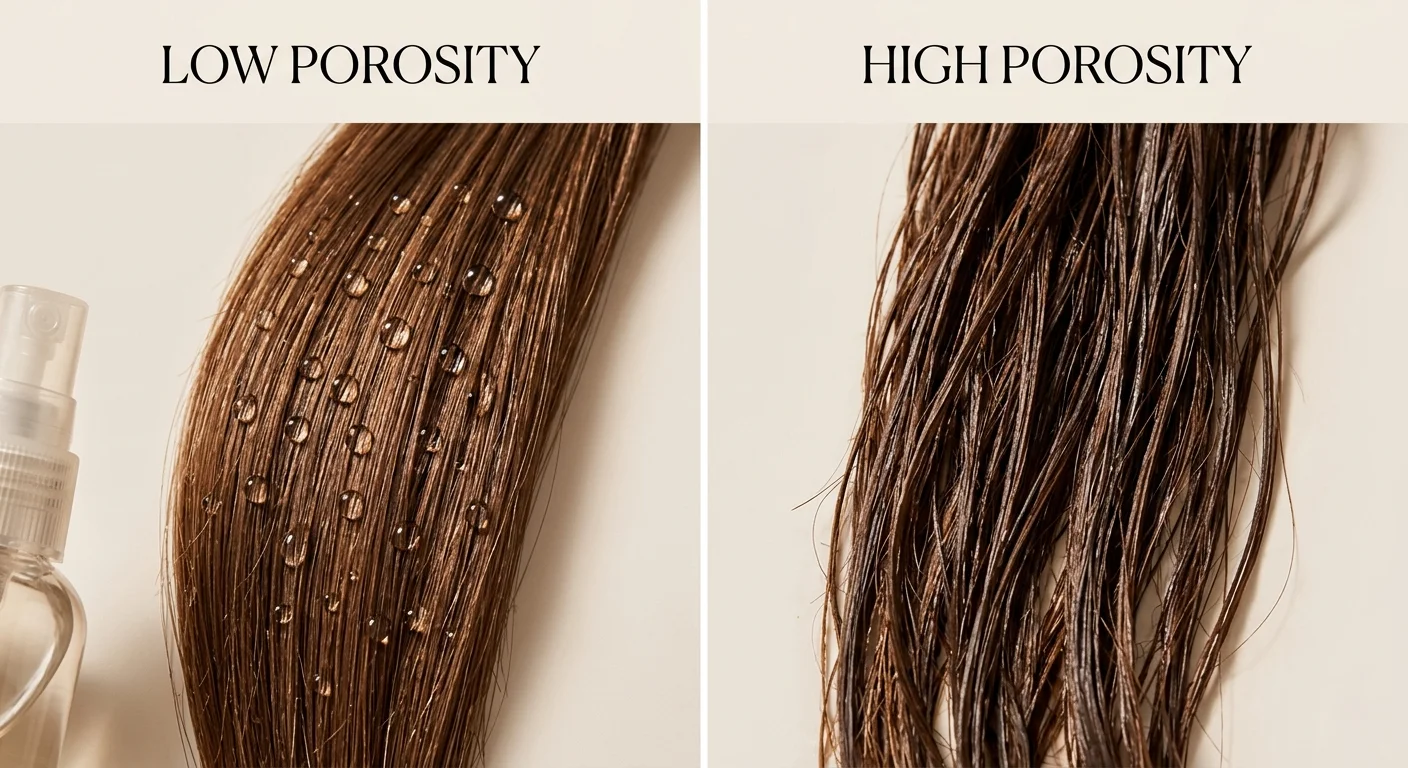
Take a small section of dry, product-free hair. Mist it with water from a spray bottle and watch what happens. Low porosity hair: water beads up and sits on the surface for several seconds before absorbing. Medium porosity: water absorbs within a few seconds. High porosity: water disappears almost instantly.
The drying time test
After washing, note how long your hair takes to air dry. Low porosity hair takes a long time (often 4+ hours for medium-length hair) because the sealed cuticle traps water inside once it eventually gets in. High porosity hair dries very quickly because moisture escapes through gaps in the cuticle.
The behavioral checklist
| Behavior | Low Porosity | High Porosity |
|---|---|---|
| Product absorption | Products sit on top, hair feels “coated” | Products absorb instantly, hair feels dry again quickly |
| Air dry time | Very slow (3–5+ hours) | Fast (under 2 hours for similar length) |
| Response to humidity | Resists frizz well in humidity | Frizzes easily, puffs up in humid weather |
| Hair color | Difficult to color; color lasts a long time once achieved | Takes color easily; fades quickly |
| Deep conditioning | Needs heat or steam to help products penetrate | Absorbs conditioner readily but dries out fast after |
| Wet hair feel | Slippery, smooth, hard to saturate | Absorbs water fast, feels heavy and mushy when wet |
If most of your answers cluster on one side, that’s your porosity. If you’re split, you likely have medium porosity — or different porosity at different parts of your hair, which is completely normal.
What Your Porosity Means for Your Routine
Low porosity care
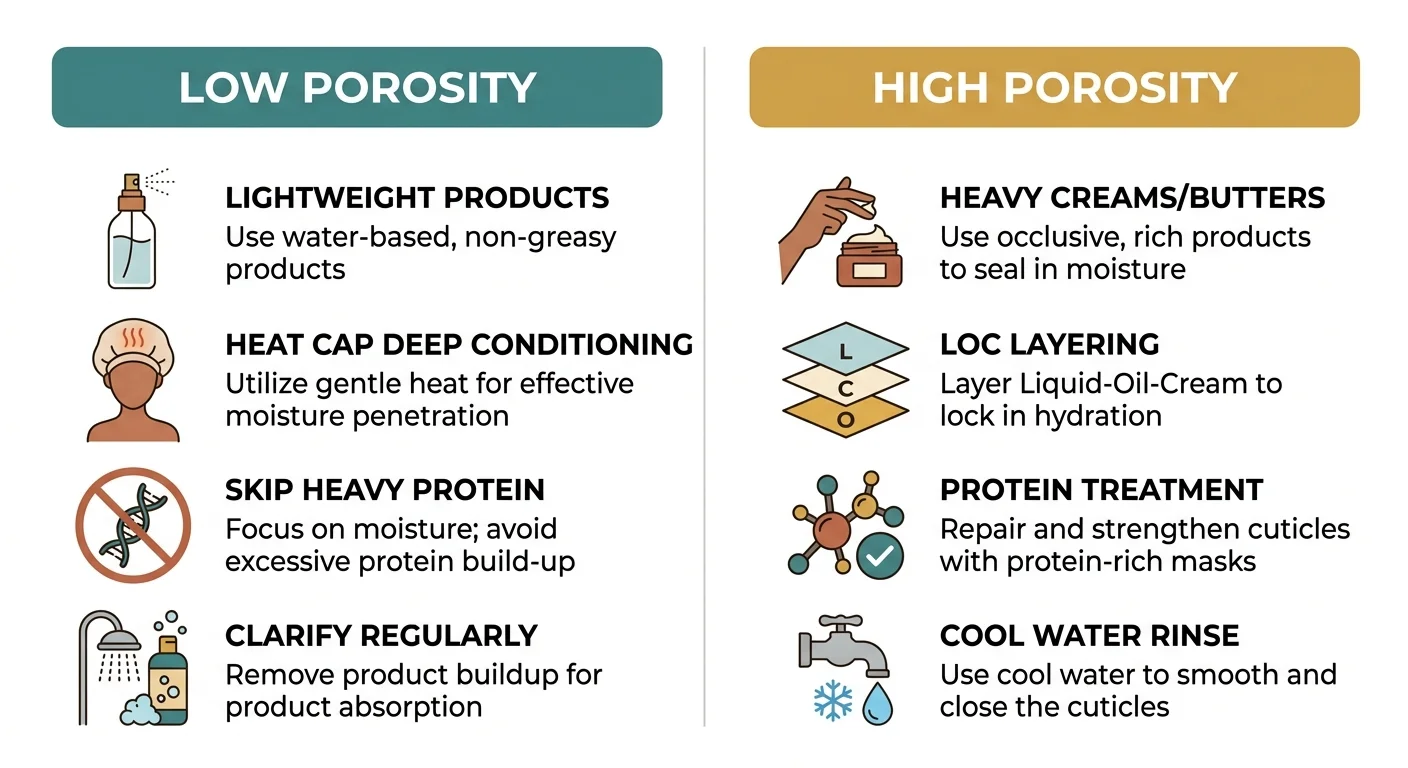
- Use lightweight, liquid-based products that won’t sit on top (avoid heavy butters and thick creams).
- Apply conditioner and masks to damp hair with gentle heat — a warm towel, hooded dryer, or steam cap helps open the cuticle for better absorption.
- Avoid protein-heavy products — low porosity hair is usually structurally intact and doesn’t need extra protein. Too much causes stiffness and breakage.
- Clarify every 2–3 weeks to prevent product buildup on the sealed cuticle surface.
High porosity care
- Focus on moisture retention — use heavier creams, butters, and oils that seal the cuticle and prevent moisture from escaping.
- The LOC (liquid, oil, cream) or LCO (liquid, cream, oil) layering method works well for trapping hydration inside the shaft.
- Protein treatments (every 2–4 weeks) help temporarily fill gaps in the damaged cuticle, improving moisture retention. See our best hair products page for treatment options.
- Rinse with cool water after conditioning — cold temperatures help close the cuticle and lock in moisture.
- Consider bond-repair treatments to rebuild internal structure, not just coat the surface. Browse our complete hair type guide for product pairing by type.
Common Mistakes With Hair Porosity
- Relying on the float test. As explained above, it’s influenced by surface tension, product residue, and strand thickness — not porosity. Use behavioral observations instead.
- Assuming porosity is uniform. Your roots, mid-lengths, and ends can all have different porosity levels. Color-treated or heat-damaged ends are almost always higher porosity than your virgin roots. Treat different sections of your hair accordingly.
- Treating porosity as permanent. Natural porosity is genetic, but it shifts with damage, chemical treatments, and age. High porosity from bleaching can be partially improved with protein treatments and bond repair. Reassess every few months.
- Loading low porosity hair with heavy products. Low porosity hair can’t absorb thick creams and butters — they just sit on top, weigh the hair down, and create buildup. Lightweight, water-based products in smaller amounts work far better.
- Skipping protein for high porosity hair. High porosity hair has structural gaps that protein treatments can temporarily fill. Without periodic protein, moisture passes straight through the hair without being retained. Balance protein treatments every 2–4 weeks with moisture-focused washes in between. For tool recommendations that protect high porosity hair, see our best hair tools guide.
What to Expect When You Start Working With Your Porosity
| Timeframe | What Changes |
|---|---|
| Week 1–2 | Products absorb more effectively. You’ll notice your hair responding differently — low porosity hair may feel lighter; high porosity hair retains softness longer after washing. |
| Week 3–4 | Less frizz, improved curl definition (if applicable), and reduced product waste — you’re using the right amounts of the right products now. |
| Month 2–3 | Visible improvement in overall hair health, shine, and manageability. Breakage decreases as moisture balance stabilizes. |
Final Thoughts: Hair Porosity Is Your Roadmap
Understanding your hair porosity transforms your routine from guesswork into strategy. It’s the reason why two people with the same curl type can have completely different product needs — one has low porosity and needs lightweight hydration with heat, the other has high porosity and needs heavy creams with protein support.
Skip the float test. Instead, observe how your hair interacts with water, products, and humidity over the course of normal wash days. Once you know your porosity, the right products, techniques, and application methods become obvious — and your results will follow within weeks.
Hair porosity isn’t a trend or a gimmick. It’s the most practical piece of information you can learn about your own hair, and adjusting your seasonal routine based on it will save you time, money, and frustration for years to come.