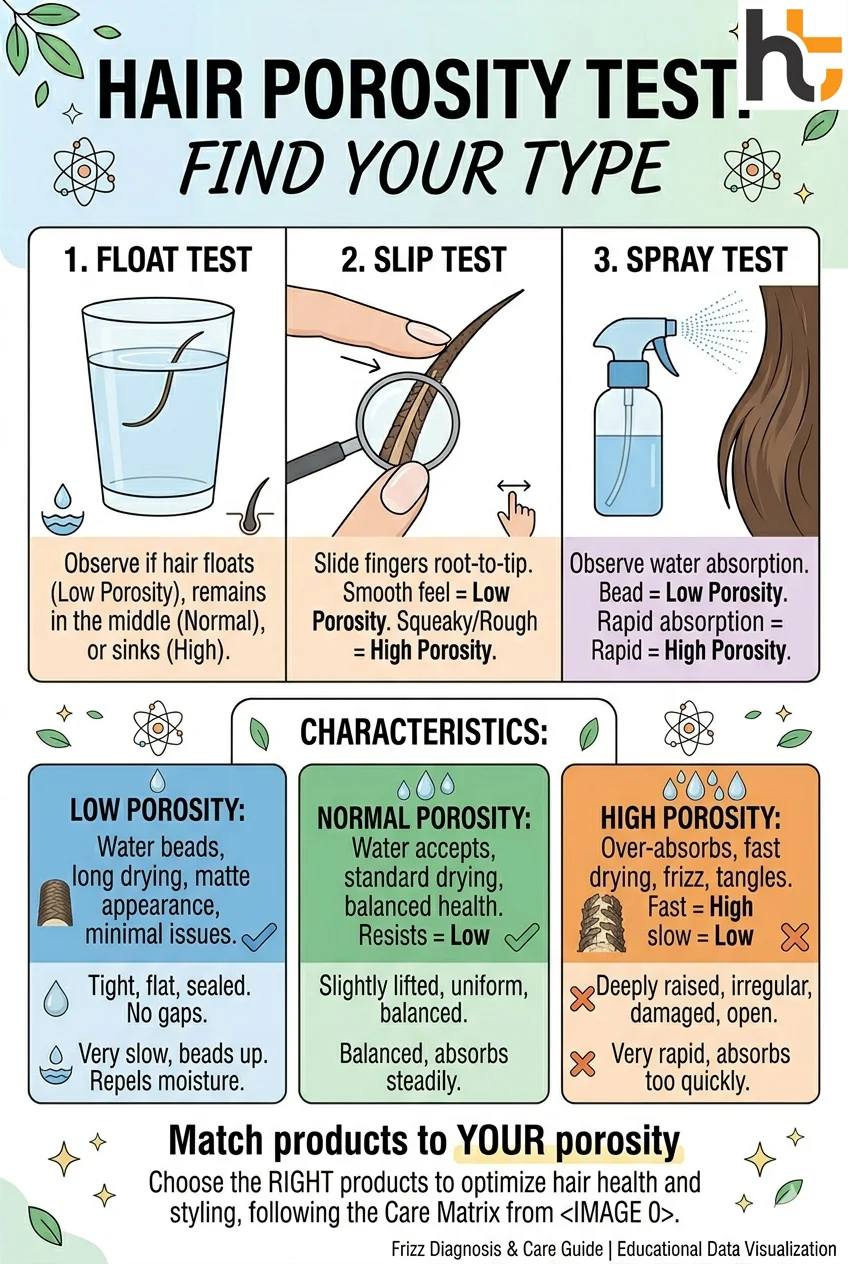
Hair porosity measures how easily your hair absorbs and holds moisture. It’s determined by the condition of your hair’s outer protective layer (cuticle). Understanding your porosity type is critical because it dictates which products work, how you should apply them, and which techniques give best results.
The hair porosity test helps you identify whether you have low, normal, or high porosity hair. Each type needs completely different care. Using products designed for the wrong porosity type wastes money and creates problems — buildup on low porosity, dryness on high porosity.
This guide gives you 5 different testing methods, explains what each porosity type means, and provides specific care recommendations.
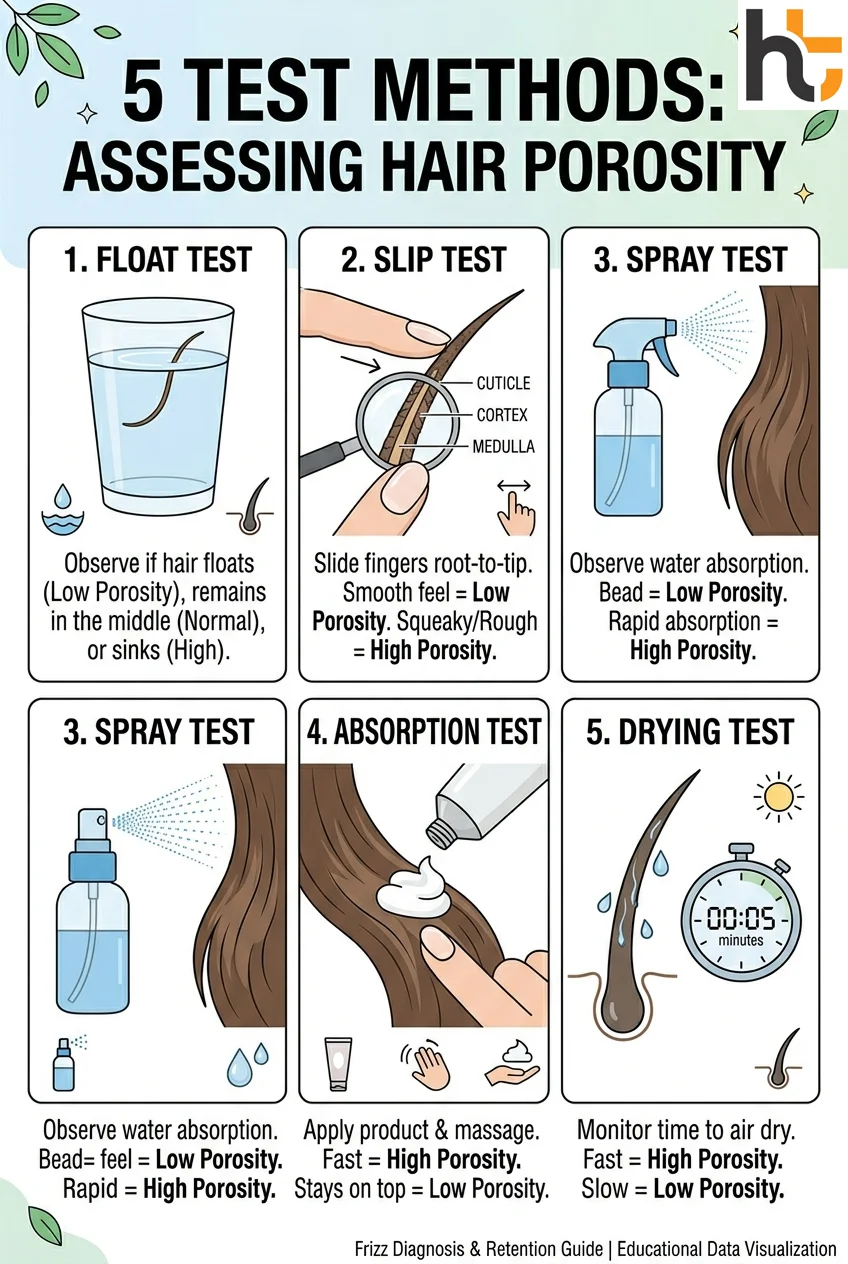
Quick Answer: Hair porosity test methods: (1) Float test – hair in water, (2) Slip/slide test – finger down strand, (3) Spray bottle test – how fast water absorbs, (4) Absorption test – product application speed, (5) Drying time test. Low porosity = slow absorption/drying, tight cuticles. High porosity = fast absorption, raised cuticles. Normal = moderate both ways.
Table of Contents
What Is Hair Porosity?
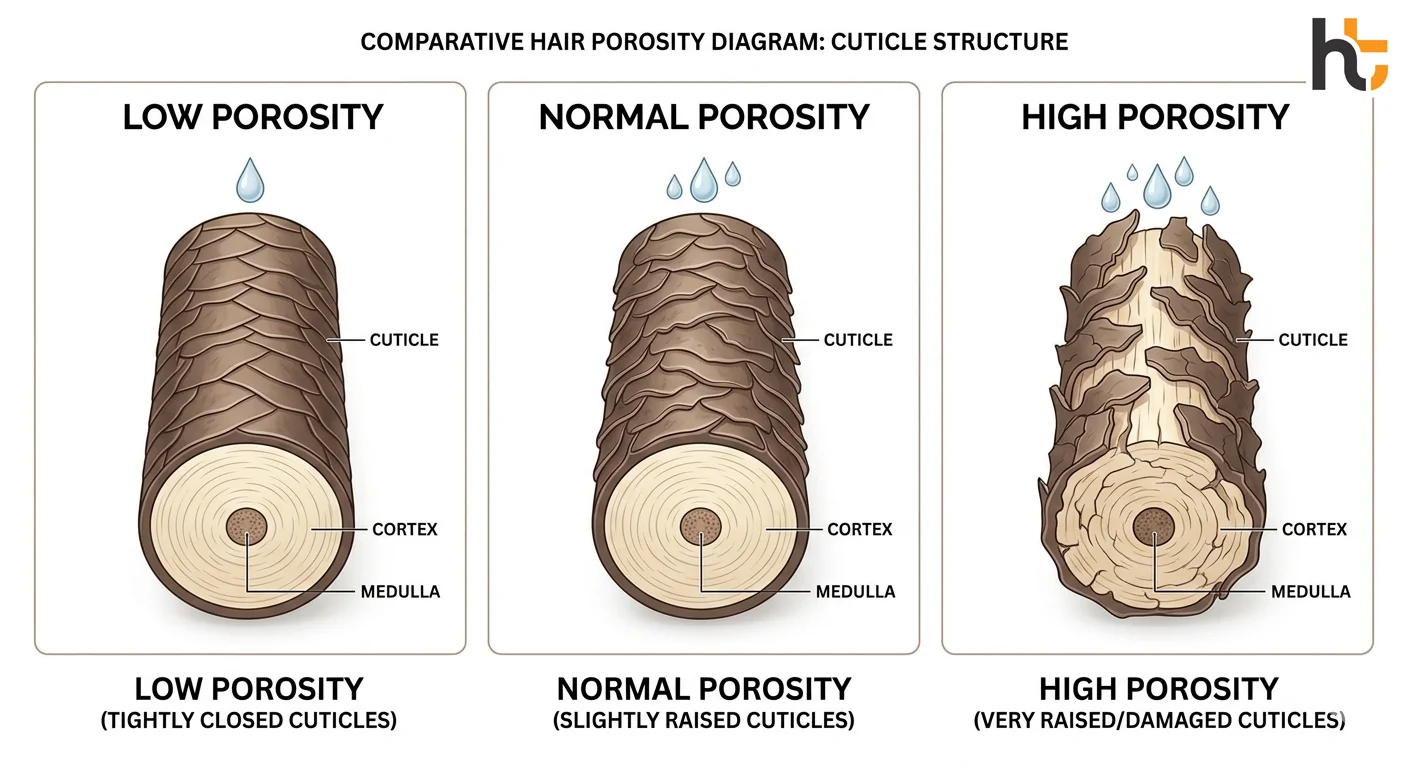
Porosity refers to your hair’s ability to absorb and retain moisture. It’s determined by the cuticle layer — the overlapping scales that protect the inner cortex.
Low porosity: Cuticles lie flat and tight. Hard for moisture to enter, but once in, stays well.
Normal porosity: Cuticles slightly raised. Allows moisture in easily and retains it well. Balanced.
High porosity: Cuticles very raised or damaged with gaps. Moisture enters easily but escapes just as fast.
Research shows porosity significantly affects how hair responds to chemical treatments, styling products, and environmental conditions [IJCS].
Test #1: The Float Test (Most Popular)
This is the most well-known hair porosity test, though not the most accurate.
How to Do It
- Get a strand of clean, product-free hair (shed hair from brush is fine)
- Fill a glass with room temperature water
- Drop the strand into water
- Wait 2-4 minutes
- Observe where hair settles
Results
- Floats on top: Low porosity (cuticles so tight, water can’t penetrate to weigh it down)
- Floats in middle: Normal porosity (some water absorption, balanced weight)
- Sinks to bottom: High porosity (absorbs water quickly, becomes heavy)
Limitations
This test can give false results if:
- Hair has product residue (affects how it floats)
- Water has high mineral content
- Strand is very short or very long (affects buoyancy)
Use this as initial screening, confirm with other tests.
Test #2: The Slip and Slide Test (Most Accurate)
This physical test directly assesses cuticle condition.
How to Do It
- Take a single strand of hair
- Hold one end firmly
- With your other hand, slide your fingers from end toward scalp (against the grain)
- Feel the texture
Results
- Very smooth, fingers glide easily: Low porosity (cuticles lie completely flat)
- Slight bumpy texture, some resistance: Normal porosity (cuticles slightly raised)
- Very bumpy/rough, significant resistance: High porosity (cuticles very raised or damaged)
Why This Works
You’re physically feeling the cuticle condition. Flat cuticles feel smooth. Raised cuticles feel rough. This is direct assessment.
Test #3: The Spray Bottle Test
This tests how quickly your hair absorbs water.
How to Do It
- Spray a section of dry, clean hair lightly with water
- Observe how water behaves
- Time how long until hair feels wet (not just surface damp)
Results
- Water beads up on surface, takes 5+ minutes to absorb: Low porosity
- Water absorbs within 1-3 minutes evenly: Normal porosity
- Water absorbs immediately, hair feels soaked instantly: High porosity
Test #4: The Product Absorption Test
Real-world test using your actual products.
How to Do It
- Apply leave-in conditioner or moisturizer to clean, damp hair
- Observe how quickly it absorbs
- Check hair 10 minutes later
Results
- Product sits on surface, hair looks/feels coated: Low porosity (cuticles won’t let product in)
- Product absorbs within 5-10 minutes, hair feels moisturized: Normal porosity
- Product disappears immediately, hair feels dry again within 30 min: High porosity (absorbs then loses moisture fast)
Test #5: The Drying Time Test
How long hair takes to air dry reveals porosity.
How to Do It
- Wash hair normally
- Gently squeeze out excess water (don’t towel dry)
- Let air dry completely with no products
- Time how long it takes
Results
- Takes 3-4+ hours to dry completely: Low porosity (water trapped inside sealed cuticles)
- Dries in 1.5-2.5 hours: Normal porosity
- Dries very quickly, under 1 hour: High porosity (water evaporates through gaps easily)
Note: Thickness affects this too. Adjust expectations: thick hair takes longer regardless of porosity.
What Your Results Mean
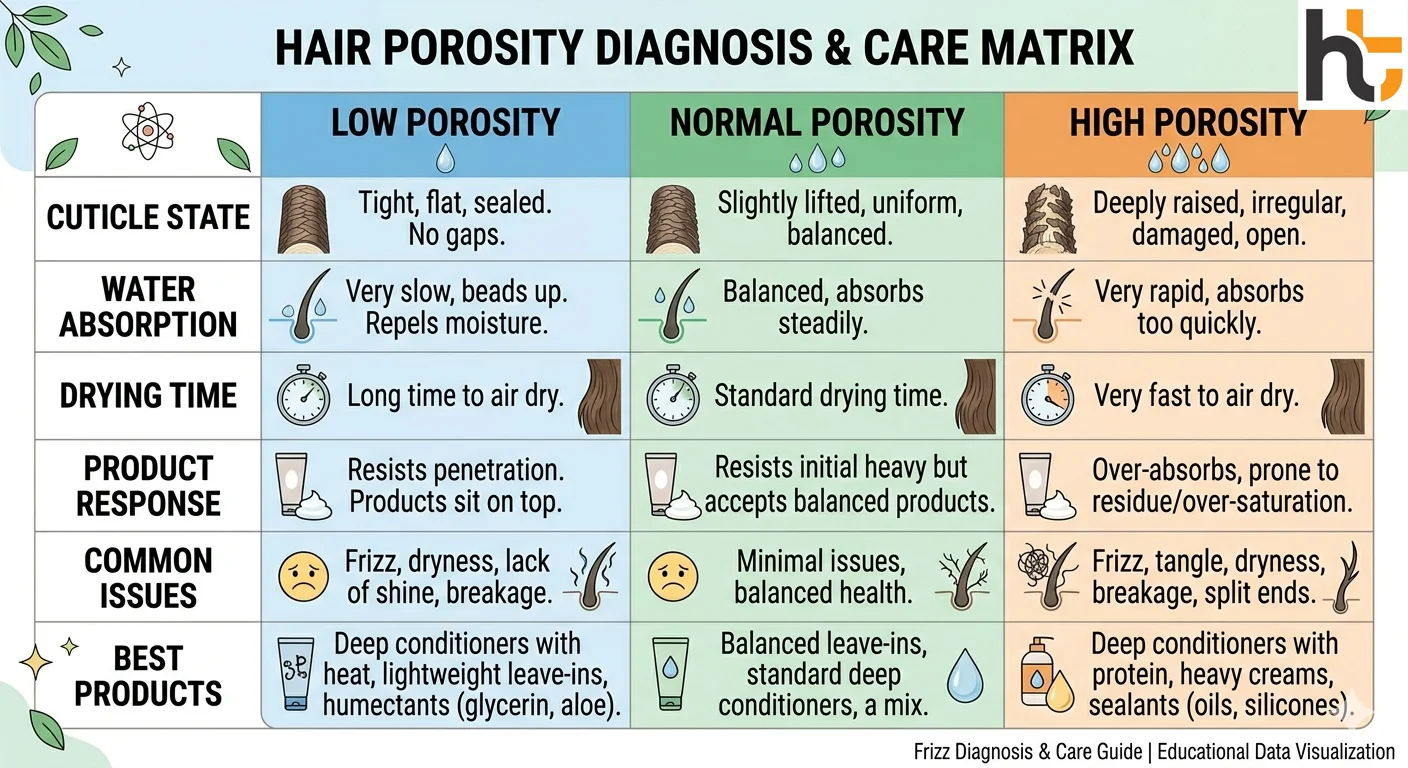
Low Porosity Hair
Characteristics:
- Products sit on surface, create buildup easily
- Takes forever to get wet in shower
- Dries slowly (3-4+ hours)
- Resistant to chemical processing (color doesn’t take well)
- Doesn’t respond well to protein treatments
- Often healthy, shiny (cuticles intact)
Causes: Usually genetic. Can also result from very gentle hair care that preserves cuticles perfectly.
Challenges: Getting moisture IN. Products don’t penetrate easily.
See our low porosity hair products guide for specific recommendations.
Normal Porosity Hair
Characteristics:
- Products absorb well without buildup
- Gets wet easily, dries in reasonable time
- Takes color and chemical treatments predictably
- Responds well to most products
- Maintains moisture balance
- Generally healthy, manageable
Causes: Genetic or result of good hair care maintaining healthy cuticles.
Advantage: Most products work. Easiest porosity to manage.
High Porosity Hair
Characteristics:
- Absorbs products instantly
- Gets soaking wet immediately
- Dries very fast
- Feels dry/rough despite moisturizing
- Color fades quickly
- Tangles easily
- Often frizzy
- Prone to breakage
Causes: Usually damage from heat, chemicals, mechanical stress. Can be genetic but less common.
Challenges: KEEPING moisture in. Hair absorbs easily but releases just as fast.
For frizz management with high porosity, see our frizzy hair solutions guide.
Care Recommendations by Porosity Type
For Low Porosity
Products:
- Lightweight, water-based formulas
- Avoid heavy oils, butters (create buildup)
- Use heat with deep conditioning (opens cuticles temporarily)
- Clarifying shampoo every 2-3 weeks
- Humectants (glycerin, aloe) over heavy moisturizers
Techniques:
- Apply products to soaking wet hair
- Use steam or heat cap with treatments
- Layer products: lightest to heaviest
- Avoid protein-heavy products (causes stiffness)
For Normal Porosity
Products:
- Most products work well
- Balance of moisture and protein
- Medium-weight formulas ideal
- Regular deep conditioning maintains health
Techniques:
- Standard application methods work
- Focus on maintaining current health
- Prevent damage (heat protection, gentle handling)
For High Porosity
Products:
- Heavy, sealing products (butters, thick oils)
- Protein treatments to fill gaps (weekly to bi-weekly)
- Acidic rinses (ACV, pH-balancing conditioners)
- Leave-in conditioners are essential
- Anti-humectants in humid weather
Techniques:
- LOC or LCO method (Liquid, Oil, Cream layering)
- Seal everything with oil or butter
- Protein treatments regularly
- pH-balancing products to temporarily close cuticles
For protein-moisture balance specific to your porosity, see our protein vs moisture balance guide.
Can Porosity Change?
Yes, but usually only in one direction: low/normal → high.
Damage increases porosity: Heat, chemicals, mechanical stress all raise cuticles permanently. You can go from low to high through damage.
Porosity rarely decreases: Once cuticles are damaged/raised, they don’t repair themselves. You can temporarily smooth them (acidic rinses, proteins) but can’t permanently return to low porosity.
Different sections = different porosity: Your ends (oldest) are often higher porosity than roots (newest). This is normal.
Common Mistakes
Mistake #1: Self-Diagnosing Based on Hair Type
Curly hair isn’t automatically high porosity. Straight hair isn’t automatically low. Test your actual hair.
Mistake #2: Using One Test Only
The float test alone can mislead. Use multiple tests for accurate results.
Mistake #3: Ignoring Porosity When Choosing Products
This is why products that work for others don’t work for you. Porosity matters more than curl pattern for product selection.
Mistake #4: Treating All Hair the Same
Your roots may be low porosity while ends are high. Adjust application — lighter products at roots, heavier at ends.
Quick Reference Guide
| If Your Hair… | You Likely Have… | You Need… |
|---|---|---|
| Takes forever to dry, products sit on surface | Low porosity | Lightweight products, heat with treatments |
| Behaves predictably, products work | Normal porosity | Maintain current routine, prevent damage |
| Dries fast, always feels dry, frizzy | High porosity | Heavy sealers, protein, moisture retention focus |
Final Thoughts
Taking a hair porosity test using multiple methods gives you critical information for choosing the right products and techniques. Low porosity needs lightweight, heat-activated care. High porosity needs heavy, sealing, protein-rich care. Normal porosity needs balanced maintenance.
Stop guessing why products don’t work. Test your porosity. Match your routine to your results. Your hair will respond immediately when you give it what it actually needs.
For complete hair type understanding including texture and curl pattern, see our complete hair type guide.