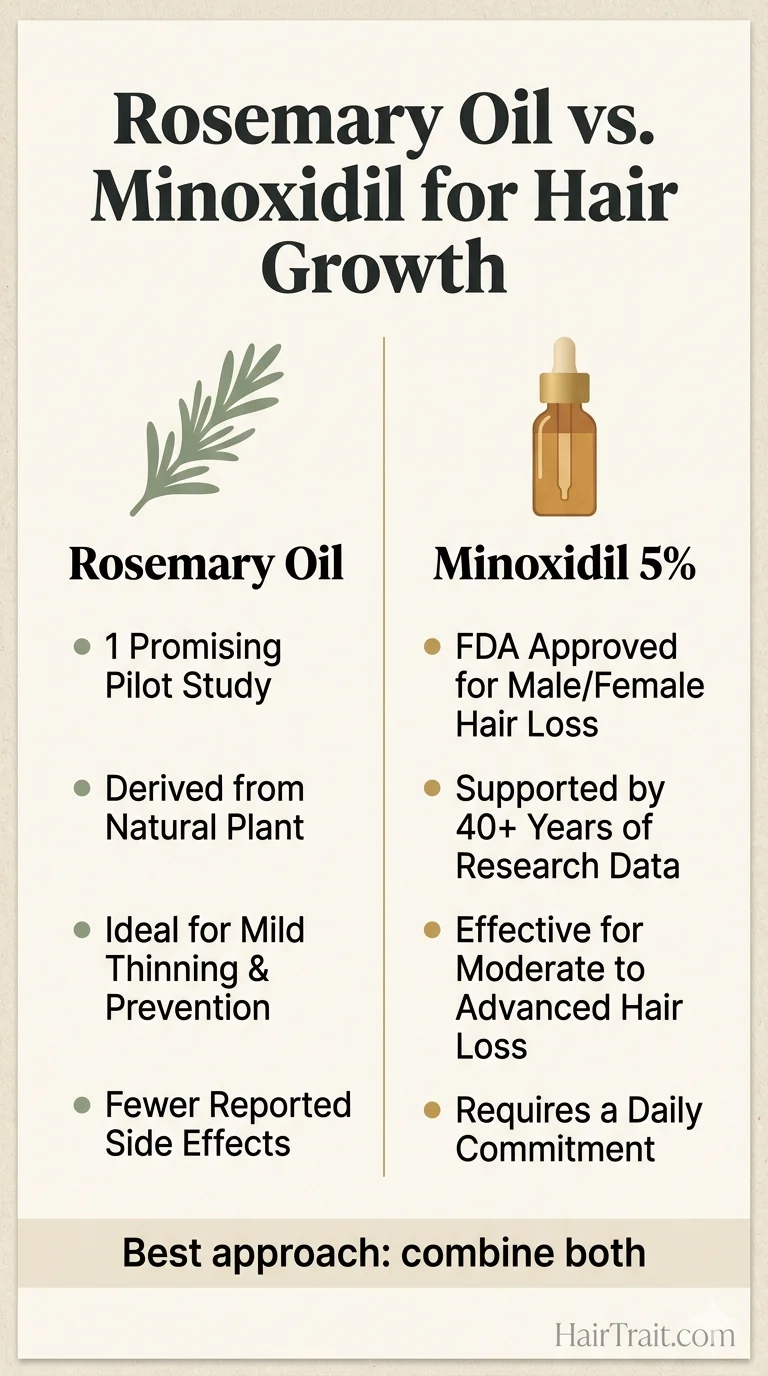
The rosemary oil vs minoxidil debate has exploded online, fueled by TikTok trends and a single study that many people have misinterpreted. If you search this topic, you’ll find confident claims that rosemary oil is “just as good” as minoxidil — a statement that requires serious context before you act on it.
Rosemary oil vs minoxidil is not a simple either/or decision. These two treatments work through different mechanisms, have different levels of scientific backing, and suit different stages of hair loss. This article walks through the actual research, sets realistic expectations, and helps you decide which approach fits your situation.
Quick Answer: One clinical trial from 2015 found that rosemary oil performed comparably to 2% minoxidil after six months for androgenetic alopecia, with less scalp itching. However, minoxidil has decades of research, FDA approval, and is available in a stronger 5% formula that outperforms the 2% version tested against rosemary oil. Rosemary oil is a reasonable option for mild thinning or as a supplement, but for moderate to advanced hair loss, minoxidil remains the stronger evidence-based choice.
Table of Contents
The Study Everyone References
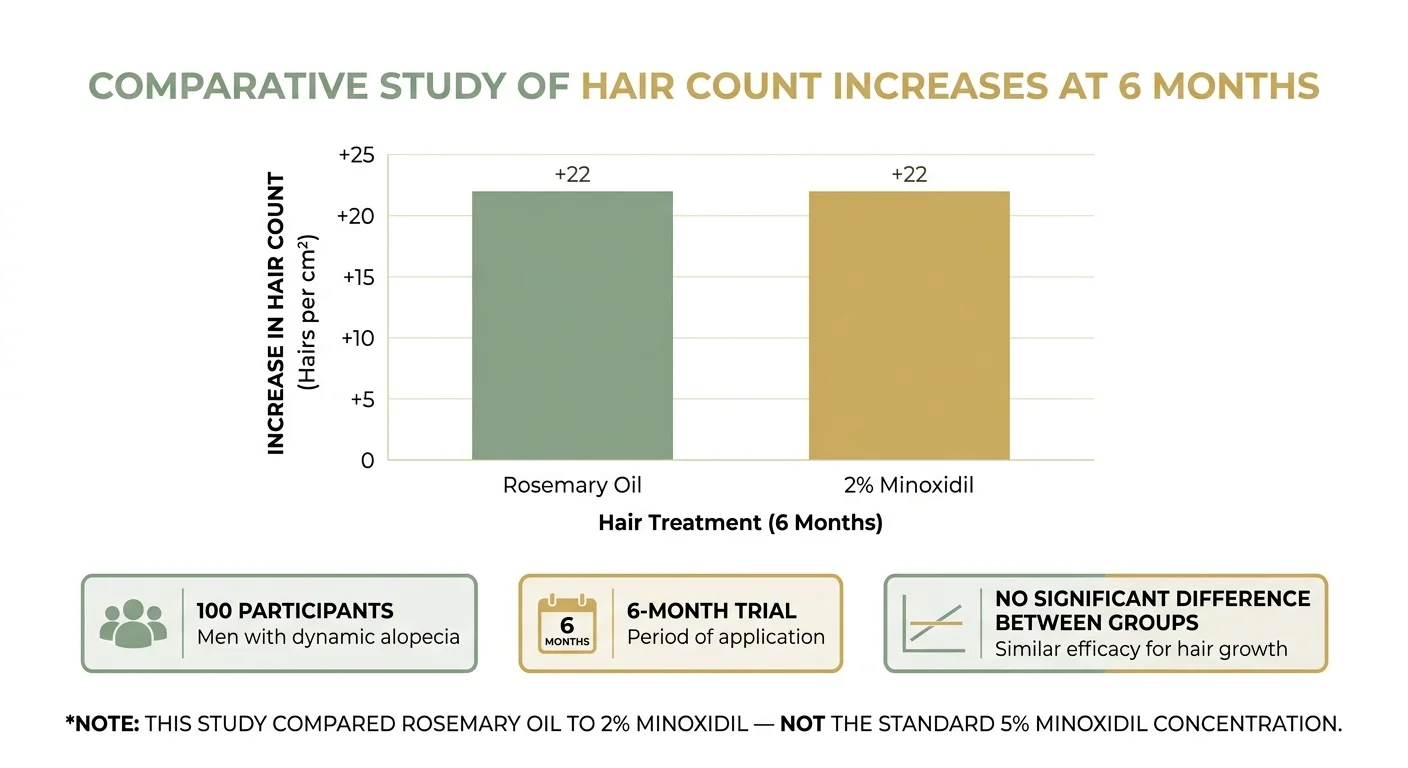
Nearly every rosemary oil claim traces back to one study: a 2015 randomized clinical trial published in the journal SKINmed. Here’s what the study actually found:
- Participants: 100 men with androgenetic alopecia (male pattern baldness).
- Groups: One group applied rosemary oil topically, the other applied 2% minoxidil solution. Both applied their treatment twice daily for six months.
- Results: Both groups showed a significant increase in hair count at six months compared to baseline. The difference between groups was not statistically significant — meaning rosemary oil performed comparably to 2% minoxidil.
- Side effects: The minoxidil group reported more frequent scalp itching.
This is a legitimate study, and the results are encouraging for rosemary oil. But context matters enormously.
Why the Study Has Limits
Before declaring rosemary oil a minoxidil replacement, there are important caveats:
- It was compared to 2% minoxidil, not 5%. The standard over-the-counter minoxidil sold today is 5%, which multiple studies show is significantly more effective than the 2% version. No study has compared rosemary oil to 5% minoxidil.
- Sample size was small. 100 participants split into two groups means only 50 people per treatment arm. Larger trials are needed to confirm the results.
- Only one study exists. Minoxidil has been studied in dozens of large-scale clinical trials over 40+ years. Rosemary oil has this single direct comparison. One positive study is promising, not conclusive.
- Participants were all men with androgenetic alopecia. The results may not apply to female pattern hair loss, telogen effluvium, alopecia areata, or traction alopecia — all of which have different underlying mechanisms.
- Concentration and formulation varied. The study used pure rosemary essential oil diluted in a carrier. Many commercial “rosemary oil” products use different concentrations, formulations, or rosemary water (which has far less active compound).
How Each Treatment Works
Minoxidil
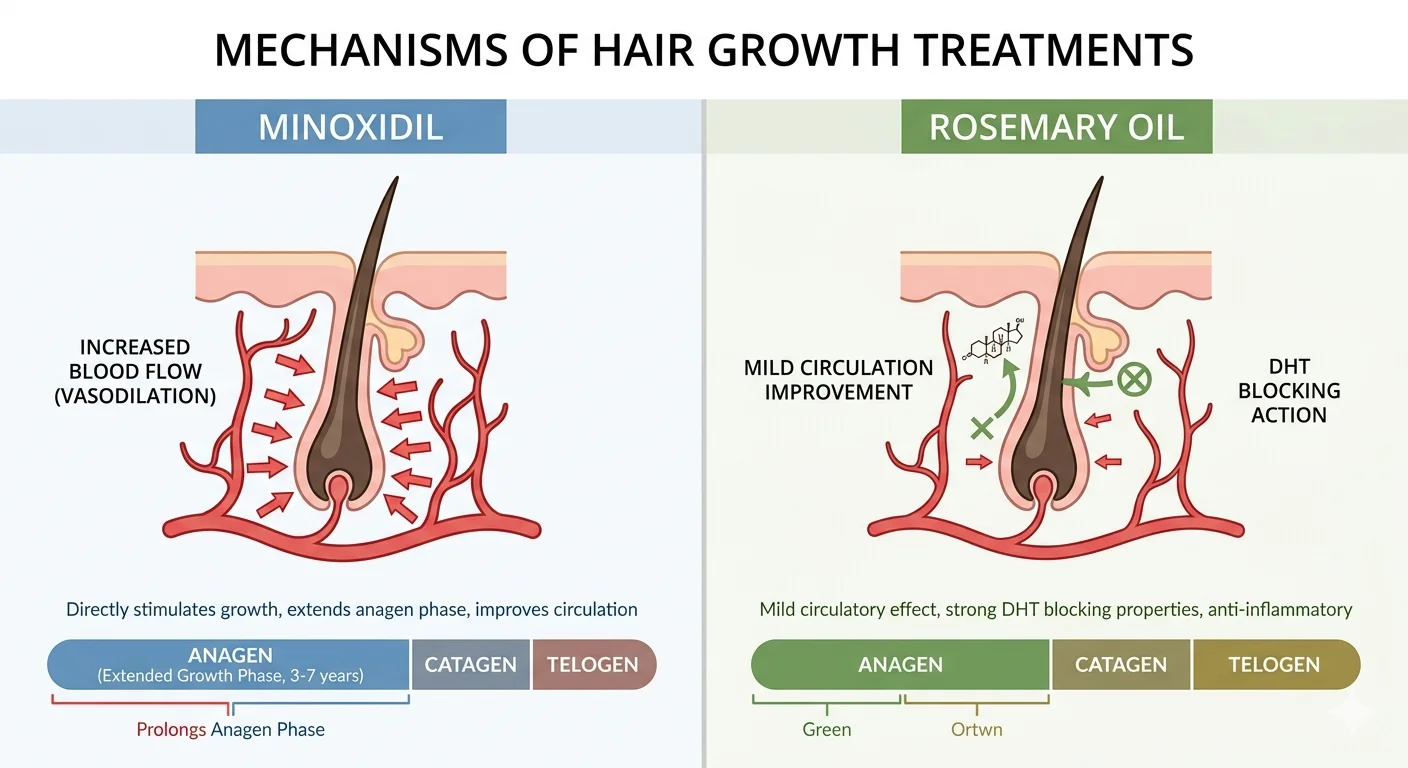
Minoxidil is an FDA-approved topical treatment that works by widening blood vessels around hair follicles, improving nutrient and oxygen delivery. It also extends the growth phase (anagen) of the hair cycle. Available as a 2% or 5% solution or foam, it requires consistent daily application for results. If you stop using it, regrowth typically reverses within 3–6 months. For a broader look at hair loss treatments, visit our hair care basics guide.
Rosemary oil
Rosemary oil contains compounds like carnosic acid, rosmarinic acid, and 1,8-cineole that may improve scalp circulation and inhibit 5-alpha reductase — the enzyme that converts testosterone to DHT, the hormone primarily responsible for androgenetic alopecia. In theory, this mechanism is similar to finasteride (an oral DHT blocker), but the topical effect of rosemary oil is far weaker and less studied. Research published in Phytotherapy Research supports rosemary extract’s potential anti-androgenic properties, but again, human data is limited.
Rosemary Oil vs Minoxidil: Full Comparison
| Factor | Minoxidil (5%) | Rosemary Oil |
|---|---|---|
| FDA approved | Yes — for both men and women | No — classified as a supplement/essential oil |
| Clinical evidence | Extensive — 40+ years, dozens of trials | Limited — 1 direct comparison (vs. 2% minoxidil) |
| How it works | Vasodilation + extends anagen phase | May improve circulation + mild DHT inhibition |
| Time to see results | 3–6 months of consistent use | 3–6 months (based on the single study) |
| Common side effects | Scalp irritation, initial shedding, unwanted facial hair | Scalp irritation if undiluted; generally well tolerated when diluted |
| Application | 1–2× daily, topical solution or foam | 2–3× weekly scalp massage, diluted in carrier oil |
| Cost (monthly) | $10–25 (generic) / $30–50 (brand) | $5–15 for essential oil + carrier oil |
| Requires ongoing use? | Yes — results reverse if stopped | Likely — though cessation data doesn’t exist |
| Best for | Moderate to advanced androgenetic alopecia | Mild thinning, general scalp health, those avoiding pharmaceuticals |
Who Should Choose Which
Choose minoxidil if:
- You have moderate to advanced hair thinning or a receding hairline.
- You want the strongest evidence-based treatment available over the counter.
- You’re comfortable with daily application as a long-term commitment.
- You want something that works for both male and female pattern hair loss.
Choose rosemary oil if:
- Your thinning is mild and you’ve caught it early.
- You prefer a natural approach and accept that the evidence is preliminary.
- You’ve experienced irritation or side effects from minoxidil.
- You want a scalp health supplement alongside other treatments.
Or combine them
There’s no evidence that rosemary oil interferes with minoxidil. Some people use minoxidil as their primary treatment and add rosemary oil scalp massages on alternating days for added circulation benefits. If you go this route, apply them at separate times — not mixed together — to ensure each product absorbs properly. Learn more about building a routine that works in our complete hair type guide.
Common Mistakes With Rosemary Oil and Minoxidil
- Applying undiluted rosemary oil directly to your scalp. Essential oils are concentrated and can cause chemical burns, redness, and irritation. Always dilute rosemary oil in a carrier oil (jojoba, coconut, or almond) at a ratio of roughly 3–5 drops per tablespoon of carrier oil.
- Confusing rosemary water with rosemary oil. Many TikTok tutorials show people spraying rosemary water (made by boiling rosemary leaves) on their scalp. This contains a tiny fraction of the active compounds found in distilled rosemary essential oil. The study used essential oil, not rosemary-infused water.
- Expecting overnight results from either treatment. Both minoxidil and rosemary oil require 3–6 months of consistent use before visible results. Minoxidil often causes temporary increased shedding in the first 2–8 weeks — this is a sign it’s working, not failing.
- Stopping minoxidil abruptly after seeing results. Minoxidil-dependent hair growth reverses within months of discontinuation. If you start it, plan for long-term use or discuss alternatives with a dermatologist.
- Ignoring the underlying cause of hair loss. If your hair loss is caused by thyroid issues, iron deficiency, autoimmune conditions, or medication side effects, neither minoxidil nor rosemary oil addresses the root cause. See a dermatologist before self-treating. Check our best hair products page for supportive care recommendations.
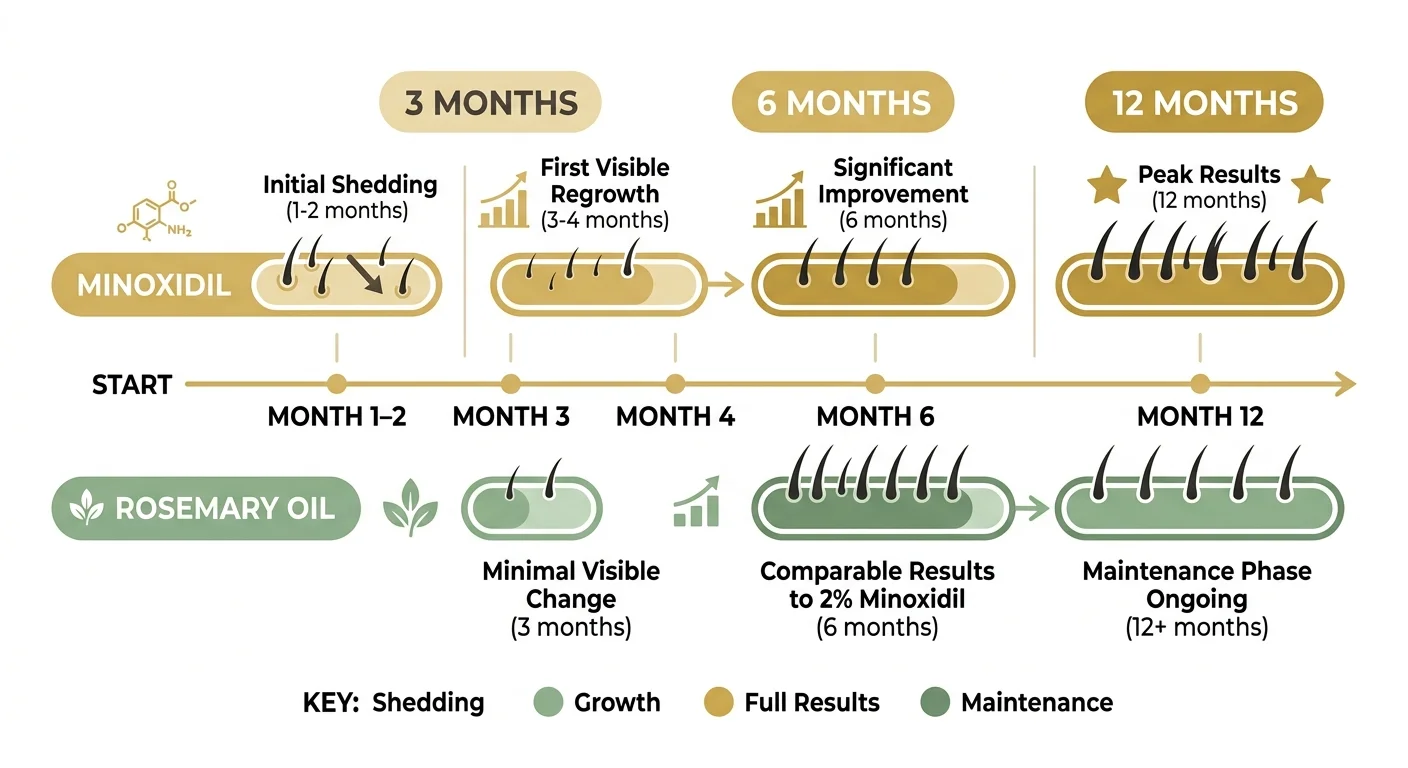
What to Expect: Realistic Results
| Timeframe | Minoxidil 5% | Rosemary Oil |
|---|---|---|
| Month 1–2 | Temporary increased shedding (normal). Scalp may feel tingly or dry. | No visible changes. Scalp may feel invigorated after massage. |
| Month 3–4 | Fine vellus hairs begin appearing in thinning areas. Shedding normalizes. | Possible slight reduction in shedding. No major visible regrowth yet. |
| Month 6 | Noticeable regrowth in 40–60% of users. Hair feels thicker. | Study showed comparable hair count increase to 2% minoxidil at this point. |
| Month 12+ | Peak results. Ongoing use required to maintain. | Long-term data not available. Likely requires continued use. |
Important caveat: neither treatment works for everyone. Roughly 30–40% of minoxidil users see minimal improvement, and rosemary oil response rates are even less documented. If you see no improvement after 6 months of consistent use, consult a dermatologist to explore other options like finasteride, PRP therapy, or microneedling. For protecting your existing hair during treatment, see our best hair tools recommendations.
Final Verdict: Rosemary Oil vs Minoxidil
The rosemary oil vs minoxidil comparison is not a fair fight in terms of evidence. Minoxidil has decades of clinical data, FDA approval, and a proven mechanism. Rosemary oil has one encouraging small study and a plausible but under-researched mechanism. Calling them equivalent based on current evidence overstates what we know.
That said, rosemary oil is not snake oil. It shows genuine promise, has fewer side effects, costs less, and may be a reasonable first step for mild thinning — especially if you prefer natural approaches. The smartest play for someone with noticeable thinning: start with minoxidil for the strongest proven results, and supplement with rosemary oil scalp massages for added circulation and scalp health benefits.
Whatever path you choose, commit to 6 full months before judging effectiveness, keep your expectations grounded in the actual research, and adjust your seasonal hair care routine to support the process. If hair loss is progressing rapidly, skip the internet debate and see a dermatologist — they can identify the cause and recommend the most effective treatment for your specific situation.