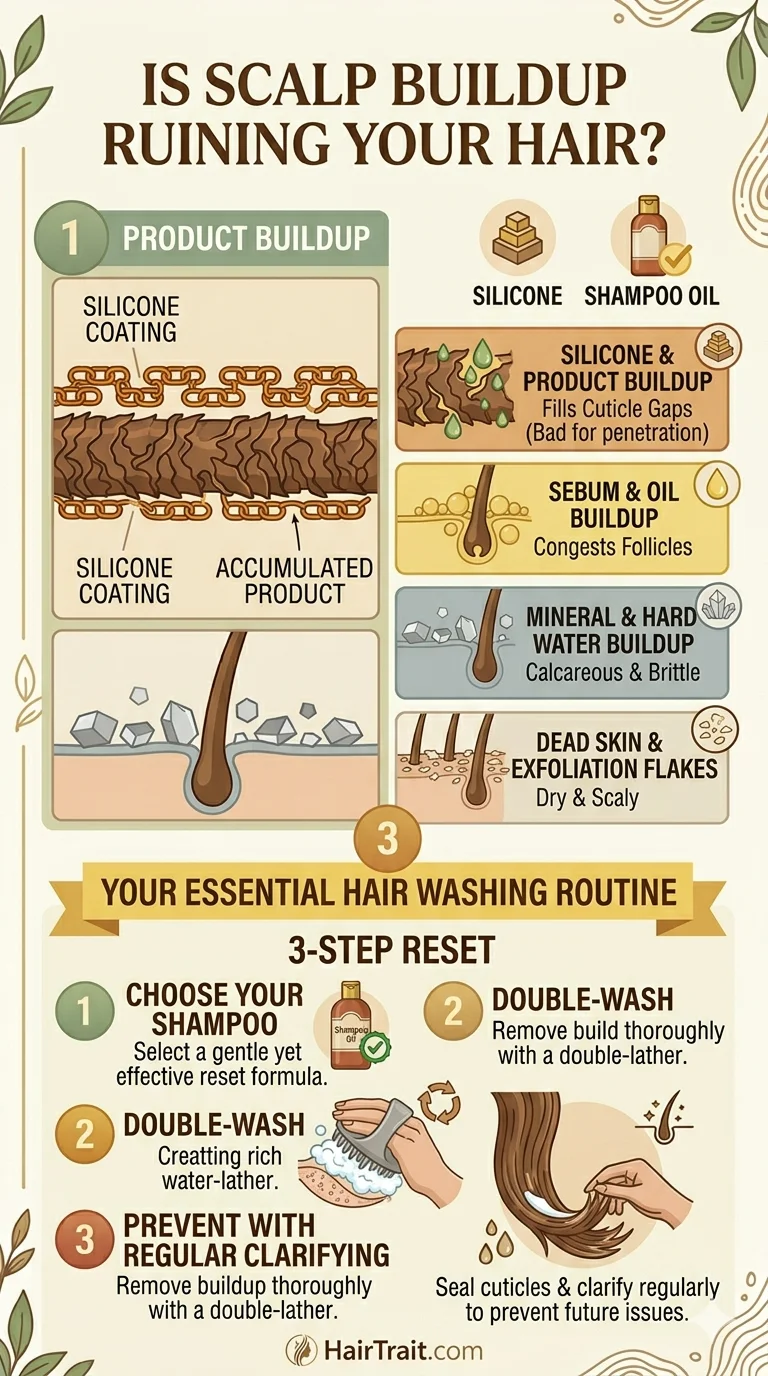
Quick Answer: Scalp buildup is the accumulation of product residue, excess sebum, dead skin cells, and/or mineral deposits on the scalp surface. It causes itching, flaking, dullness, flat hair, and can even contribute to hair thinning if left untreated. There are four distinct types — product buildup, sebum buildup, mineral buildup, and dead skin buildup — and each requires a different removal approach. A clarifying shampoo handles product and sebum buildup, a chelating shampoo targets minerals, and a salicylic acid treatment addresses dead skin.
Scalp buildup is one of those problems that accumulates so gradually you don’t realize it’s happening until your hair consistently looks flat, your scalp itches despite using gentle shampoo, and your conditioner seems to have stopped working. It’s one of the most common issues discussed on hair care forums — and one of the most frequently misdiagnosed.
People often confuse scalp buildup with dandruff, dry scalp, or product sensitivity because the symptoms overlap. But the treatment for each type of scalp buildup is different, and using the wrong approach wastes time and money. This guide helps you identify which type you have and gives you the exact steps to clear it.
Table of Contents
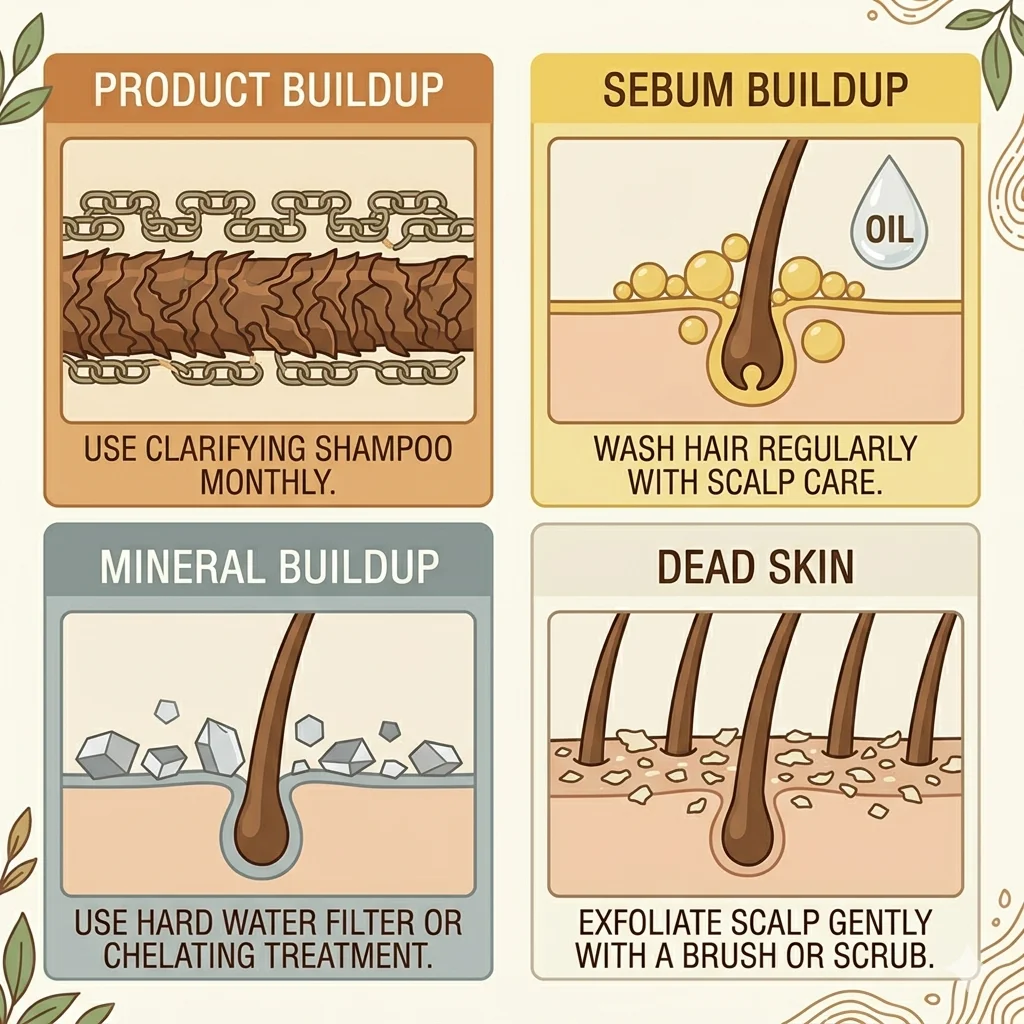
The Four Types of Scalp Buildup
Not all buildup is created equal. Understanding which type is causing your symptoms determines which treatment will actually work.
| Type | What It Is | Feels Like | How to Remove |
|---|---|---|---|
| Product buildup | Residue from silicones, waxes, polymers, and heavy styling products that don’t wash out fully with gentle shampoo | Hair feels coated, heavy, “dirty” even after washing. Scalp may feel slightly greasy or waxy. | Clarifying shampoo with sulfates (SLS/SLES) |
| Sebum buildup | Excess natural oil that accumulates between washes, especially in people who wash infrequently or skip shampoo | Oily, flat roots. Hair clumps near the scalp. Slight odor possible. | Regular shampooing; clarifying shampoo for heavy accumulation |
| Mineral buildup | Calcium, magnesium, and iron deposits from hard water that coat the scalp and hair shaft | Scalp feels tight or flaky. Hair is stiff and dull. Products stop absorbing properly. | Chelating shampoo (EDTA-based); ACV rinse |
| Dead skin buildup | Normal cell turnover that isn’t being cleared — dead skin cells accumulate on the scalp surface | Visible white flakes (not dandruff — no redness or fungal involvement). Mild itching. | Scalp exfoliant or salicylic acid shampoo |
Most people have a combination of two or more types, especially if they have hard water and use silicone-based products while washing every 2–3 days. The layering effect — mineral deposits trapping product residue trapping dead skin — creates a compound problem that a single product type can’t solve alone.
Signs You Have Scalp Buildup
Scalp buildup shares symptoms with several other scalp conditions, which is why it’s often misidentified. Here are the specific signs that point to buildup rather than dandruff, psoriasis, or seborrheic dermatitis:
- Hair looks and feels dirty within 24 hours of washing — even with a good shampoo. This is the most common complaint and strongly suggests product or sebum buildup.
- Your scalp itches but isn’t red or inflamed. Buildup-related itching is mechanical irritation, not an immune response. If your scalp is red, has thick plaques, or is flaking in large oily patches, you may have seborrheic dermatitis — which requires a different treatment approach.
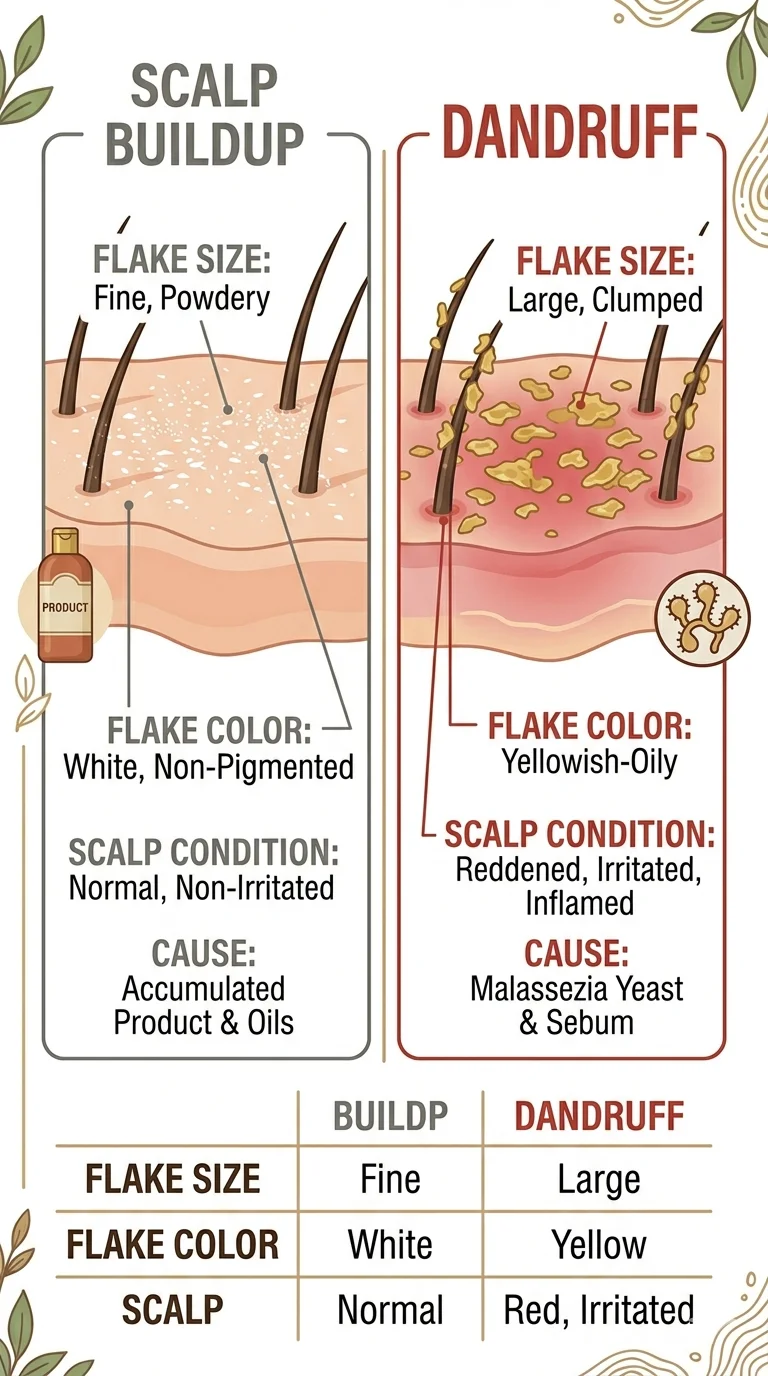
- White flakes that are dry and powdery. Dead skin buildup produces fine white flakes that brush off easily. Dandruff flakes tend to be larger, yellowish, and oily because they involve fungal overgrowth (Malassezia).
- Flat, lifeless hair with no volume at the roots. Buildup weighs hair down from the scalp outward, collapsing root lift.
- Products stop working. When your scalp and hair are coated in residue, new products can’t reach the surface to do their job. If your favorite shampoo and conditioner suddenly feel ineffective, buildup is likely the reason.
- Your hair feels different when you travel. If your hair feels noticeably better when you wash it in a different city (hotel shower), your home water’s mineral content is likely causing buildup. Read our hair care basics guide for water quality tips.
How to Remove Scalp Buildup: Step-by-Step
Step 1: Identify your primary type
Use the table above and the symptom checklist to determine whether your buildup is mostly product-based, sebum-based, mineral-based, or dead-skin-based. If you’re unsure, start with a clarifying wash — it addresses the most common type and gives you a clean baseline.
Step 2: Choose the right shampoo
| Buildup Type | Shampoo Type | Key Ingredient to Look For |
|---|---|---|
| Product buildup | Clarifying shampoo | Sodium lauryl sulfate (SLS) or sodium laureth sulfate (SLES) |
| Sebum buildup | Clarifying or regular sulfate shampoo | Any effective surfactant; shampoo more frequently |
| Mineral buildup | Chelating shampoo | EDTA, phytic acid, or citric acid |
| Dead skin buildup | Exfoliating scalp treatment | Salicylic acid (BHA), glycolic acid, or physical scalp scrub |
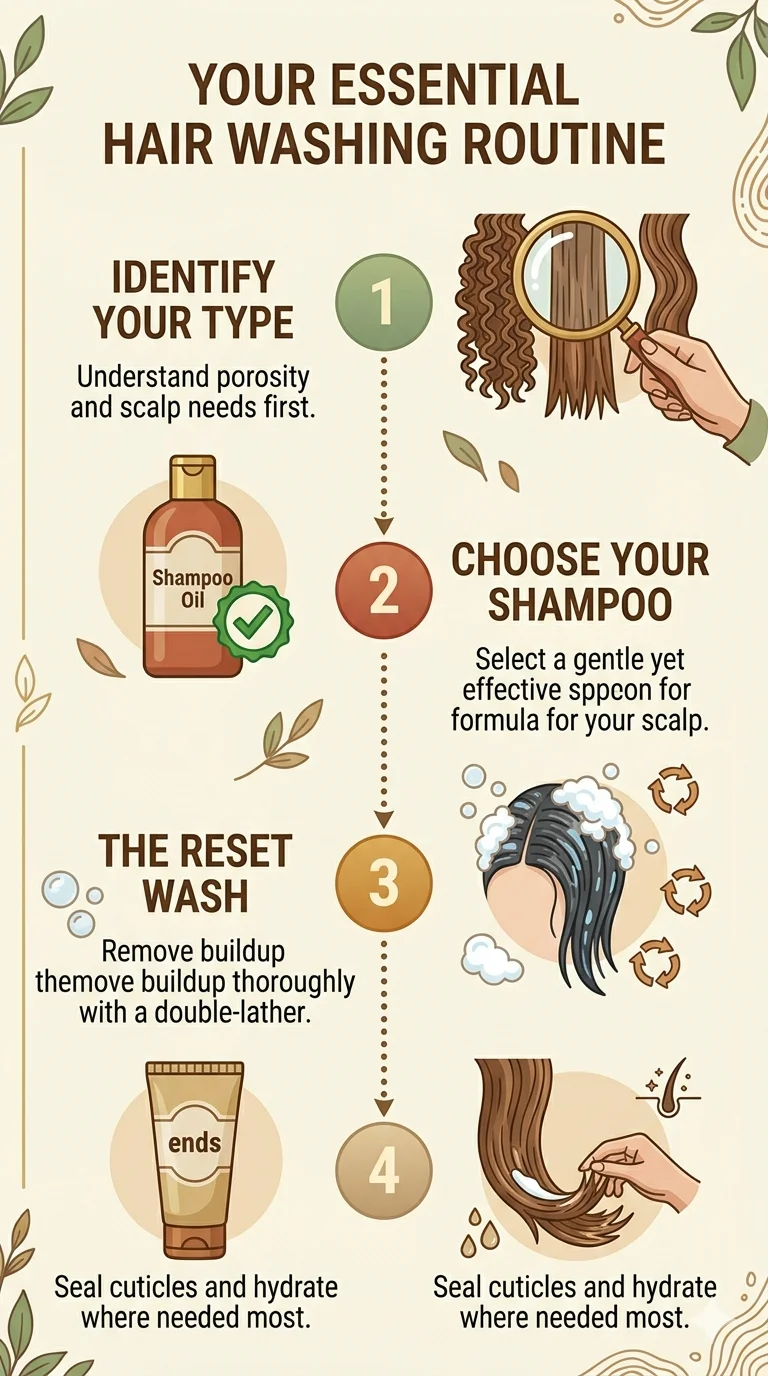
Step 3: The reset wash
- Pre-treat if needed. For mineral buildup, apply an apple cider vinegar rinse (1–2 tbsp in 1 cup distilled water) before shampooing to begin dissolving deposits. For dead skin buildup, apply a salicylic acid scalp treatment 10 minutes before washing.
- Shampoo twice. The first lather breaks down the buildup layer. The second lather actually cleans. Focus the shampoo on your scalp using fingertips (not nails) in small circular motions. Let the runoff clean your lengths.
- Rinse thoroughly. Spend at least 60 seconds rinsing — inadequate rinsing is itself a cause of product buildup. Tilt your head to let water flow through different sections.
- Condition mid-lengths and ends only. After a clarifying or chelating wash, your hair needs moisture — but keep conditioner off the freshly cleaned scalp to avoid re-clogging immediately.
Preventing Scalp Buildup From Coming Back
Removing buildup is the easy part. Keeping it from returning requires ongoing adjustments:
- Clarify regularly. Use a clarifying shampoo every 1–2 weeks if you use silicones, waxes, or heavy styling products. If your products are all water-soluble, you may only need to clarify monthly. Our best hair products page flags which formulas cause more buildup.
- Chelate if you have hard water. A chelating shampoo every 1–2 weeks removes mineral deposits before they compound. Test your water hardness to know if this applies to you.
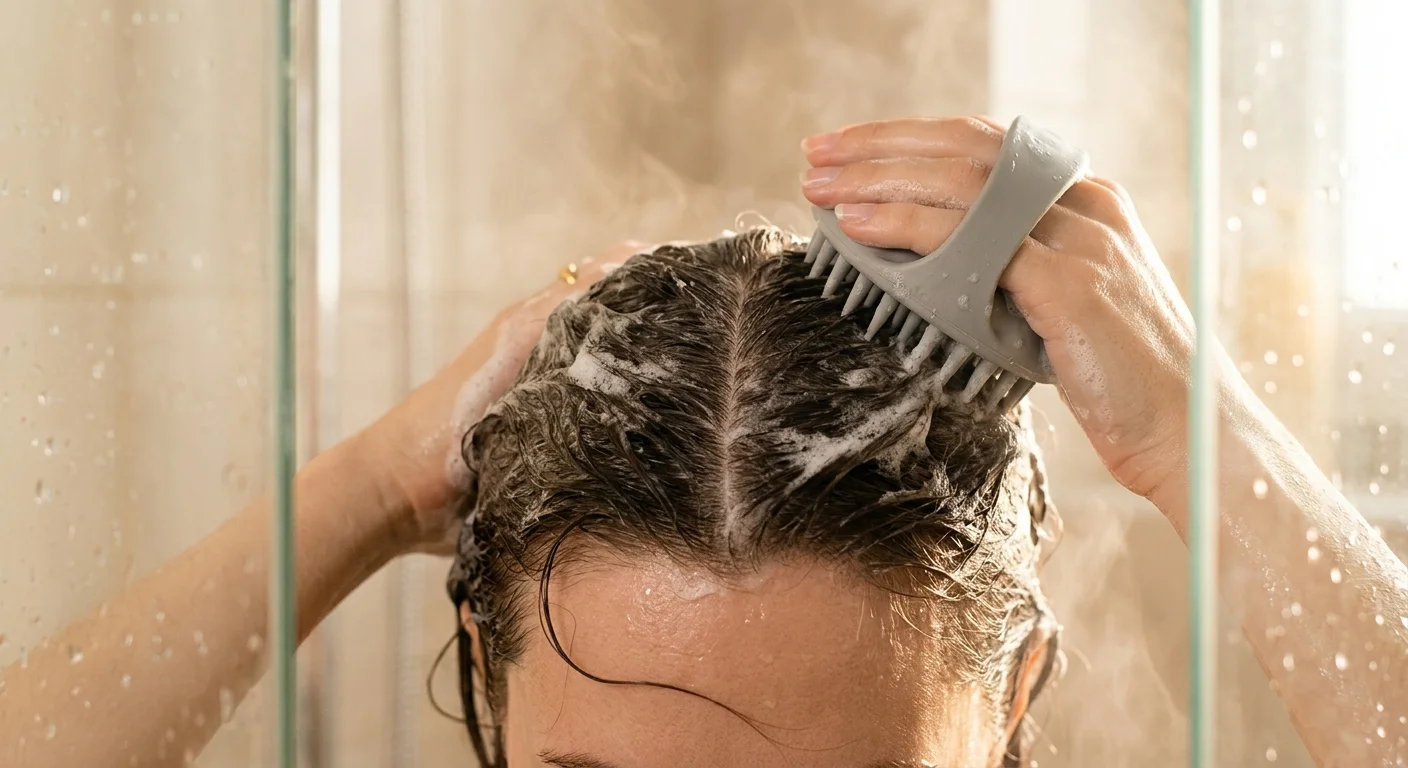
- Use a scalp brush. A silicone scalp massager used during shampooing helps physically loosen buildup and dead skin while improving circulation. It’s one of the cheapest and most effective tools for scalp health. See our best tools guide for recommendations.
- Rinse properly. Most people under-rinse. After shampooing and conditioning, spend 60+ seconds rinsing each section of your head. Product left behind is the number one cause of product buildup.
- Adjust wash frequency to your scalp. “Training” your scalp to produce less oil by washing less frequently is largely a myth. If your scalp is oily, wash it. Letting sebum accumulate for days doesn’t reduce production — it just creates buildup. Determine what works for your hair type specifically.
Scalp Buildup vs. Dandruff: How to Tell the Difference
| Feature | Scalp Buildup (Dead Skin) | Dandruff (Seborrheic Dermatitis) |
|---|---|---|
| Flakes | Fine, dry, white, powdery | Larger, yellowish, oily, sticky |
| Scalp appearance | Normal color, no inflammation | Red, irritated, sometimes greasy patches |
| Itching | Mild, mechanical irritation | Persistent, sometimes intense |
| Cause | Inadequate cleansing, infrequent exfoliation | Malassezia yeast overgrowth, immune response |
| Treatment | Clarifying wash + scalp exfoliation | Anti-fungal shampoo (ketoconazole, zinc pyrithione, selenium sulfide) |
| Response to clarifying | Improves significantly or resolves | May temporarily improve but returns quickly |
If a thorough clarifying wash eliminates your symptoms for 1–2 weeks, it was buildup. If flaking and itching return within days regardless of washing, you likely have dandruff and should switch to an anti-fungal shampoo or see a dermatologist.
Common Mistakes With Scalp Buildup
- Using clarifying shampoo for mineral buildup. Clarifying shampoos remove product residue and sebum — they don’t chelate mineral deposits. If you have hard water, you need a chelating shampoo (look for EDTA) in addition to clarifying.
- Clarifying too often. A clarifying wash every 1–2 weeks is sufficient for most people. Using it daily strips the scalp of protective oils, triggers excess sebum production, and can irritate a healthy scalp.
- Scratching instead of scrubbing. Using fingernails to “scrape off” buildup damages the scalp and can cause micro-tears that lead to infection. Use fingertip pads or a silicone scalp brush instead.
- Applying conditioner to the scalp after clarifying. Your freshly stripped scalp doesn’t need conditioner — your dry lengths do. Applying conditioner to the scalp immediately re-coats it with film-forming ingredients and partially undoes the clarifying wash.
- Treating buildup with more products instead of removal. Adding a scalp serum or oil on top of existing buildup traps the residue underneath and worsens the problem. Always remove buildup first, then apply any treatment products to a clean scalp.
What to Expect After Removing Scalp Buildup
| Timeframe | What Changes |
|---|---|
| After first clarifying wash | Immediate lift at the roots. Hair feels lighter, bouncier, and cleaner than it has in weeks. Scalp itching decreases noticeably. This is often a dramatic before-and-after moment. |
| Week 1–2 | Products start working properly again. Conditioner absorbs, leave-ins feel effective, and styling holds better. Scalp feels comfortable between washes. |
| Week 3–4 | With a consistent prevention routine (regular clarifying + proper rinsing), buildup stops accumulating. Hair and scalp reach a predictable, healthy baseline. |
| Ongoing | Maintenance clarifying every 1–2 weeks keeps buildup managed permanently. You’ll immediately notice when it’s time to clarify again — the “coated” feeling returns as a reminder. |
If symptoms persist after 3–4 weeks of proper buildup removal, consult a dermatologist to rule out scalp conditions like seborrheic dermatitis, psoriasis, or contact dermatitis. Adjust your maintenance schedule seasonally using our seasonal hair care guide.
Final Thoughts: Clean Scalp, Better Hair
Scalp buildup is the invisible saboteur of otherwise good hair routines. You can use the best shampoo, the most nourishing conditioner, and the most advanced treatments — but if your scalp is coated in residue, minerals, and dead skin, nothing penetrates and nothing works properly.
The fix is straightforward: identify which type of scalp buildup you’re dealing with, use the corresponding removal method, and build regular clarifying or chelating washes into your ongoing routine. It’s not glamorous, but it’s the foundation that makes every other product in your routine more effective. A clean scalp isn’t just about comfort — it’s the baseline for healthy hair growth.