This complete hair type guide exists because following advice meant for someone else’s hair is one of the most frustrating things in hair care.
Most advice online is written for wavy hair or “normal” texture. If you’ve bought a product because someone raved about it — only to have it weigh your hair down or do nothing — wrong hair type matching is why.
This complete hair type guide helps you identify your curl pattern and porosity level. Then you’ll know exactly what products and routines actually work for you. No more guessing.
If you want the broader foundation first, start with our hair care basics guide which covers wash day structure and the five core products every routine needs.
Table of Contents
Why This Complete Hair Type Guide Uses Two Systems, Not One
Most hair charts show you curl pattern (1A through 4C) and stop there. That’s useful but incomplete. Curl pattern tells you the shape. But it doesn’t tell you how your hair behaves with products. For that, you need porosity.
Two people can both have Type 3C curls. But one person’s hair drinks in conditioner and looks defined. The other person’s hair goes limp and greasy. The difference is porosity.
Studies show the outer layer structure varies a lot between people [International Journal of Trichology]. This is true even if they have the same curl pattern. That’s why a complete hair type guide must cover both systems together.
Part 1 — Curl Pattern Explained (Type 1 to 4)
Curl pattern is the natural shape of your strand when left alone. No heat. No product. Air-dried.
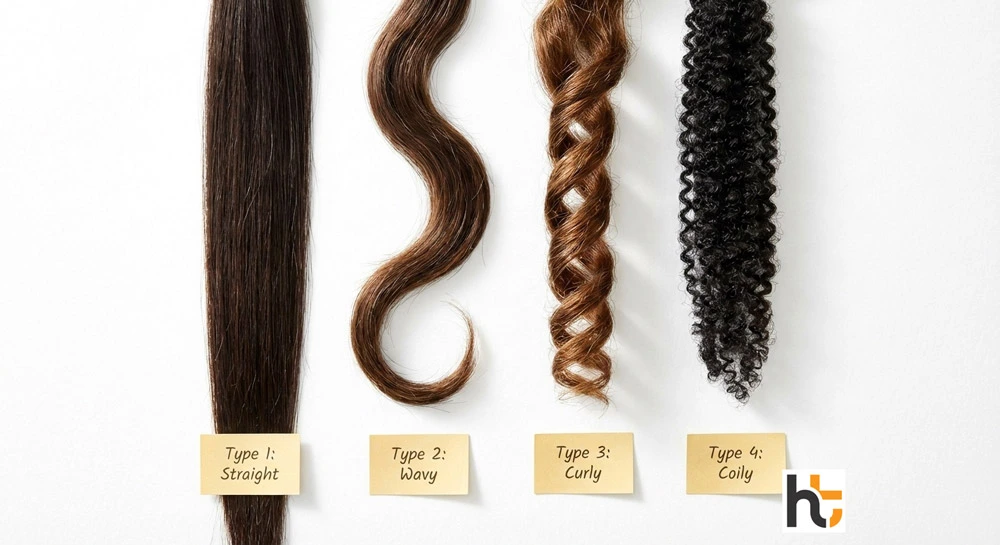
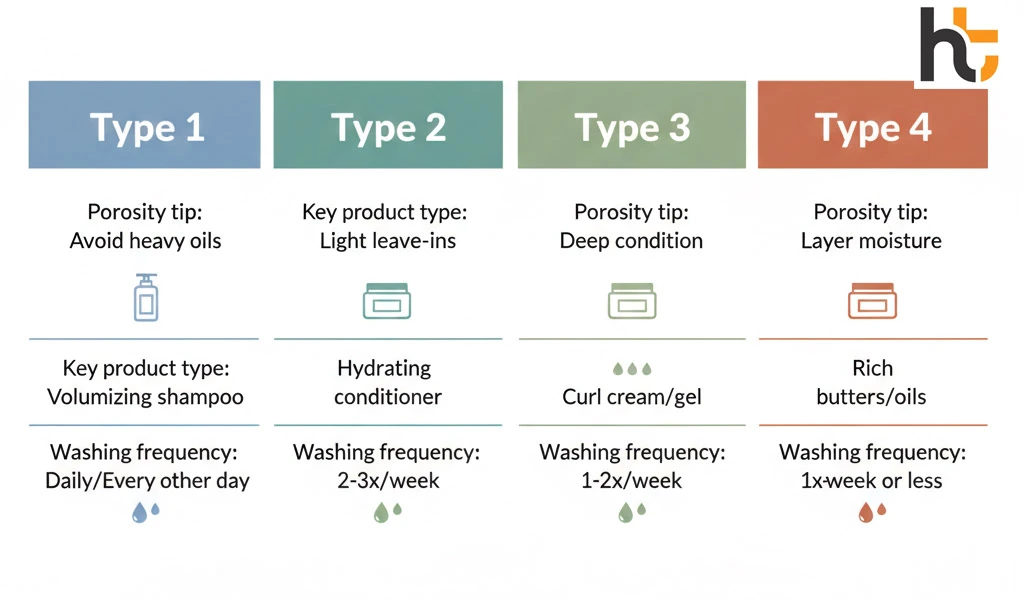
Type 1 — Straight Hair
Straight hair grows with no natural curve. Oil travels down the strand easily. This is why Type 1 hair gets oily fast.
- What it needs: Lightweight products. Heavy oils weigh it flat.
- Common problems: Oiliness at the root, no volume, buildup.
- Washing frequency: Every 1–3 days.
Type 2 — Wavy Hair
Wavy hair has a natural S-shaped bend. It sits between straight and curly. It can frizz like curly hair or go flat like straight hair. It depends on humidity and product weight.
- What it needs: Balance. Light gels for definition without weight.
- Common problems: Frizz in humidity, waves dropping by midday.
- Washing frequency: Every 2–4 days.
Type 3 — Curly Hair
Type 3 hair has defined springy curls. They range from loose loops to tight spirals. Curly hair is naturally drier than straight or wavy. Oil struggles to travel along a curved strand. The tighter the curl, the drier the hair.
- What it needs: Consistent moisture and definition products.
- Common problems: Dryness, shrinkage, frizz, tangles.
- Washing frequency: Once a week. Co-washing between wash days is common.
Type 4 — Coily and Kinky Hair
Type 4 hair has the tightest curl pattern. It ranges from soft coils to zig-zag strands with no visible curl when dry. It’s also the most fragile. The tight bends create natural weak points where breakage happens.
- What it needs: Maximum moisture and gentle handling.
- Common problems: Extreme dryness, shrinkage of 70% or more, knots, breakage.
- Washing frequency: Every 1–2 weeks.
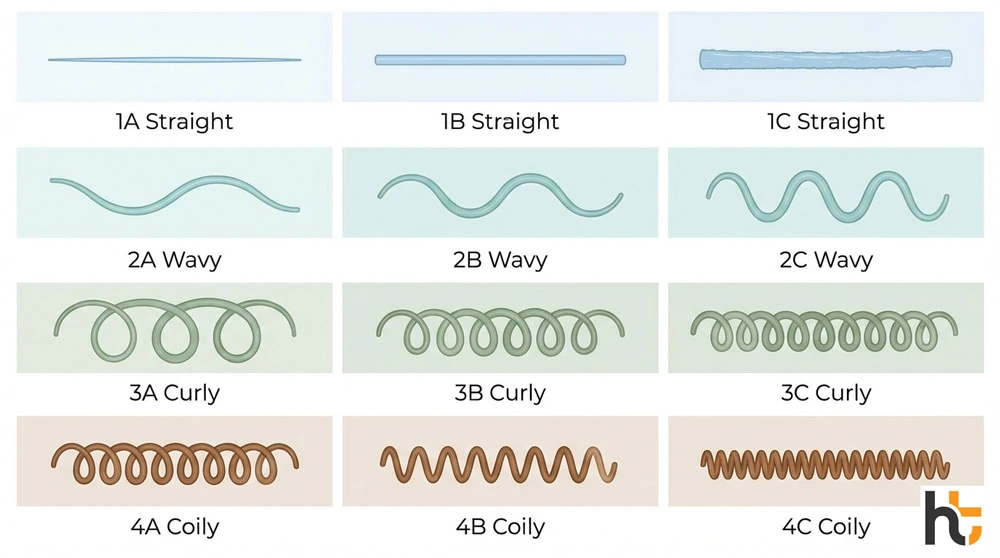
Hair types chart
Part 2 — Porosity: The Missing Piece of Every Hair Type Guide
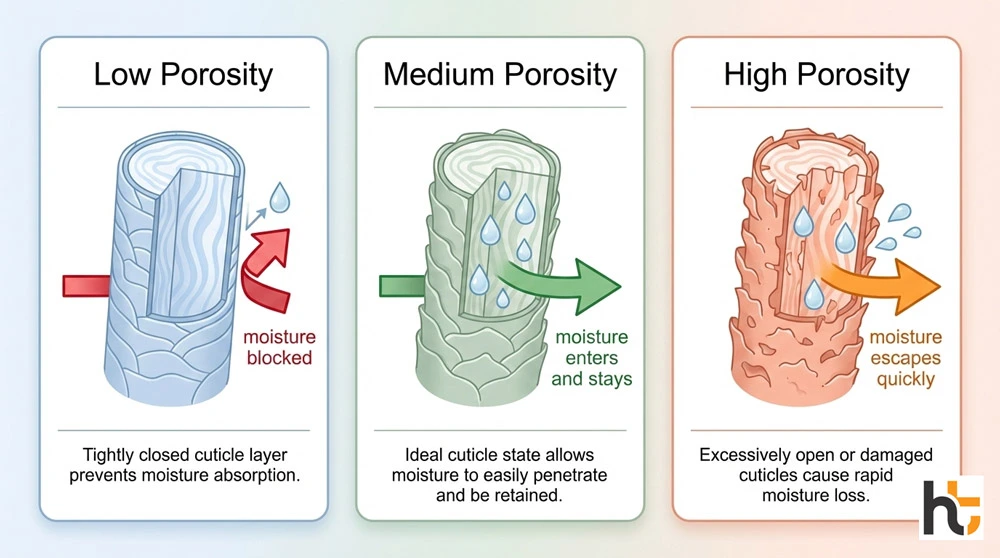
Porosity is how easily your hair soaks up and holds moisture. It’s determined by your outer layer structure. There are three levels:
Low Porosity — Sealed Outer Layer
Low porosity hair has tightly closed outer scales. Moisture and conditioners struggle to get in. Products sit on top instead of soaking in.
- Signs: Water beads on your hair before soaking in. Products feel like they sit on top. Hair takes forever to get fully wet in the shower.
- What it needs: Lightweight moisture-grabbers. Heat during deep conditioning. Protein-free formulas.
- What to avoid: Heavy butters, thick creams, protein conditioners.
For a deep dive specifically on low porosity routines, see our guide to the best deep conditioners for low porosity hair.
Medium Porosity — Balanced
Medium porosity hair has slightly raised outer scales. Moisture gets in at a healthy rate and stays in effectively. Most products work well.
- Signs: Hair wets and dries at a normal rate. Products soak in without feeling heavy.
- What it needs: A balanced routine. Protein treatments once a month.
- What to avoid: Over-processing and excessive heat.
High Porosity — Raised or Damaged Outer Layer
High porosity hair soaks up moisture rapidly but loses it just as fast. The raised outer scales can’t seal moisture in. This can be natural or caused by chemical processing, heat, or hard water.
- Signs: Hair soaks up water very quickly but dries out fast. High frizz. Tangles easily.
- What it needs: Protein treatments to fill gaps. Heavier creams to seal. Cold water rinses.
- What to avoid: Any further chemical or heat damage. Hard water.
If you live in a hard water area, the raised outer layers of high porosity hair and mineral deposits are a particularly damaging combination. Our hard water hair care routine covers this in full.
How to Test Your Porosity at Home
There are two reliable tests. Use both for accuracy.
The Spray Bottle Test (Most Reliable)
Spray water on clean hair. Watch what happens over 30 seconds.
- Water beads on the surface → Low porosity
- Water soaks in slowly and evenly → Medium porosity
- Water soaks in almost instantly → High porosity
The Strand Slide Test
Take one clean hair strand. Slide your fingers from tip to root along it.
- Feels smooth throughout → Low porosity
- Feels slightly textured → Medium porosity
- Feels rough, bumpy, or breaks → High porosity
Experts say the physical integrity of the hair outer layer is the primary indicator of hair health and moisture retention capacity [AAD.org]. These simple tests are genuinely useful for understanding your hair’s baseline condition.
Building Your Routine Using This Complete Hair Type Guide
Once you know your curl pattern and porosity, the right routine becomes clear. Here’s how they combine:
| Hair Type | Priority | Key Product Focus |
|---|---|---|
| Type 1–2 + Low Porosity | Avoid buildup, keep lightweight | Sulfate-free shampoo, humectant leave-in, no butters |
| Type 1–2 + High Porosity | Repair and seal outer layer | Protein conditioner, heavier sealing cream |
| Type 3 + Low Porosity | Moisture without protein buildup | Protein-free deep conditioner with heat, light gel |
| Type 3 + High Porosity | Moisture + protein balance | Protein-rich deep conditioner, leave-in, cream, oil |
| Type 4 + Low Porosity | Penetrating moisture + heat | Steamer sessions, humectant-heavy products, no heavy butter |
| Type 4 + High Porosity | Maximum moisture and sealing | LOC or LCO method, protein monthly, protective styles |
For curated product picks for each combination, see our best hair products guide and our best hair tools guide.
What to Realistically Expect After Identifying Your Hair Type
Knowing your type doesn’t produce overnight change. It’s the starting point for making better decisions. Those decisions produce results over weeks.
Within 2–4 weeks of using type-appropriate products, most people notice less breakage during detangling, better moisture between wash days, and less frizz. Within 2–3 months with a consistent routine, overall texture and manageability improve.
The biggest shift is simply stopping the guesswork. When every product you use is chosen with your specific type and porosity in mind, you stop wasting money on things that will never work for your hair.
When to See a Professional
If your hair type has shifted dramatically — become much coarser, thinner, or changed texture without a clear reason like a new medication or chemical treatment — it may indicate an underlying health condition.
- Sudden unexplained texture change across the whole head
- Significant new shedding or thinning alongside texture change
- Scalp tenderness, inflammation, or visible scaling
Studies show hair texture and density changes are sometimes early indicators of thyroid dysfunction, nutritional deficiencies, or hormonal shifts [NCBI]. All of these require medical rather than topical intervention.
Final Thoughts
This complete hair type guide gives you the two pieces everything else builds on. Your curl pattern and your porosity. Together they tell you what your hair can soak up, what it needs, and what will work against it.
Use the combination table above to identify your starting routine. Choose products built for your specific type. Give it eight consistent weeks before evaluating results. Adjustments are normal. The key is making them from knowledge, not guesswork.
For your next step, explore our hair care basics guide for wash day structure, and our seasonal hair care guide to adapt your routine throughout the year.