Your scalp sheds about 500,000 skin cells every day. When those dead cells don’t shed properly, they create buildup that blocks follicles, traps oil, and prevents new healthy hair growth. That’s where scalp exfoliation comes in.
Done right, exfoliation removes buildup, improves circulation, and creates the clean foundation healthy hair needs. Done wrong — which is surprisingly easy — it damages the scalp barrier, causes inflammation, and makes existing problems worse.
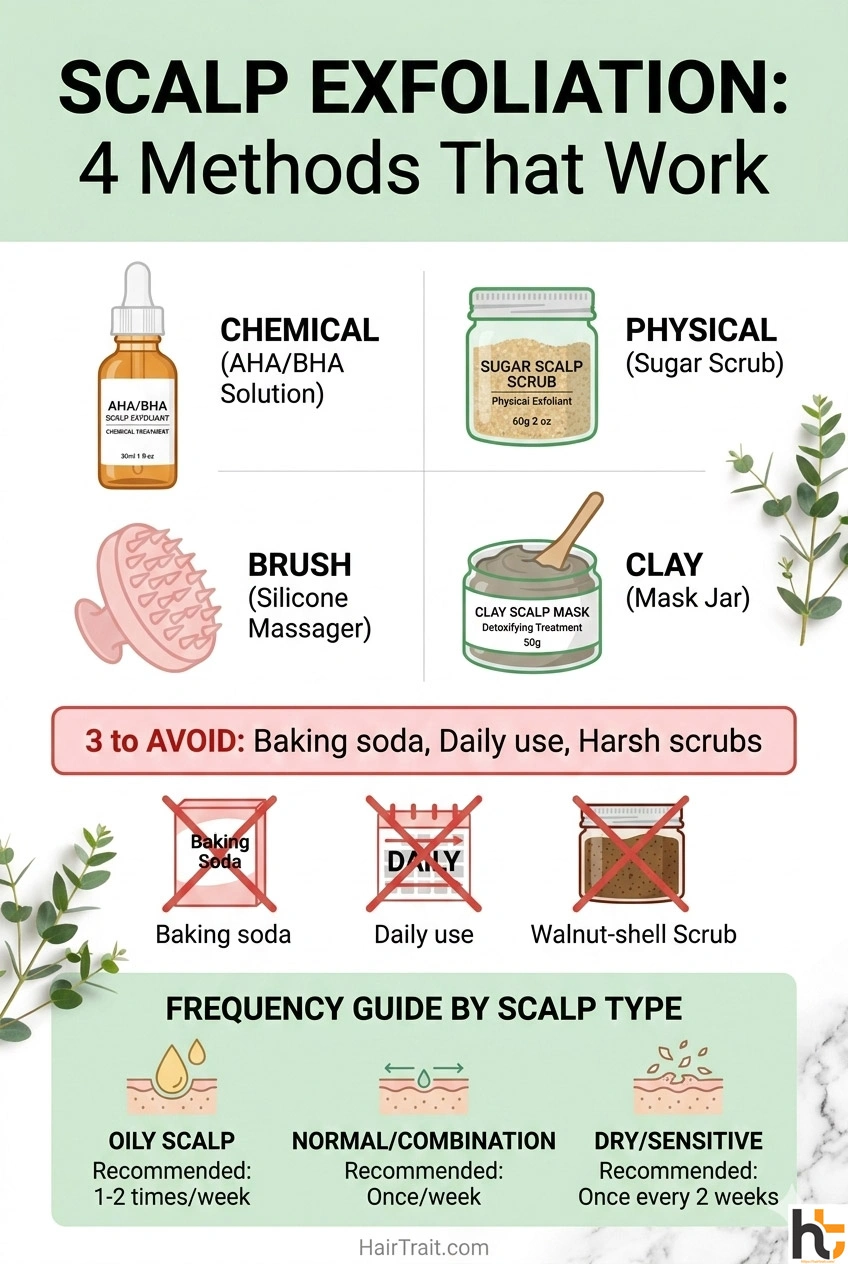
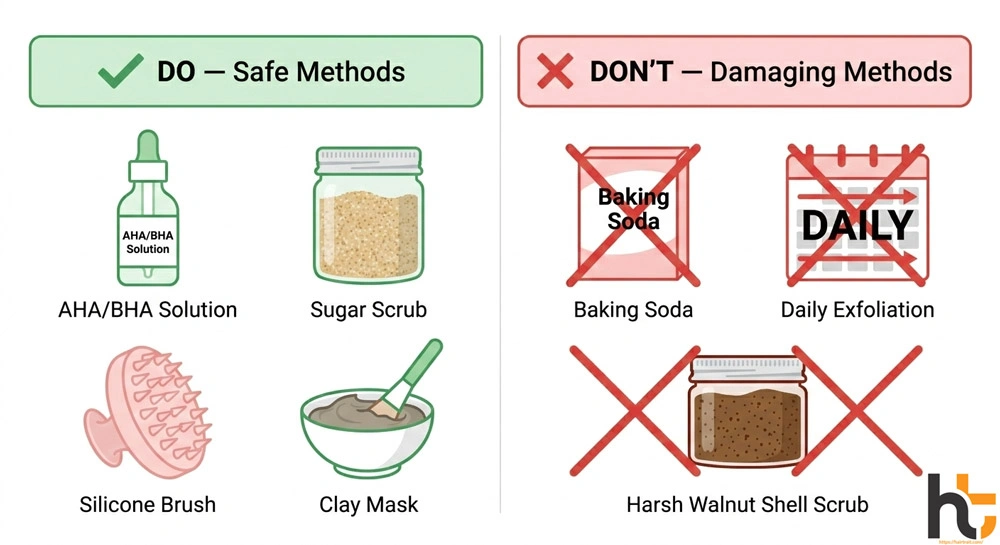
This guide covers the 4 scalp exfoliation methods that actually work, the 3 damaging methods to avoid completely, and exactly how often you should exfoliate based on your specific scalp type.
Before starting any scalp treatment, understand your baseline hair care routine using our hair care basics guide. Exfoliation is an addition to a solid routine, not a replacement for one.
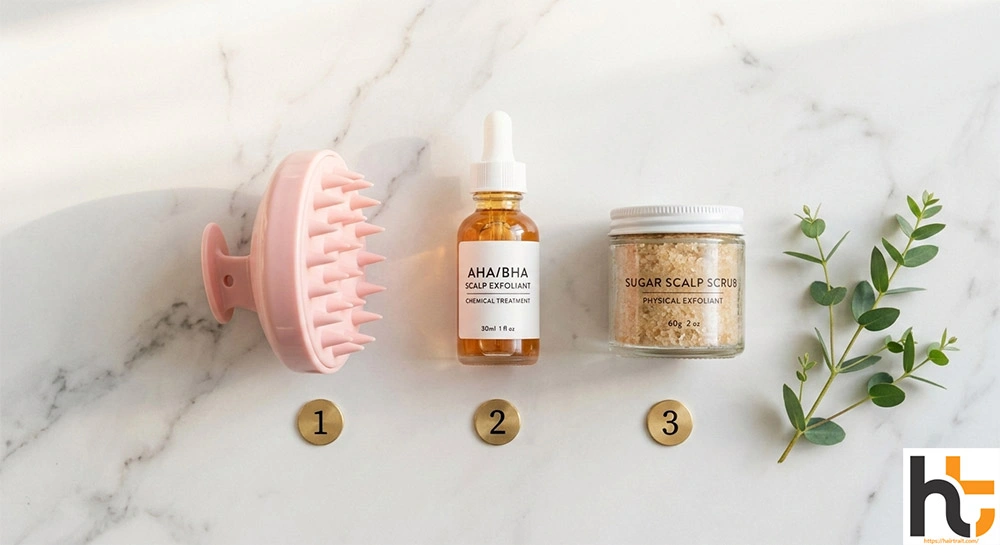
Quick Answer: The best scalp exfoliation methods are: (1) Chemical exfoliants (AHA/BHA), (2) Physical scrubs (sugar/salt), (3) Scalp brushes, and (4) Clay masks. Avoid: harsh scrubs, daily exfoliation, and exfoliating inflamed or broken skin. Frequency: 1-2 times per week for oily scalps, every 2 weeks for normal, monthly for dry/sensitive.
Table of Contents
Why Scalp Exfoliation Actually Matters for Hair Health
Your scalp is skin. Like facial skin, it accumulates dead cells, sebum, product residue, and environmental pollution. Unlike facial skin, it’s covered by hair which traps this buildup against the surface.
Research shows that excess scalp buildup creates an anaerobic environment that favors the growth of Malassezia fungi — the primary cause of dandruff [NCBI]. Regular scalp exfoliation disrupts this environment and reduces fungal overgrowth.
Additionally, buildup around hair follicles can contribute to:
- Slowed hair growth (follicles can’t function optimally when clogged)
- Itching and irritation
- Limp, lifeless hair even when freshly washed
- Products that don’t work as well because they can’t reach the scalp
- Scalp odor from trapped bacteria
Think of scalp exfoliation like brushing your teeth. You brush to remove plaque before it becomes a problem. You exfoliate your scalp to remove buildup before it clogs follicles.
Identify Your Scalp Type First
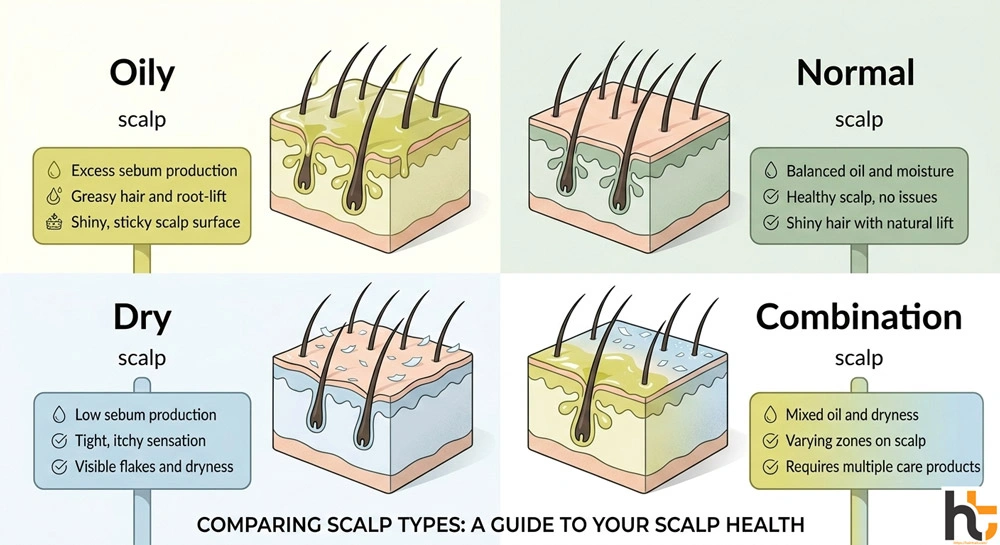
Before choosing a scalp exfoliation method, you need to know your scalp type. The wrong method for your type causes damage.
| Scalp Type | Signs | Exfoliation Frequency |
|---|---|---|
| Oily | Greasy by end of day, large visible flakes, needs daily washing | 1-2 times per week |
| Normal/Balanced | Stays fresh 2-3 days, minimal flaking, comfortable | Every 2 weeks |
| Dry/Sensitive | Tight feeling, small dry flakes, redness or itching after products | Once monthly, gentle methods only |
| Combination | Oily at crown/hairline, dry at nape/sides | Spot-treat oily areas weekly, dry areas monthly |
Method #1: Chemical Exfoliants (AHA/BHA) — Most Effective
Chemical scalp exfoliation uses acids to dissolve the bonds between dead skin cells. This is the most effective method because it works beneath the surface rather than just scrubbing the top layer.
How It Works
AHAs (Alpha Hydroxy Acids): Glycolic acid, lactic acid. Water-soluble. Work on the surface. Best for dry scalp with flaking.
BHAs (Beta Hydroxy Acids): Salicylic acid. Oil-soluble. Penetrate into pores. Best for oily scalp with clogged follicles.
Studies show salicylic acid effectively reduces scalp buildup and improves the scalp microbiome balance [International Journal of Dermatology].
How to Use
- Apply to dry scalp before shampooing
- Section hair to access scalp directly
- Massage gently with fingertips (not nails)
- Leave on for 5-10 minutes
- Rinse thoroughly and shampoo as normal
Best For
- Oily scalp
- Dandruff or seborrheic dermatitis
- Scalp acne
- Product buildup
Avoid If
- Scalp is inflamed, sunburned, or broken
- You have very sensitive skin
- Immediately after chemical hair treatments
Method #2: Physical Scrubs (Sugar/Salt) — Immediate Results
Physical scalp exfoliation uses granules to manually remove dead cells and buildup. It’s satisfying and produces immediate results you can feel.
How It Works
Fine granules (sugar, salt, ground rice, jojoba beads) create gentle friction that lifts away surface buildup without scratching the scalp.
Best Ingredients
- Brown sugar: Dissolves gradually, gentle, moisturizing
- Sea salt (fine grain): More abrasive, good for very oily scalps
- Jojoba beads: Synthetic, perfectly round, gentlest option
DIY Recipe
Mix 2 tablespoons brown sugar + 2 tablespoons coconut oil + 5 drops tea tree oil (optional, antimicrobial). Apply to wet scalp, massage 2-3 minutes, rinse, shampoo.
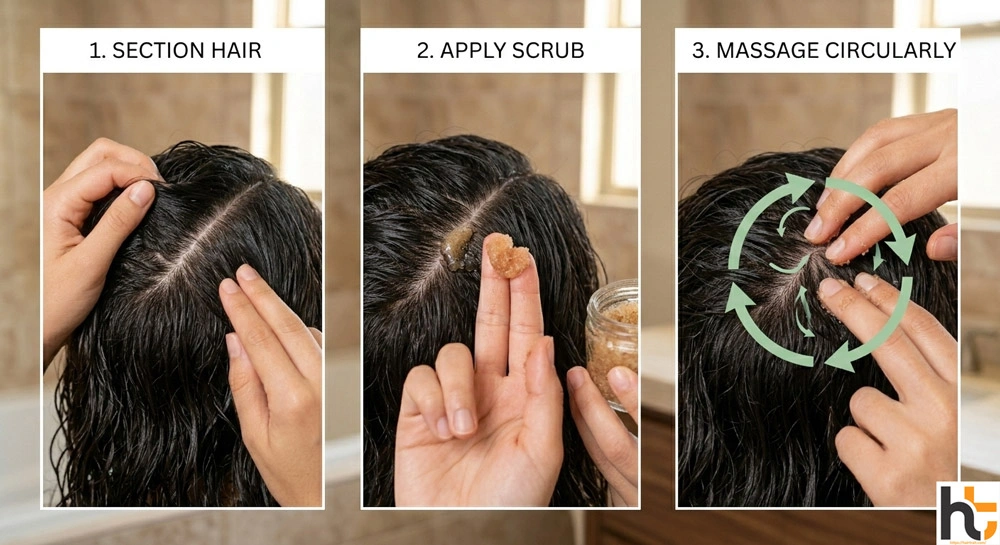
How to Use
- Wet hair and scalp
- Apply scrub in sections
- Massage with circular motions for 2-3 minutes
- Focus on areas with most buildup (usually crown and hairline)
- Rinse thoroughly (sugar/salt must be completely removed)
- Shampoo and condition as normal
Critical Rules
- Use gentle pressure — you’re exfoliating skin, not scrubbing a pot
- Never use on broken, irritated, or inflamed scalp
- Rinse completely — residual salt can be drying
Method #3: Scalp Brushes — Gentlest Option
Scalp brushes provide mechanical scalp exfoliation through soft, flexible bristles. This is the safest method for sensitive scalps.
How It Works
Soft silicone or natural bristles lift dead skin cells and increase circulation without harsh abrasion. Can be used during shampooing or on dry scalp.
Types of Brushes
- Silicone scalp massagers: Flexible, hygienic, easy to clean. Best for most people.
- Natural bristle brushes: Boar or plant-based. Distribute oils well. Best for dry scalp.
- Electric scalp massagers: Vibration + massage. More expensive but very effective.
How to Use
Wet method (most common):
- Apply shampoo to wet scalp
- Use brush in circular motions for 3-5 minutes
- Cover entire scalp systematically
- Rinse thoroughly
Dry method:
- Before washing, brush dry scalp for 5 minutes
- Loosens buildup before shampooing
- Improves circulation
Best For
- Sensitive scalps
- Daily or frequent use (gentle enough)
- People who find scrubs too harsh
- Improving circulation and relaxation
For complete tool recommendations including scalp brushes, see our best hair tools guide.
Method #4: Clay Masks — Deep Cleansing
Clay-based scalp exfoliation absorbs excess oil and draws out impurities without physical abrasion. It’s chemical-free exfoliation for people who want natural options.
Best Clays for Scalp
- Bentonite clay: Strong oil-absorption. Best for very oily scalps.
- Kaolin clay: Gentle. Good for normal to dry scalps.
- Rhassoul clay: Mineral-rich. Balances while cleansing.
How to Use
- Mix 2-3 tablespoons clay with enough water or apple cider vinegar to make a smooth paste
- Apply to dry scalp in sections
- Massage gently
- Leave on 10-15 minutes (don’t let it dry completely — keep misting with water)
- Rinse thoroughly with warm water
- Shampoo lightly if needed
Benefits
- Absorbs excess sebum without stripping
- Detoxifies scalp
- Adds minerals
- No harsh ingredients
3 Scalp Exfoliation Methods That Actually Damage Your Scalp
These are popular but harmful. Avoid them completely:
Damaging Method #1: Baking Soda Scrubs
Why it’s harmful: Baking soda has a pH of 9 (highly alkaline). Your scalp’s natural pH is 4.5-5.5 (acidic). Research shows alkaline treatments disrupt the scalp barrier and increase sensitivity [Journal of Cosmetic Dermatology].
Repeated use causes chronic dryness, irritation, and can trigger seborrheic dermatitis.
Damaging Method #2: Daily or Excessive Exfoliation
Why it’s harmful: Your scalp needs time to regenerate its protective barrier. Daily exfoliation strips this barrier faster than it can rebuild.
Signs of over-exfoliation: increased sensitivity, redness, burning sensation with products that never bothered you before, paradoxical increase in oiliness (scalp overproduces to compensate).
Damaging Method #3: Harsh Physical Scrubs (Apricot Kernels, Walnut Shells)
Why it’s harmful: Irregularly shaped particles create micro-tears in the scalp surface. These tears become entry points for bacteria and inflammation.
Use only smooth, rounded particles. Sugar dissolves. Jojoba beads are spherical. Salt (fine grain) is crystalline but gentler than crushed shells.
How Often to Do Scalp Exfoliation (By Scalp Type)
More is not better. Follow these evidence-based frequencies:
| Scalp Type | Chemical Exfoliant | Physical Scrub | Scalp Brush | Clay Mask |
|---|---|---|---|---|
| Oily | 1-2× per week | 1× per week | Daily (gentle) | 1× per week |
| Normal | Every 2 weeks | Every 2 weeks | 3-4× per week | Every 2 weeks |
| Dry/Sensitive | Monthly (low %) | Monthly (sugar only) | 2-3× per week | Monthly |
Critical rule: Never combine methods on the same day. Pick one exfoliation method per wash day.
What to Expect After Starting Scalp Exfoliation
Week 1-2: Scalp feels cleaner. Hair has more volume at the roots. You might experience a brief “purge” period as trapped buildup releases.
Week 3-4: Less itching. Reduced flaking. Hair stays fresh longer between washes. Products absorb better.
Week 6-8: Improved hair texture at the root. Faster-seeming growth (not actually faster growth, but healthier emergence from clean follicles). Overall scalp comfort.
What won’t improve: Hair loss from genetic causes, scarring alopecia, or hormonal thinning. Scalp exfoliation optimizes the environment for growth. It doesn’t override genetic or medical factors.
For complete product recommendations to support scalp health, see our best hair products guide.
When to See a Professional
Home scalp exfoliation addresses normal buildup and mild concerns. Seek professional help for:
- Severe, persistent flaking that doesn’t improve with exfoliation
- Painful, inflamed, or weeping areas on the scalp
- Sudden hair loss accompanying scalp changes
- Scalp that worsens with any exfoliation method
These may indicate seborrheic dermatitis, psoriasis, folliculitis, or other conditions requiring medical treatment.
Final Thoughts
Scalp exfoliation is a simple practice that produces significant results when done correctly. Choose one method that suits your scalp type. Use it at the right frequency. Avoid the three damaging methods completely.
For most people, a gentle scalp brush 3-4 times per week plus a chemical exfoliant every 2 weeks creates the ideal balance. Your scalp will feel cleaner, your hair will have more body, and your products will work better.
Start conservatively. You can always increase frequency. You can’t undo damage from over-exfoliation.